Showing posts with label Art History's Problems. Show all posts
Showing posts with label Art History's Problems. Show all posts
11 December 2006
Art History: Problematic Situation #7
This is another installment in an ongoing series.
Back when I first came across Art History as a discipline—a major study option at the university—I imagined it would be something like history from the perspective of art. I thought of the world civilization courses that I’d had in the past and envisioned a place where art would play a bigger role in essentially the same discussions of the past.
Oh, no. No, no, no.
Art History is the history of art. Certainly, one could use art to tell the history of a group, people, culture, or slice of time. I think it would work quite well, too. But after all the studying, reading, learning, researching, etc. that I have engaged in over the last decade-and-then-some, I find that I still could tell you very little about the historic events that surrounded and in some cases created the art and theory about which I (immodestly) know buckets.
This, I suppose should be the first of Art History’s Problematic Situations. It causes a foundation-level tension between historiography and the far more limited task of charting art’s history. And though Art History is at times undermined and crippled by its own issues, history proper is nothing if not worse.

25 May 2006
Art History: Problematic situation #6
This is part of an ongoing series discussing Art History's issues.
It has been ages since I wrote about Art history's problems. Some of my posts have been relevant, but its time to really speak to the point.
Art is (and as far as I can tell) and has always been self-referential. Among other things, art quotes art. When I wrote about identity, I commented on the long tradition in art of eye-candy-cuties. The Bouguereau I used as an example echoes so many others like it--maybe it even references predecessors. I don't actually know.
But I do know that artists continue to rummage through the past for ideas, and sometimes they even simulate the past. The thing is, though, that the past was the present at one time. The ruins of ancient civilizations weren't ruins when they were new. Sure, that's obvious. But often, what artists pick up is not the original "new" look of the art of the past. Rather, they copy the aged appearance that the thing has in the present.
 This is Auguste Rodin's 1900 sculpture called Walking Man. Put simply, it is without arms and head because lots of sculptural antiquities are missing a limb here or there. Not that they were originally made without arms, heads, or both feet. They were. But the way we see them today, more often than not, something is missing.
Rodin's work was a century ago, but there is still at least some hearkening to the look of age, even in a new work of art. I think Sally Mann's antique camera and process fall into this category. Some of her more recent images from Deep South and What Remains look like they have barely survived from a much earlier period. In this case, new looks really old, referencing things that look old only because they are old.
21 December 2005
Art History: Problematic situation #5
This is part of an ongoing series.
I’ve addressed some of the extensions of today’s problem in Art History before, but I thought it would be good to bring it back to its roots for a moment. This is a problem for art and anything else that has a history.
Speaking of women and their anonymity in history, Virginia Woolf wrote:
“Nothing remains of it all. All has vanished. No biography or history has a word to say about it.. . . I would as soon have her true history as the hundred and fiftieth life of Napoleon or the seventieth study of Keats and his use of Miltonic inversion . . . ”
That comes from pages 89-90 of her A Room of One’s Own, published in 1929. I’ve tried to find it and I can’t, but I’m sure she challenged her readers to write the history of women. To search out what their lives were like, and add that as a counterpoint to the history we already had.
I think the call has been answered, not thoroughly or perfectly, but at least acknowledged. I distinctly recall Women’s History Month and Black History Month in my elementary school in middle America. I remember that when we learned about the westward expansion of the United States, we learned about the Trail of Tears too. History, for at least two decades then, has ceased to be the domain of the victor telling the story from their point of view, or to reinforce their agenda.
What about art and its history, then? Do we allow art history to be the domain of the strong, famous, most successful, most shocking, most popular, most relevant to the Next-Big-Thing?
03 December 2005
Art History: Problematic situation #4
I thought those of you out there who like art but haven’t really studied art history would appreciate an overview of art history methodologies. Methodology is a big word, and in this context it means “approach”. These are the most common ways that scholars look at and judge art. They are not all compatible, and some are mutually exclusive. Each will lead you to a very different appraisal of any given work. To illustrate, I’ve chosen Daumier’s Third Class Carriage from 1865. You can refer back to it for each of the methodologies below.
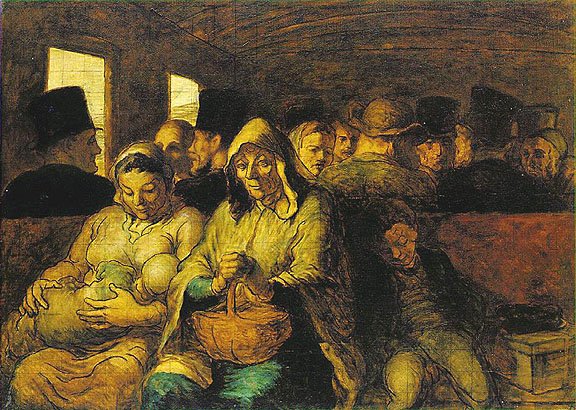
Formalistic—This approach might seems inappropriate unless the art in question is one of total abstraction, but it yields interesting content anyway. The color, line, value, and composition are the only things a formalistic reading concerns itself with. You’d note the heavy outlines, the subdued tones, the crowded composition. All of this would then feed into one of the other approaches, which would help create an interpretation of those formalistic elements.
Psycho-analytic—Typically, this methodology focuses on the artist and how their work illustrates their various psychoses. Using it with the Daumier above, you’d want to also investigate the psychologies of the people he depicts, and if these depictions are in any way autobiographical. Freud’s ideas are usually at the center of these writings. It doesn’t seem to matter that Freud got a lot wrong, so I’m not really fond of this methodology.
Socio-historical—This methodology is concerned with what was it like to be an artist, to be a viewer, and the condition of art at the time it was done. Was it common to depict scenes like this? Who was the intended audience? Is the artist moralizing, glorifying, condemning anyone?
Feminist—The feminist methodology is like the socio-historical, but woman-centric. Relevant questions include, “what was the condition of women at the time the art was done?”, “what was it like to be a woman artist?”, “what was it like to be a woman viewer?”, “whose gaze is it, a man’s or a woman’s?” Daumier wasn’t a woman, but that doesn’t mean his works are outside the scope of this methodology.
Marxism/class—Not too different from the feminist critique, the Marxist approach centers on class, status, money, power, and so on. Relevant questions include, “who were the viewers?”, “who were the artists?”, “what was their status?”, “how is status depicted?” It makes a difference if Daumier was on a level with the occupants of the third class section, or if he depicts them as a voyeur with a better seat.
Iconography—This one is tricky, because there are times when a rock or an apple or a sailboat is only that and nothing more. Other time, depicted objects, placement of people, gestures, and other visual devices carry symbolic weight that is necessary to understand the intended message of a piece. I don’t have any idea if a symbolic reading of Daumier’s work has been done or if anything came of it if it has been.
Semiotics-- This has to do with visual culture and how a piece of it relates to the whole. The fact that we look at Daumier’s heavy black outlines and we think of cartoons is relevant here. This approach is concerned with what images mean and why they mean them. So if you find Daumier’s painting a bit, well, depressing, this approach is all about figuring out why it seems that way.
So why does this qualify as one of Art History's problematic situations? Well, there are at least seven ways to look at any work of art, yielding seven potentially mutually exclusive interpretations. This really only works if you already believe that art is something different for each viewer out there.
21 November 2005
Art History: Problematic situation #3
My November issue of Vogue (UK) has a lot of really interesting stuff in it, and one such thing relates to one of Art history’s many problems. They’ve published an article about photographer Diane Arbus, who committed suicide in 1971. Here’s a quote from that article.
. . . Arbus’ life and work, her reputation – all the things, in fact, that contribute to the enduring hold of the Arbus myth – are all but impossible to extricate from the fact of her suicide.
Its effect on the reception of her work was almost instantaneous. It was one of the reasons why so many people who were otherwise uninterested in photography flocked to the 1972 retrospective at the Museum of Modern Art in New York. And it continues to play a part in luring crowds to the far more comprehensive show of her work now at the V&A.
For more information about the exhibit click here.
So, about art history. While Arbus was alive and making pictures, she obviously wasn’t dead at her own hands. Suicide, even if she was morbidly obsessed with death, wasn’t the great punctuating mark at the end of her life because her life wasn’t over. The same is true of Van Gogh or any other artist whose suicide has become the final word about their art.. What if these suicides hadn’t been—what if they were simply (to a greater or lesser degree) nuts and died of old age? Would their works mean something else, or something less? Should we go back and re-evaluate art and rewrite history based on how an artist dies?
I don’t know if we should, and I don’t know if the author of Vogue’s article, Geoff Dyer, is right that Arbus’ legacy is inseparable from the mode of her death. This is a problem in all of history, not just art. We all respect Beethoven a bit more when we realize he went deaf. We find meaning in Hemingway’s suicide and the early deaths of musicians and actors. But prevalence doesn’t undercut the problematic nature of it for art and everything else.
03 November 2005
Art History: Problematic situation #2
This is the second of it's kind. To read the first, click here.
Many different arts have their histories divided into periods, movements, styles, etc. For example, Music, Literature, Dance, and Fine Art all have a Romantic period. Josh pointed out not long ago that there isn't much continuity of meaning when you jump from one art to another. In other words, the influences acting on Baroque music are hard to reconcile to the influences that shaped Baroque architecture. The specific case was Impressionism. While I was thinking about that I remembered something else that is rather important whenever the discussion turns to art history.
The idea that history progresses in movements and periods and ages and eras is usually a construct of the present looking back at the past, recognizing macro-trends and generalizing about them. This helps us make sense of history and allows us to sequentially progress from one phase to the next.
Sometimes art doesn't easily lend itself to being "periodized", and artists don't fit neatly into a movement. That is exactly what happened with Pop Art. Time magazine ran an article called "The Slice of Cake School" in its May 11, 1962 issue. The writer noted that several contemporary artists had, "come to the common conclusion that the most banal and even vulgar trappings of modern civilization can, when transposed to canvas, become Art."

Who was included in the Slice of Cake School? Time magazine lists Wayne Thiebaud, Roy Lichtenstein, James Rosenquist, and Andy Warhol. The photo credit goes to Thiebaud, who was the only one actually doing cake. It was an uncomfortable school to be sure, and even today, historians are very hesitant to refer to a Pop Art style, because stylistically, each artist was on his own.
Interestingly, Pop Art is one of the last movements that Art History can really point to. After that point, pluralism set in, the art world fractured into a hundred different segments going as many directions. Maybe our grandchildren will be able to look at what the '80s or '90s produced and find a macro-trend and make it into a movement or a period. If they can't, it may prove Arthur Danto right.
21 October 2005
Art History: Problematic situation #1
If you are the kind of person who likes to think of history as “solid, believable, verifiable fact” you won’t like what I have to say today.
History generally, and art history specifically evolve and change. Their priorities realign, and things previously believed insignificant become central to historic discourses. In other words, as our present evolves, we sometimes find that the historical events we thought were shaping and directing our future actually weren’t. Sometimes there was something else going on in the past that we hadn’t seen before that actually turned out to be the most important thing of all.
When that happens, we go back and rewrite or revise history, because what we though was in fact important, in fact wasn’t.
And, oh my, has this happened in art. The following two paintings were each completed by Frenchmen in 1880. Both images have classical nudes and semi-nudes. Both are of traditional mythological subject matter. But the painters’ style is nothing if not dissimilar.
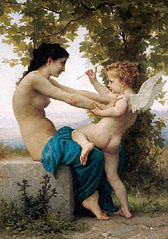
The first is by Bouguereau, a master of academic painting and a favorite at the French Academy’s exhibitions.
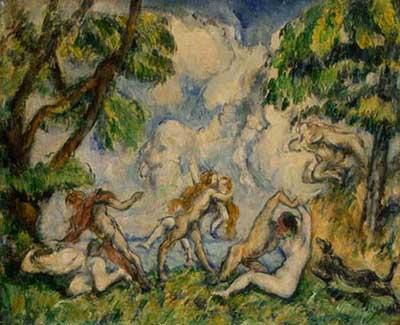
The second is by Cezanne. Unlike Bouguereau, Cezanne wasn’t an Academy favorite. But he was one of Picasso’s favorites. During the first half of the 20th century, histories of art glossed over Bouguereau and lauded Cezanne because Cezanne’s work was relevant to the developments of Modern Art.
Since the 1960s, Bouguereau has regained some of the old glory. Over the last 40 years, art history has made an effort to recognize movements and artists that contributed to other events, not just the long and, increasingly austere road to High Modernism.
Subscribe to:
Posts (Atom)
