Showing posts with label Architecture. Show all posts
Showing posts with label Architecture. Show all posts
14 December 2006
The New Beautiful
I just read the NYT’ rather ironic, (and I conclude) unfavorable review of The Architecture Of Happiness by Alain de Botton, which contained this little, priceless gem:
As John Ruskin observed, we don’t want our buildings merely to shelter us; we also want them to speak to us. But of what? De Botton has an answer. Great buildings, he says, “speak of visions of happiness.”
Up until the precise moment, I really did believe that beauty was the most subjective of all things, but de Botton has shown me my error. But really, could happiness become the new beauty? All chiding aside, I’d like to read that book. I’ve added it to my list of books to test drive at the library just as soon as I live in a country that has one to patronize.

06 January 2006
Art in my Neighborhood
Knowing about art and not much else really makes the world look like a different place. Take this picture as an example. It's what I see outside my living room windows.

For those of you with nice views of greenery, seaside, forest, mountainous landscape, or other beauteous vistas, you'll probably think this is downright ugly, cityish, crowded, etc. Maybe some of you will think, "Wow. Satellite TV in Beirut". Others of you will wonder if I live in a dangerous part of town what with all the bars on the windows. Still others might be interested in the apparent bullet holes in the building on the left, or the general boringness of the very rectilinear architecture.
Want to know what I see when I look out the window?
I see modern sculpture.

Maybe if an architect or someone with greater understanding of construction technology looked at this they would know what it was for. I, without that specialization, look at it and am pretty sure it is 'useless'. Decorative. Embellishment. Art.
 It actually reminds me of this, a sculpture from the mid-1960s by Donald Judd. He did loads of these in lots of different sizes and colors. I like the repetition of them, the uniformity of the pieces. That a unified whole is made of very separable parts.
Much as I like Judd's sculptures, I find his art theory stifling and aggravating. He was one of those Modern purists, all about forms becoming increasingly streamlined as though that was the true, eternal, uncompromisable destiny of art.
So, although I disagree with why Judd made sculptures like this one, I never the less like the outcome. I like it the way I like certain clothes or junk TV. It looks nice. It looks right. I rather like seeing a "homage to Donald Judd" right outside my window. There are lots of other artists who made art to represent the way they thought art should be made, and sometimes I like their art too. But usually, I don't like their art theory.
22 December 2005
A recommended site
There are, frankly, a lot of very good sites out there for your art fix. I've admitted before that I'm not much of an architecture expert. Actually, I'm not even really knowledgeable. Enter a weekly dose of architecture. Each week there's a new focal point.
I came across the site quite by accident, and I honestly can't remember the chain of art type sites that eventually lead me there. I discovered them last week, when lo forth and behold:

I saw something I recognized. Finally, a picture from the city I live in appears on my site. Beirut isn't the first city that comes to mind when you ask people to list architectural hotspots. Anyway, I have to admit that their analysis made me smile.
13 December 2005
. . . and Government Art
So yesterday I made a case for art and not art rather than good and bad art. I need one more disclaimer on it. There are all these areas where art is used as a descriptor on a specific category of creation: media arts, arts and crafts, folk art, decorative art, etc. My previous post wasn’t intended to castigate or condone any of these art derivations/deviations/divisions. They exist in their own right apart and outside of the art I wrote about yesterday.
And that brings me to Government Art, which is one of those categories outside the scope of art as described yesterday. I’ll just come right out and say that most of what governments make to present themselves to the world stinks. It isn’t art. Government Art is only called that because that’s what they claim it is. Most of the art in this category is an oxymoron like “honest politician”, but there are a few notable exceptions.
We aren’t talking about the exceptions today though. We are talking about the rule.
The first example is from the US Capitol building, which, thank goodness, wasn’t even mentioned in any of the art classes I have ever taken. Nothing from the US Capitol is in any of my art books either. If you click here you’ll find an image of the statuary on the pediment of the Senate entrance. All classically rendered, proportional etc., I can’t really object to the looks of it except to say that it is fairly blah. But look at what is depicted. The following is a statement from the US government’s site about this statuary:
The sculptural pediment over the Senate entrance on the U.S. Capitol's east front is called Progress of Civilization. The center figure is America, who stands with an eagle at her side and the sun at her back. On the right, a woodsman, hunter, Indian chief, Indian mother and child, and Indian grave represent the early days of America. On the left the diversity of human endeavor is suggested by the soldier, the merchant, the two youths, the schoolmaster and child, and the mechanic. Completing this side of the tympanum are sheaves of wheat, symbolic of fertility, and an anchor, symbolic of hope; these elements are in contrast with the grave at the opposite end of the tympanum.
What a load of propaganda. But that’s what Government Art generally is, and luckily, most of it is so devoid of educational value that nobody is taught about it. At least, art students aren’t. I frankly think that the sculpture should be taken down.
On a different, but equally bad note, Bosnia has recently added this to their collection of state art. Government Art (with only a few exceptions) is a travesty.
11 December 2005
When I dream, I dream of. . . .
I thought I would share a bit of what I think is architectural perfection.
Several years ago I came across a floor plan that I really liked. Really, really liked. I liked it so much that I saved a copy of it on my computer and labeled it "dream house".
The original wasn't perfect, so I started making changes. Just minor things, like adding a wall so that the kitchen isn't soooo huge (which magically added a laundry room at the same time). So here it is:
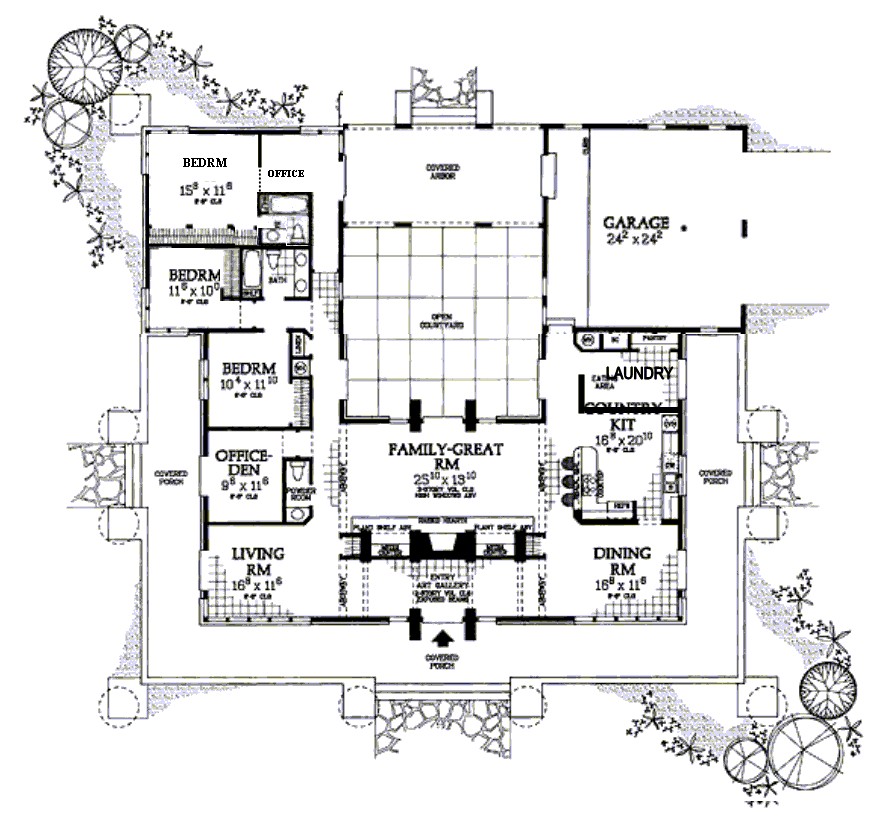
Here is a list of things I think are good about it:
1. The garage is not visible from the front of the house, but it is located close to the kitchen (good for hauling in groceries).
2. The bedrooms are closely grouped (which means I wouldn’t have to walk through the entire house to comfort a crying child in the dead of night).
3. The entryway doubles as an art gallery, and doesn’t open directly into living spaces.
4. I like the internal courtyard.
5. The house is symmetrical, which appeals to my sense of design and proportion.
6. It is a single story house, which means that I could grow old in it—no stairs to negotiate.
7. It is not too big for me to keep clean on my own. (Well maybe it is too big. I don't know about that anymore.)
8. There are enough bedrooms for all the kids I could ever hope to have, and plenty of room for grandkids or otherwise guests.
9. I really like the large porch area all around the front and sides. It seems perfect for a summer evening.
The mid-westerner in me really would like to see a basement added to this house, and that can be done fairly easily, I think, just by adding a staircase somewhere, from the garage perhaps.
There are a few, more fundamental problems with my dream though. Like the fact that I prefer to live in cities where a home like this would be prohibitively expensive, that I detest the "have to drive everywhere" culture of the US that a house like this would impose on me, or that I am too security minded to actually have a home with so many doors to the outside.
So the question is, is this house actually perfect? Is it only perfect if it can be put into practice?
27 November 2005
Blame it on Art
There's an interesting article in the New York times that Matthew just brought to my attention, and since I'm out of time for my post today, I'm passing it on.
The thesis of the article seems to be that, yeah, architecture matters. Here's a quote:
Le Corbusier called houses "machines for living." France's housing projects, as we now know, became machines for alienation. In theory, the cause of this alienation is some mix of the buildings themselves and the way they're joined to the city. But in practice, the most effective urban renewal has tended to focus on the buildings. It focuses on the buildings by razing them.
Could it be that these houses were so bad that they actually are responsible for social unrest, spontaneous violence, and general human unhappiness? Is that even reasonable? It looks a little like scapegoating to me, but at least they aren't blaming the Louvre.
This article isn't alone, by the way. In fact, the failure of modern architecture to be the promised utopia was a catalyst that brought about post-modernism, that great enigma of art, philosophy, and life. More about that later. I promise.
Anyway, have any of you ever been in an architectural space that just made you feel like a hoodlum? I have. Low ceilings and happy me don't mix.
28 October 2005
Eero Saarinen
A while ago I said I would at some future point write about interesting architecture. Well, folks, here it is. The architect in question, Eero Saarinen, is responsible for this:

The photo credit goes to Ezra Stoller, who has a well-deserved reputation as a photographer of modern architecture. This is the TWA terminal at what is now JFK airport in New York. I'm pretty sure that when I moved away from the US I departed from some other terminal at JFK and never saw this one. So that's one more place to see. . . .
I've always admired the interior, the way it curves and bends. And I also like the architect's philosophy that even the smallest detail is part of the whole and should be treated as such. When I look at pictures of Saarinen's terminal, I am irresistibly reminded of a cave and of the Jetsons. It has a marvelous "this is what they thought the future would look like back in the past" feel.
Saarinen is also the architect behind the Jefferson National Expansion Memorial--more commonly known as the St. Louis Arch, which incidentally was completed on this day 40 years ago.
25 October 2005
Unity Temple
Frank Lloyd Wright had what Neil Levine called a "moral scripture" above the hearth of his family home:
Truth is Life,
Good Friend, Around These
Hearth Stones Speak No Evil
Word of Any Creature . . .
Nineteen years after that home was build, Wright abandoned his family and took up with the wife of a former client. There weren't any proverbs above the hearth of the home he built with her.
During the years before all that happened Wright built Unity Temple in Oak Park, Illinois.

It was completed in 1908, and went against many of the established conventions of American church-building. Incidentally, 1908 is the same year the Model T was introduced. Juxtaposing those two images helps the contemporary viewer to understand how innovative and even strange Wright's design was. Just about everything about the church is atypical. The congregation met in square space rather than the traditional oblong basilica. In a rather clever way, the entry to the chapel was behind the pulpit, hidden from view of both the speaker and the audience. There were innovations too in Wright's choice of materials, use of space and light, and so on.
Someday, I hope to have a long layover in Chicago (or maybe a long weekend in Chicago) so that I can go see this building for myself.
18 October 2005
Pimp my Carriage
Ayn Rand's The Fountainhead was one of the first books that I read because I wanted to, unassociated with any kind of school assignment. The protagonist, Roark, is an architect--a visionary, rogue, Avant-garde, etc., and as such has a hard time getting commissions. The following discussion with a prospective client begins on page 164:
"Mr. Janss, when you buy an automobile, you don't want it to have rose garlands about the windows, a lion on each fender and an angel sitting on the roof. Why don't you?"
"That would be silly," stated Mr. Janss.
"Why would it be silly? Now I think it would be beautiful. Besides, Louis the Fourteenth had a carriage like that and what was good enough for Louis is good enough for us. We shouldn't go in for rash innovations and we shouldn't break with tradition."
"Now you know damn well you don't believe anything of the sort!"
"I know I don't. But that's what you believe, isn't it? . . . Tell me, Mr. Janss, do you really think that Greek columns and fruit baskets are beautiful on a modern, steel office building?"
Just so that we are all on the same page, here is a carriage not unlike the one Roark describes.

Angels, garland, and lions were a great way to soup up your wheels anywhere between 1700 and 1830. At the time The Fountainhead was written (1946), the best ride around was probably a Bentley like this one.

And today, you know you’ve arrived if you have a playstation, flat screens, and at least one hydraulic powered flip out thingy in your car.
The discussion in Rand's book has stuck with me ever since I first read it, mostly because it has applicability to about 12 different art topics. Whenever one of them comes up this passage pops into my head. Today, I'll limit the discussion to taste. Simply put, taste, aesthetics, beauty, and so on change. It is very tempting to believe that there is a universal beauty out there that touches the soul of every man and woman on earth. When I encounter something of immense beauty I can scarcely comprehend that any one else wouldn't feel what I do. But there always are people out there who don't. Universal aesthetic appeal is a myth.* While this may be disappointing, it opens up worlds of fascinating inquiry into why we like what we do.
*I can think of two possible exceptions to this rather fatalistic pronouncement: nature and children. But people don't design those things. They just come beautiful without help, which is different. And I regretfully speculate that their appeal isn't universal, though I wish it was.
16 October 2005
Modern Artists, Religious Architecture
I’m not nearly as interested in architecture as I am in art. Not that architecture isn’t fascinating; it is. But it takes a lot for me to get beyond the do-I-like-it-or-not point with architecture. I get hung up on whether or not I would like to be in a certain building, which I guess is not too different from those people who evaluate contemporary art based on what it might look like hanging above their couch. That’s really not the best way to judge a work of art, and I suppose my approach to architecture is equally insufficient.
There are some works of architecture that really grab my attention. Among them are buildings designed by artists. Because it is Sunday, the examples are churches. Because I am Mary Ann, my examples are modern.
The first is the Rothko Chapel. It is located in Huston Texas, and is about 34 years old. It is minimal, non-denominational, and filled with the works of Mark Rothko. Technically, Mark Rothko isn’t the architect, but he was involved in every stage of the building’s design and production. It functions not only as a chapel, but also as a museum, performance hall, and lecture forum.
The second is the Matisse Chapel. It is located in Vence, France, and is about 54 years old. It is a Dominican chapel, and Matisse personally designed every last scrap of it. Religious services are still held there.
Neither chapel strikes me as being particularly impressive as architecture goes. Even my limited appreciation of architecture is sufficient to deduce that. When compared to other “interesting” architecture, it is clear that these chapels are woefully simple, and it is certainly the artist’s involvement that is to blame for my interest in them. Also woefully simple is my appraisal of them, that though I have never been to see them, I think I would like to. I think I would like to sit down and just be there for a while.
I’ll write something about interesting architecture in the future.
Subscribe to:
Posts (Atom)
