skip to main |
skip to sidebar
Shrinky Dinks. They're remarkable, really. $5 for ten 8x10 pages of shrikable magic. For anyone unfamiliar with shrinky-dinks, here's the story. Plastic sheets that you can color/cut any way you want, and then bake for 1-3 minutes. In the oven they reduce to about 1/3 their original size.
Here are some things that we've made recently.

The odd shapes in the middle are Star's very own designs. I think they might make nice pendants. Any takers? Oma Bonnie? We used a hole punch (regular office size) to make the holes in each of the shapes so that they can be strung.
As you can see, we traced my kids' hands and they colored them in. Star on the left and Dandelion on the right. Actually, Dandelion just scribbled all over a page and I traced her hand onto the already-there marks. Star really did color hers in, and if you look really close, you can see that she drew rings on her fingers.
Today, Star ought to have had a little birthday party at school, but there was much ado about nothing in Beirut today and school was canceled. But I wasn't to know that last night when I was preparing for the festivities. Star decided that bubble-blow would be a great party favor for all her little friends at school. I liked that idea, except for the fact that bubble-blow is exactly the kind of thing that gets branded all the time. You can't just get bubbles, they're going to be barbie, pooh bear, dora, or diego bubbles. That's bad. Yes, it is. I think kids ought to be free from that kind of thing, especially when they’re blowing bubbles.
So, I got out my wrapping paper and covered up the labels. I did a nice job too, see?

I've got all 25 of them ready (oh, I don't think there are that many kids in her class, but I figured better too many than too few) and waiting. Just as soon as the "mood on the ground" stabilizes and people go back to their day-in day-out, Star will have a great class party. This weekend of course, there will be two parties. Dandelion on Saturday, Star on Sunday.
Here's another installment extolling Beirut's artsy side. Two years ago I strollered Star to and from pre-school each day, walking a route that took us right past a little shop called Trompe L'Oeil. Looking through the big picture window on their storefront, I could see that the shop was full of children's things. Tiny stepping stools, hangers, toy boxes, book cases, kid-size table and chair sets, etc. All wood. All painted (usually with animals and plants). I loved it, but I knew it wasn't going to come cheap, so I waited. And waited. Waited some more because that is what I do. And bought!

If they had a webpage, I'd link to it, but since they don't, here's a scan of the business card they left with me. That black streak is my hand turning the card over while the scanner took it all in.
So, back to buying things. Star and Dandelion have (for about half a year now) been in a phase where just about everything has to have a nap time. Spoons, scrubbrushes, shoes. I have even been scolded for interrupting said naps unintentionally. So I requested a doll size cradle in an effort to create less trauma for my dear little mommie-daughters. The second purchase had less to do with the girls and more to do with war-induced shortages. After the summer-war, plastic storage boxes (big ones) have been hard to come by. When you find them, they're likely to be totally expensive and flimsy. Anyway, I need more even though I already have lots. They were all in use, and the only one that I could imagine repurposing to hold other stuff was the one serving as the girls' toy box. So, to free up the tub for other storage, I got the ladies a 'real' toy box. It is exactly what a toy box ought to be: huge with a lid, and hinges that prevent said lid from smashing fingers. Ah, perfection.
 If for no other reason than that I own both the books pictured at left, I am a lucky dog. The top, Handbags, and bottom, Bags, are about, duh, purses. And though they have that in common, there is little else the same about them. First, there isn't much duplicate information in them, even though they cover the same time periods, production sites and techniques. Handbags includes interviews, brief biographies, and brand histories of the best contemporary purse designers and companies. The purses are organized by style, which allows a 2001 Jamin Puech to appear directly before a rare English purse from the 1550s, emphasizing a continuity of sorts--a harmony within this genre that has endured for centuries (see pgs 264-5).
By contrast, Bags is organized first by date, beginning with the oldest surviving examples of purses. Beca use all the bags of a certain era appear together, it is far easier to imagine the time, appreciate the purse in its context. The emphasis here is on the history of the purse, whereas the Handbags emphasis was on the style of the purse. Bags also offers much more detailed information about materials, construction methods, and the historic context of each period's chosen forms. For example, this about Petit-point, lace and cloth:
Until the nineteenth century, fine needlework was performed not only by women as a home industry, but also by professional embroiderers. Partly due to technological developments, the variety of needlework techniques increased sharply. Although less very fine needlework was done at that time, there were many techniques for making reticules, such as Berlin woolwork, blackwork, lace, weaving, embroidery, crocheting and knitting.
pg 248
So, there you have it. Both are heartily welcome in my library of things about which I probably know either too much or too little. But since I don't know which it is, I'll stop here.
Way back at Christmas 2003 Matthew gave me a book making kit, and I have just now gotten around to using it. At first I was quite worried that the included glue would have passed its shelf-life. But it was still functional and so on New Year's Eve I went forward with the project. New Year’s Eve was the perfect time for this. It is the one night of the year when getting into bed late is expected. After the kiddies were snuggly in bed, I had about 4.5 hours to work.
The kit included enough materials for two books and I almost finished both in one night. The instruction booklet said to expect it to take 3 hours, but since this was my first time through the process and I made two of them, I’m content with my turnaround time. And my results aren't too shabby either. I'll post pictures later.
I now know all kinds of bookbinding terminology. The pages are placed together in groups called signatures, which are individually sewn and sewn to each other. The sewing on the fold lines is called a mull, and the pretty band that is placed on the mull at the top and bottom is called a headband. I could go on and on like this, but won’t.
The best part of the process is that I have lots of leftover glue, thread (a nice, sturdy one) and even some special papers. If I got my hands on the other necessities, I’d have the ability to make another book. I really like the idea of that. The books I made require nothing more special than 8½x11 paper and some heavy card-board for the spine and covers. I know my way around papers and fabrics well enough to be able to find buckram and everything else right here.
I've dabbled in bookbinding before, but I've never had instructions, tools or such professional looking results. In comparing my book with other hard-cover books in my house I see little difference in construction or quality, which is impressive.
This comment was left by Suz about five months ago when I featured Jasper John's White Flag in this post:
i thought it was interesting that johns was described as a neo-dadaist as well as a pop artist. that made me think of a question i'v been meaning to ask you. i was having an art discussion with my roommate who is a tattoo artist/painter, in which he commented "as an artist, i think that stuff like duchamp's 'fountain' is the biggest insult to the work i do" i'm rather curious about your thoughts on this- might make a good upcoming post, maybe?
Thanks for the question. I hope I can provide a satisfactory response, even though the closest I have ever come to "body art" are those face-painting booths at carnivals.
My first thought is that, tattoo artists are very likely quite good at getting a butterfly to look like a butterfly, or an anchor to look like an anchor. Because of this your roommate probably sees craftsmanship as an integral part of what it is to create art. Tattoos, frankly, have to meet certain visual expectations. No one wants bumbling imperfection burned into their flesh. And having painted faces a time or two myself, I recognize that flesh is not the easiest foundation for such work.
In addition to good technique, I'd imagine that a tattoo artist also needs at least a little artistic feeling. Probably, there are customers out there who are not satisfied with the same old tattoo that everyone else already has. Creativity, improvisation, even thoughtful re-interpretation are skills that such an artist would likely do well to have in his arsenal. Otherwise, people could just get branded and have the whole thing done in one very painful go.
In the case of the tattoo-artist-friend-roommate, my guess is that he sees Duchamp's work as an insult to the requisite technique of his medium--as an insult to anyone who has acquired that skill through hard work, practice, maybe a few black-eyes if it went wrong . . .
Fountain can be seen as an insult to certain definitions of craftsmanship, but I don't see it as an insult to craftsmanship itself. Duchamp's interest was in searching out the fringes, the gray area between art and not art. His Fountain was less an assertion than this question: "can it still be art, even though there is no reason for it be except that I say it is?" Ever since, that question has driven art and artists and has become one of art's most productive inquiries of the 20th century.
Rather than insulting fields that require high levels of skill and technique, I believe Fountain simply differentiates itself from them. Art can be found in exquisite craftsmanship, but after Fountain, it can be found elsewhere too.
Back in early October, I went to an antique dealer in town who I knew sold old pointed-arch window frames. The man selling them wanted $150 for the ones about a meter high, $200 for the larger ones. As is. And they were a mess. They had obviously been left out in the rain, there were chunks missing, no or broken glass, peeling paint, etc. I pointed all that out to the man and offered him $20.
Looking back on it, I think he was probably offended that I, a foreigner, would dare to think that one of the region’s treasures could be worth so little. After all, these are not really being made anymore, apparently came from palaces and their origins, age, and relative rarity adds value. But I disagree. The window frames were in terrible shape. They might as well be garbage or firewood and nobody pays even so much as $20 for a few scraps of wet wood. I still can’t believe that he thought $150 was a possible price. He offered to lower it to $130, but that was his final offer. So I, very satisfied with NOT buying one, went home.
Anyway, I’ve been thinking about age-value and art and wondering what it all means. The assertion that age=art comes down to everything eventually becoming art if you just wait long enough.
In some cases, age does add value. Like Greek vases, hand made lace, etc. Especially when a craft is lost it has a much higher chance of becoming an art. But alas, the carpentry of making a pointed arch is not lost at all, and arguing that an old, decaying window frame is somehow worth more because it is too broken to possibly serve its purpose is crazy.
No, we aren’t really talking about cuisine or fine dining or any of the culinary arts.
But I will pass along a recipe that I include among those arts and it’s yummy and it’s relevant to my art idea today. It’s at the end of the post.
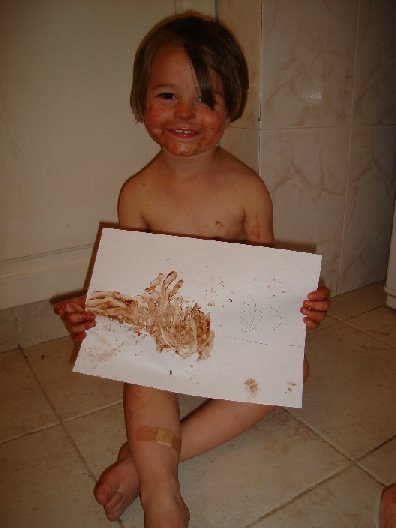
So one afternoon, I made a chocolate desert and let my daughter have one of the mixing bowls. This is one of those childhood indulgences that I thought she ought to have access to, but she soon found a different use for the chocolate.

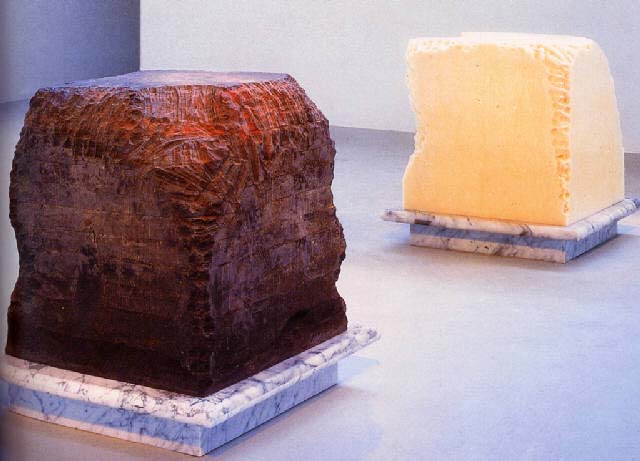
And she isn’t alone. Lots of artists have worked with chocolate, which is a phenomenon I can’t fully explain. Among them are Janine Antoni who made this piece called Chocolate Gnaw in 1992
and Vic Muniz who I wrote about back in January for his sugar art. He’s also done marvelous things with chocolate syrup. Here’s an example from 1999

Antoni’s huge hunk of gnawed-away chocolate deserves more attention than this, and I guess Muniz’s work could also use some more explication. But I'd rather have some chocolate. If you'd like to join me, here’s the recipe that became the medium of my daughter’s creativity.
Inspirational Chocolate Dessert *
4oz. semisweet chocolate
½ cup heavy cream
3 egg yolks
5 egg whites
3 tbsp granulated sugar
Line a jelly roll pan with foil, butter it, and turn the oven on to 425 F.
Roughly chop the chocolate and melt it together with the cream in a small-ish sauce pan, stirring constantly.
Remove from heat and add the egg yolks one at a time, combining thoroughly after each one.
Return the pan to low heat for a few minutes, stirring all the while to cook the yolks.
Beat the whites with a handheld mixer for a few minutes until they are fluffy but not firm. Add the sugar, and continue beating until stiff peaks form.
Fold the chocolate and beaten egg whites together.
Spread evenly in the jelly roll pan, and bake for about 20 minutes.
Remove from oven. Cover with a tea towel, and invert on a table or countertop. Place the pan to the side, and gently loosen the foil from the cake.
Allow to cool completely.
Cut away any crust that may have formed a the edges of the cake.
Spread with something ridiculously tasty, like peanut butter cream frosting (equal volumes peanut butter and real whipped cream, blended with enough confectioners’ sugar to give it the consistency and taste of frosting).
Roll it up and serve.
*yes, I named it all by my onesie.
Yesterday, I visited Lebanon’s only Contemporary Ceramics Studio, the appropriately named Ceramic Lounge. It is in the squeaky-clean area of Beirut that promotes itself as an “art village”. Here’s the concept at the lounge. You go, choose a white ceramic thing (they have all kinds of table/kitchen wares, plus boxes, banks, ornaments, coasters, decorative figurines, etc.), choose some colors and start painting. For those who doubt their own creative genius, they have tons of ideas, patterns, things to trace and things to out-right copy. While you work, you can eat. They offer drinks and light snacks. When you finish your meisterwerk, they glaze and fire it for you, ensuring the colors last.
There are a lot of things to praise about the Ceramic Lounge. The staff were helpful both in person and on the telephone (oddly rare in Lebanon, or maybe its just the language barrier striking once again). The atmosphere there is accordingly relaxed, open, and fun. The quality of the finished product is beyond dispute (microwave, dishwasher, everything-safe). Not least of the lounge’s merits is the food. I can, with confidence in my objectivity, state that their cheesecake is THE best I have had in Lebanon. That alone might justify a visit.
Lest you think that I’m just advertising for them (NO web presence?—a cause in itself for demerit) my experience there was not all roses, sunshine, and happiness. The cost of everything in the lounge is unnecessarily high, and prices are poorly explained. One tiny item, a desert and a drink cost over $20, which admittedly precipitated a slight decline in my avid interest in making their art a part of my life.
Is fashion art?
Ok, that is a much bigger question than I deal with in these tiny snippets I publish each day. It demands a clear idea of what art is, a clear idea of what fashion is, and a very clearly delineated comparison of the two. Fashion and art have been compared endlessly in recent decades, and it is not as if the two have nothing in common. But I'm not here to write about what makes them the same. That's only too obvious as evidenced by all the people out there saying how fabulously interconnected they are.
Although there are many differences between fashion and art (and differences too between how the two fields function and evolve), I'll only mention one difference here. Interestingly, this difference may seem too obvious to merit discussion at all. Yet it provides a fundamental incongruity between fashion and art. Fashion, even in its most extreme forms, is designed with the assumption that it will be worn. It operates in tandem with human bodies.
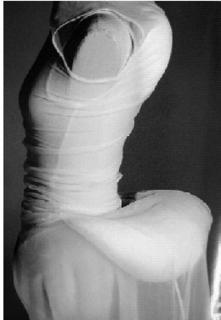
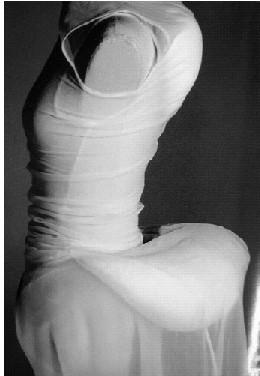
Even the extreme designs of Rei Kawakubo (above, Dress becomes Body becomes Dress, 1997) are created in view of the body as the pre-existing template of creation. The body gives origin (if not a purpose) to fashion. As such, fashion operates within a construct quite foreign to artistic production. Fashion is inextricably attached to the body, a limitation fine art has never had. It is true that both fashion and art are to some extent dependent on a viewer, but fashion remains dependent on both a viewer and a wearer.