Showing posts with label art as art. Show all posts
Showing posts with label art as art. Show all posts
16 January 2007
Art: Because I Say So
Even though he’s not my favorite artist, Andy Warhol does provide good fodder for Impart Art, and for contemporary art generally. One of the very first installments of Impart Art described a short-on-cash assistant who in 1968 produced a new series of silkscreen paintings, forged Warhol’s signature, and made a deal with a gallery. As planned, all of this transpired without Warhol’s knowledge, who found out about the paintings only when the gallery owner asked for authentication of the works. He claimed them as his own, as well as payment for them (surely the assistant was disappointed).
In 1969, another assistant told the press that she had been doing all Warhol’s art for over a year. Warhol, she reported, had given up art. When asked by Time magazine about the matter, Warhol confirmed the report, only to retract the statement when infuriated collectors and dealers heard the news.
Can an artist outsource, and if so, how much? I know it isn’t uncommon among contemporary artists to hire skilled painters with good technique to execute ideas on their behalf. As far as I know, the painting is still considered the work of the one who thought of it. And let’s face it. Warhol wasn’t really “painting” anyway. So what if it was his arm working the silkscreen machine? But here, if you trust the assistants, Warhol wasn’t involved at all. His participation amounted to nothing more than his saying so. And he might not have even done that much if the buyers hadn't been scandalized.

05 January 2007
Innovation
innovative: adjective
1. ahead of the times; "the advanced teaching methods"; "had advanced views on the subject"; "a forward-looking corporation"; "is British industry innovative enough?" [syn: advanced]
2. being or producing something like nothing done or experienced or created before; "stylistically innovative works"; "innovative members of the artistic community"; "a mind so innovational, so original"
This from WordNet® 2.1. Princeton University by way of dictionary.com
I've always thought of innovation as inherently good, useful, and productive (though I couldn't find any dictionary to support my sense of the word). It isn't like invention or creativity. They can be negative. Inventors come up with useles junk all the time, and we've all (at one point or another) been abused by the very annoying creativity of others. But no one ever bothers to say "positive innovation", useful innovation", or "constructive innovation", to give a few examples. To do so would be redundant, at least in our current use of the term.
Given that innovation is seen (by me at least) as relevant, needful, and good, does the ongoing story of art require anything more than this?
12 December 2006
Insult Art
This comment was left by Suz about five months ago when I featured Jasper John's White Flag in this post:
i thought it was interesting that johns was described as a neo-dadaist as well as a pop artist. that made me think of a question i'v been meaning to ask you. i was having an art discussion with my roommate who is a tattoo artist/painter, in which he commented "as an artist, i think that stuff like duchamp's 'fountain' is the biggest insult to the work i do" i'm rather curious about your thoughts on this- might make a good upcoming post, maybe?
Thanks for the question. I hope I can provide a satisfactory response, even though the closest I have ever come to "body art" are those face-painting booths at carnivals.
My first thought is that, tattoo artists are very likely quite good at getting a butterfly to look like a butterfly, or an anchor to look like an anchor. Because of this your roommate probably sees craftsmanship as an integral part of what it is to create art. Tattoos, frankly, have to meet certain visual expectations. No one wants bumbling imperfection burned into their flesh. And having painted faces a time or two myself, I recognize that flesh is not the easiest foundation for such work.
In addition to good technique, I'd imagine that a tattoo artist also needs at least a little artistic feeling. Probably, there are customers out there who are not satisfied with the same old tattoo that everyone else already has. Creativity, improvisation, even thoughtful re-interpretation are skills that such an artist would likely do well to have in his arsenal. Otherwise, people could just get branded and have the whole thing done in one very painful go.
In the case of the tattoo-artist-friend-roommate, my guess is that he sees Duchamp's work as an insult to the requisite technique of his medium--as an insult to anyone who has acquired that skill through hard work, practice, maybe a few black-eyes if it went wrong . . .
Fountain can be seen as an insult to certain definitions of craftsmanship, but I don't see it as an insult to craftsmanship itself. Duchamp's interest was in searching out the fringes, the gray area between art and not art. His Fountain was less an assertion than this question: "can it still be art, even though there is no reason for it be except that I say it is?" Ever since, that question has driven art and artists and has become one of art's most productive inquiries of the 20th century.
Rather than insulting fields that require high levels of skill and technique, I believe Fountain simply differentiates itself from them. Art can be found in exquisite craftsmanship, but after Fountain, it can be found elsewhere too.
01 December 2006
That's pretty good for a . . .
Consider this:
When asked to provide details about his life to a curator, the painter Balthus sent the following telegram in reply: "No biographical details. Begin: Balthus is a painter of whom nothing is known. Now let us look at the pictures. Regards. B." Balthus was rebelling against the modern fondness for viewing an artist's output through the prism of his public image. He worried that once an artist's personal life was known, his work would be seen only as a means of diagnosing the artist's psychological shortcomings and not as an end in itself. (found here)
So, do Vincent's letters to Theo make Starry Night a better picture? Did Warhol's attention-craving-madness make his silkscreenes art? Would it have mattered if Jackson Pollock had instead been Jackie? What if Picasso hadn't been a womanizer?
Pictures rarely, if ever, stand alone. There is always a context, a background, an origin. All too often, a person's lifestyle choices are seen as an integral part of the images they make. But what if everything we (think we) know is wrong? Do we read art one way for a suicide, and another way for death by natural causes? Do we read the art by men one way and women another? What exactly are our foregon conclusions about a life that are transposed onto the image we see?
01 January 2006
When was Art?
Becuase I am an idiot, I have been trying in vain to publish this post since the 29th.
Here’s a little exercise. Think for a short, short moment about your own idea of art; what it has to be/do/not be/not do. Keep it as short as you possibly can. Not a visual artist/art historian? No problem. Think instead about your idea of what freedom or justice means. Got an idea? It will probably do.
So, now think for a moment about art history (or if you had to revert to freedom, just think about history). How far back can you go before your idea of art no longer fits? For example, most people these days are happy to acknowledge photography as valid, canonized, high art. Not so 50 years ago. Another example? Greek vases. Is it only art if it was created to be art? I am sure that when the Greeks were decorating their vases they had no more artistic feeling than do these folks making these things. But don’t tell the Louvre, or the Italians.
Two important scholars form the backbone of what I have to say today. Hans Belting who wrote about image-creating before there was a thing called art, and Arthur Danto, who wrote about the end of art, which he argues took place back in the mid-1960s. It is a bit strange to think of art having started and stopped, but really, art was more like a craft or trade before the Renaissance. I don’t know if it is true that art has ended, but Danto sure makes sense when he argues for it.
Anyway, the purpose of the foregoing exercise is to emphasize that our current notion of many things (art and freedom are merely convenient examples) has very little in common with what our grandparents would say about those subjects. That in turn has little in common with what their own grandparents would say and so on throughout time. These ever evolving definitions are one reason that I have a series devoted to the problematic nature of art history. But it isn’t just an art history or a history problem. It is a problem for all of contemporary society and contemporary art. Art (freedom too) can't be everything to everyone becuase it never has been that.
28 December 2005
Art: Paying for it
Happy Birthday to my Dad.
Patrons are, if anything, essential and indispensable. No matter what the art; good, bad, or ugly, someone has to pay for it. Some people get really bent out of shape about art “selling out”, and I don’t blame them. It is annoying to think that something so crude as money is driving something so noble as art.
So I was paging through another great Christmas present that came my way this week--this book, which has the following advice in it:
. . . Oh ye artists who can spell, speak French, and read Homer, never show your patrons they speak bad French, or read Bad Greek, and spell carelessly, but listen to their French as if it was Racine’s, to their Greek as if old Homer himself were spouting, and read their epistles as if they had orthography, grammar, and common sense. Do this, and you will drink their claret, adorn their rooms, ride their horses, visit their chateaux, and eat their venison. But if, on the contrary, you answer the French not meant for you to understand, rectify their quotations which you are not supposed ever to have heard of, and discuss opinions only put forth for you to bow to, you will not eat their venison, you will not adorn their apartments, you will not ride their horses, you will not drink their claret, or visit their chateaux, at any rate more than once. And, so, artists, be humble and discreet.
So wrote Benjamin Robert Haydon, an “awkward man and an unsuccessful artist”, according to Grove (pg 427-8).
I’ve mentioned Sherrie Levine’s statement before, but today it is relevant for a part I didn’t talk about then. The statement ends with “The birth of the viewer must be at the cost of the painter.”
Is she right about that? I’m inclined to think that she is. The artist/patron relationship is, in every case I can think of, one in which one party bows to the other. Has it ever been otherwise?
15 December 2005
Art and Music
Ah music--to artists 150 years ago, music was synonymous with freedom. It was their ticket out of representationalism and into the hitherto unexplored realms of abstraction.
 This James Abbot McNeil Whistler's Symphony in White No. 1: The White Girl from 1861-62.
The title is taken from music, and so is the apparent lack of subject matter. Sure, there's a girl there, but she is white, white dress, white background and forgound, white, white, white. It isn't about her. It's about the color. Whistler would get far more abstract than this, but even his most daring Falling Rocket is only a partial abstraction.
So time goes by and things change. About fifty years after Whistler's image, Wassily Kandinsky took music as the ideal for the visual arts. He theorized and wrote about the confluence of music and color and painting, and started naming his paintings the way musicians name their compositions: improvisation, composition, contrasting sounds, etc. By the time we get to Kandinsky Modernism is in full swing. Cubism has already evolved through its first two phases, and the influence of academic "correct" painting had fallen considerably.
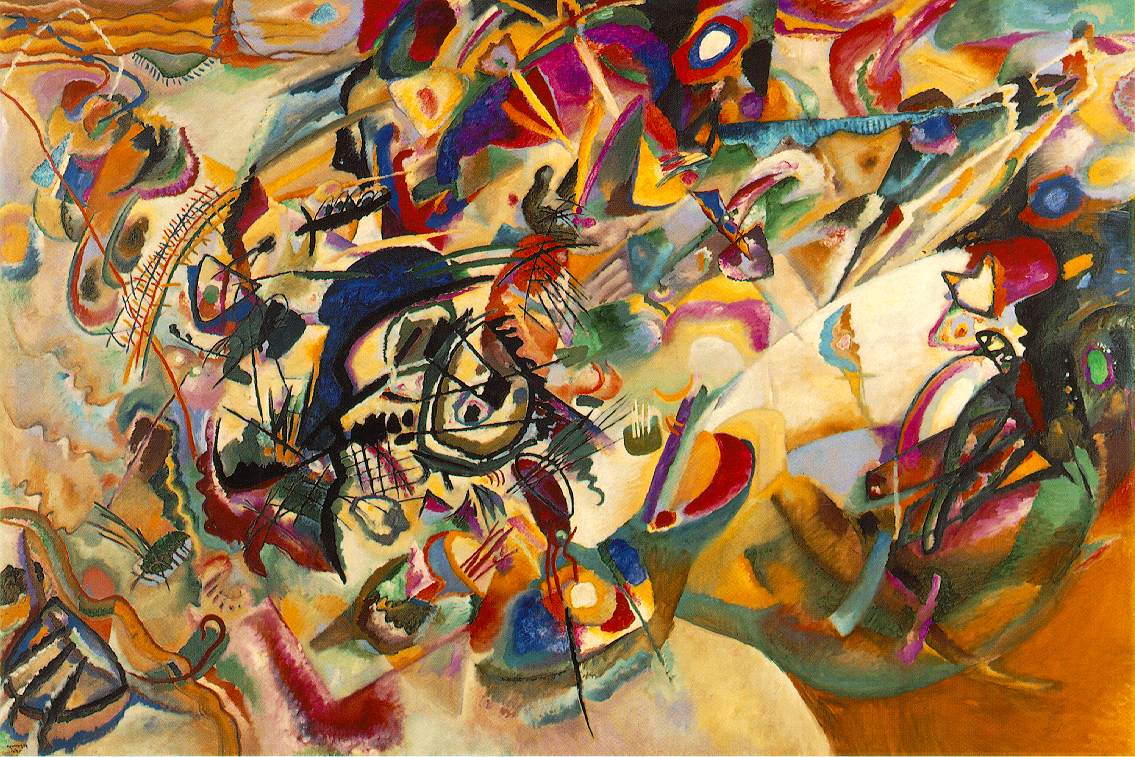 This is one of his 1913 compositions (number seven for those of you who care. And incidentally, the numbering thing also derives from music (think of all the numbered classical compositions out there). Kandinsky was able to take the influence of music further than Whistler ever had. Music is a far more overt inspiration and starting point for these later works.
Once again, time goes by and things change. Another fifty years pass. 100 years after Whistler's Symphony in White, Clement Greenberg wrote:
". . . the unique and proper area of competence of each art coincided with all that was unique to the nature of its medium. The task of self-criticism became to eliminate from the effects of each art any and every effect that might conceivably be borrowed from or by the medium of any other art. Thereby each art would be rendered 'pure' and in its 'purity' find the guarantee of its standards of quality as well as of its independence."
In other words, painting should not try to imitate music, and sculpture should not try to imitate literature, and music and literature should not try to imitate painting or sculpture. This was Greenberg's attempt to put some rules into an art world that, already in 1960, was all wrong.
12 December 2005
Good Art Bad Art
Good and bad are dangerous terms almost everywhere and especially in art. The first, most obvious reason is that taste changes. We get sick of the same old same old beautiful (or meaningful or moving or inspiring or whatever you want art to be) stuff and find that we need something new. This has been going on for millennia, and everything about modern life seems to support the idea that this (if not a whole lot else) will continue to be as it has been in the past.
The second reason why the terms good and bad are dangerous for art is that they set up a specific operational structure under which art must labor. If there was such a thing as "good" art it would presuppose both the existence of "bad" art and specific criteria by which that distinction had been reached ("this art is good because x, y, & z"). That set of criteria would only be useful if it applied to all art everywhere for all time. For the reason why such criteria are impossible to identify, reread the first, most obvious reason. I wish to argue here that there is no such thing as good art and bad art—there is only art and not art. Either it is or isn’t. There are no varying degrees of art-being. It’s all or nothing here, and therefore "good"” is meaningless. Think of it like this: an organism is a human being or it isn’t. There are no "kinda-sorta" humans.
Please don’t take this further than what I have just outlined. A Monet is usually a good example of Impressionism, and a Warhol is always a bad example of Neo-classicism, and so on. Specific works of art can be good or bad illustration of specific things, but that has nothing to do with being good or bad art. Also, I think it is fair for individuals to decide what for them is good or bad art, acknowledging that these assessments fail to be universally applicable.
24 November 2005
Activist Art
It seems like such a good idea, Activist Art. People look at art, and they try to figure it out, and maybe they take something with them from the experience. Why not have that 'something' be a message that could change their world-view, or at least the way they take a shower?
That’s exactly what is behind The Running Tap, and you can read all about it here. Essentially, an artist has decided to leave a faucet running full force for a year. In the course of that time 200,000 liters of water will come and go through the House Gallery in Camberwell, south London before 27 June 2006 where this bit of Activist Art is taking place.
Here’s what the artist, Mark McGowan has to say about it:
"The piece is directed towards individuals. I've told them stuff like how you can waste up to 100 litres of water doing your washing up under a running tap, to draw attention to why I'm doing it."
As a person deeply committed to art and to the appreciation of it, and to the systems that promote and preserve art and the public’s access to it, I have to take issue with this piece. The idea is at best, half developed. Excessive waste to moralize against it? With more thought and effort I think McGowan could have come up with something far less hypocritical and better able to express the actual idea. To me, the best or most art-like part of what he has done is to expose our already-there sensitivity to waste. Everyone who sees this feels an urge to turn it off—which is not a new reaction in the viewer. It doesn’t raise awareness of the wasteful aspects of water usage because anyone who sees it is going to pat themselves on the back that they aren’t nearly so wasteful as this artist.
So anyway, all you activist artists out there, please be careful.
16 November 2005
Art Crime
I have put off writing about art crime for a while, mostly because I'm no expert. It has been in the news a lot lately--domestic and internationl news, so nobody is off the hook this time. I have read with rapt interest about the Getty Museum's troubles. Frankly, it reminded me of all the great movies about stolen art. The list keeps growing the longer I think about it. And it also reminded me of some real life stolen art.
I've been looking into what can be done when art is stolen, lost, illegally seized, etc. First, there is Interpol, which has a art unit, and a sub-unit devoted t recovering Iraq's looted art. There is also a private organization called the Art Loss Register that keeps a database of lost or stolen art. It seems to me that they are more geared toward private property losses than the museum's worth of loss sustained in Iraq. They also emphasize their services for art lost during the Holocaust. And then there is the US government's Art Crime Team, a division of the FBI. NPR recently interviewed their chief, and you can listen to that here.
Looking at all this information impressed me on two counts. First, these agencies do a lot to recover lost and stolen art. Second, there is an awful lot of unrecovered loot out there. Where’s Indiana Jones when you need him?
12 November 2005
Art and Feminism
Feminism has been on the list of ways to do art history for a couple of decades now. Linda Nochlin had a lot to do with that, writing about the way women are depicted as well as the way women depict. Interesting stuff to read, preferably with your salt shaker handy.
I'm not saying there isn't anything to the Feminist approach to art history. I would hate to see where art and society would be without the women's movement and I'm glad that I've reaped the benefits of it. All the same, I have some questions about the intersection of art and feminism.
Here's an Arthur Danto quote about art in the 1970s:
It was in those years . . . that a kind of radical feminist critique began to surface. . . . The argument was that it was false to the nature of women to apply to their work standards that had been developed in connection with the work of men. "There is no language of forms for women" is something Linda Nochiln said. My sense of what was meant was that women were doing things in these years which did not fall under definitions of art that were formalist in character, and were especially embodied in the criticism of Clement Greenberg. SO in effect the radical critique was an appeal to Pluralism of a kind, even if it somewhat sexualized the appeal, talking as if women did one kind of art and men another.
Ok, so what to say about that. First, I think there is a point to be made that men and women do not of necessity make different kinds of art. Certainly there are some men and some women whose work is so gendered that it couldn't have been made by the other sex. But what about the rest?
My second problem is a more general problem with feminism. By making gender the central point of analysis it becomes the most important consideration, providing the origin of all other meaning. I am uncomfortable with that because as an individual, I would so much rather be judged based on me--my choices, my accomplishments, my cares and concerns. To instead assess all that based on something I didn't choose is to subvert it, placing it secondary to something else. For some artists gender isn't secondary at all--but what about those for whom it is well and truly irrelevant?
Lets replace the man/woman thing with something else: nationality/ethnicity. I don't think that Europeans, or Africans, or the Chinese of necessity make art that must be examined within their nationality or ethnic origin. Certainly it might make a difference based on the particular concerns and work of each artist, but how much of one? Do we really need an independent art historical critique of each way of being?
07 November 2005
Invisible Art, Silent Music
Of all the crazy stuff that happened in the 20th century it is important not to forget some of the more traumatic moments in the arts. There are more than the two I will discuss in this segment, but these two seem to be a good mix of extremity and accessibility.
Invisible Art
Although there are a lot of examples of this, the one that I think is best suited to the occasion is Robert Smithson’s Spiral Jetty.
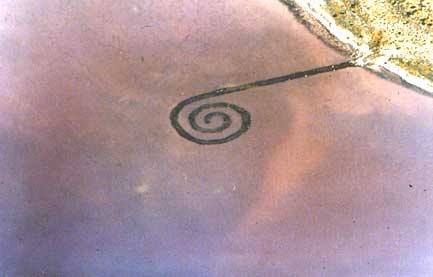
This belongs to a movement known as Earth Works. Artists started rearranging or manipulating or “sculpting” the landscape to produce a work of art. There were a lot of reasons why artists started doing Earth Works. Some liked that you couldn’t really buy it or sell it at auction, you couldn’t put it in a museum, you couldn’t reproduce it as one of a series.
So back to the Spiral Jetty. Smithson made it in 1970, and ever since, it has been there, and then eventually not been there as the water level of the Great Salt Lake has risen and fallen. Of course, it is still there, but there are times when you can’t see that it is. It was for this reason that I never saw the Spiral Jetty even though I lived not far away for quite a while.
Silent Music
As I’ve already admitted elsewhere, I’m not that knowledgeable about music. I know enough to know that I really don’t know enough—um, yeah.
Every now and then, something I come across in the world of music really sticks in my mind, and John Cage’s 1952 piece 4’33” is part of that crowd. For three timed sections, the musician is silent—plays nothing—and then it is over.
So admittedly these things are a bit crazy. What is the point of art that can’t be seen and music that can’t be heard? In the case of 4’33”, there was arguably no music to listen to in the first place. At least the Spiral Jetty was there even if it out of sight for a few years. So, reader, you tell me. Is this sort of thing ok? Is it conceptualism gone too far?
01 November 2005
Smart art Stupid art
I am going to write something today that I know I will regret. If anyone chooses to take issue with my comments here, just please remember that I knew it would happen.
There is a big difference between smart art and stupid art, and a piece of art can be at first smart, and over time become extremely stupid. The reverse is also true. My two examples of the smart/stupid paradox come right out of the art history cannon. Quite by chance, the two images I have chosen were completed in 1917.
Smart art becomes stupid art.
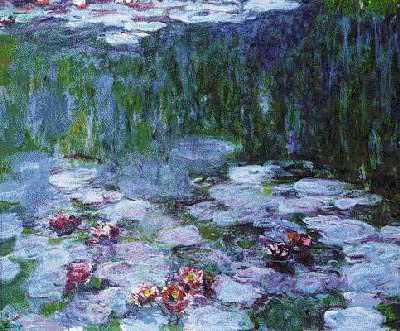
Right, further introduction might not be necessary, but for the record, it's by Claude Monet, one of his many, many waterlilies. Waterlilies (incorrect but consistent spelling) is practically synonymous with Monet, and they are among his most recognizable work. At the time (1917) Impressionism had seen its day and was on the wane. Post Impressionism had come and gone. But Monet was a master, and Expressionism in all its variety owes him something for his very new approach to seeing, depicting, painting. In 1917, Monet was still a bit of a rebel. But that isn't why people like Monet today. They like it because it is pretty. And it is that. Incidentally, I saw one of this genre in the Kunstmuseum Basel back in 1997, and it was far more impressive in real life. I suggest, however, that the artistic value of Monet is found in what is unique about his work, and sadly, pretty isn't unique when we are talking about art. Monet's work offers much more than a pretty face, but you'd never know from the bathrooms you'll find it in.
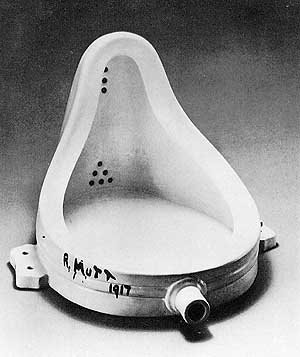
This one needs a bit more introduction, I think. This is a urinal, perpendicular to the wall instead of parallel to it, and relabeled "fountain" by Marcel Duchamp. Duchamp submitted this piece to a juried exhibit that said it would turn nothing away. He wanted to see if they were as good as their word, and they weren't. The piece, though arguably a prank, was not shown. Since that time, the question has become, "Why not?" That attitude still exists in the art world, and has been a driving force behind some of the more innovative things that have happened. But the thing I wish to point out is that Duchamp's idea was juvenile. This was not a deeply analytical work of art, or one that even Duchamp even meant to be art. It was the rejection of it that made it important. What started out very stupid has become smart.
23 October 2005
War art
Art has taken war as subject matter for as long as there has been art (exactly how long that is remains up for debate). Think of the Hellenistic Dying Gaul or Trajan’s Column. War ceased to be central subject matter at about the time artists decided that they didn’t need any subject matter. So there's a chicken-or-the-egg debate for you.
During the 1800s, artists painted dramatic scenes of combat and uprising, spoils of war, victory, defeat, etc. These paintings were sometimes critical, other times supportive of the crisis at hand. Frequently of monumental scale, these works universally convey the importance of the subject matter, the heroism or villainy of the individuals depicted. War was serious, important business, and art knew it.
I do not know if there are such paintings of the first World War. Maybe there are, but if so, I’ve never seen or heard of them. Many artists who personally experienced the horrors of the first world war returned to their easel and brushes with disgust, anger, disillusionment, and trauma. Their images ache with the pain of innocence lost. They didn’t paint the importance of war, but the personal (or impersonal) consequences of it.
However painful the reality of the first World War was, it could not compare with the second. All of Hiroshima and Nagasaki disappear in a blinding flash, millions of European Jews are systematically exterminated, suicide pilots on death missions and so on. How, pray tell, are you going to represent that in the prim art of painting? Picasso painted Guernica, but I don’t know that anyone else even tried. Faced with all that, I think I’d choose non-representationalism too. It is a simpler solution.
17 October 2005
Fashion and art
Is fashion art?
Ok, that is a much bigger question than I deal with in these tiny snippets I publish each day. It demands a clear idea of what art is, a clear idea of what fashion is, and a very clearly delineated comparison of the two. Fashion and art have been compared endlessly in recent decades, and it is not as if the two have nothing in common. But I'm not here to write about what makes them the same. That's only too obvious as evidenced by all the people out there saying how fabulously interconnected they are.
Although there are many differences between fashion and art (and differences too between how the two fields function and evolve), I'll only mention one difference here. Interestingly, this difference may seem too obvious to merit discussion at all. Yet it provides a fundamental incongruity between fashion and art. Fashion, even in its most extreme forms, is designed with the assumption that it will be worn. It operates in tandem with human bodies.
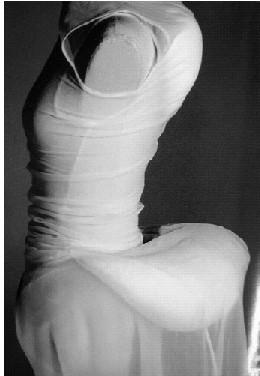
Even the extreme designs of Rei Kawakubo (above, Dress becomes Body becomes Dress, 1997) are created in view of the body as the pre-existing template of creation. The body gives origin (if not a purpose) to fashion. As such, fashion operates within a construct quite foreign to artistic production. Fashion is inextricably attached to the body, a limitation fine art has never had. It is true that both fashion and art are to some extent dependent on a viewer, but fashion remains dependent on both a viewer and a wearer.
Subscribe to:
Posts (Atom)

