skip to main |
skip to sidebar
Élisabeth-Louise Vigée-Le Brun's Marie Antoinette and her children, 1787.

Vigée-Le Brun is yet another french woman that I really wish I had learned more about a long time ago. Unlike some of the other 'forgotten French ladies', it is easy to find information about Vigée-Le Brun. I've linked to a fantastic web-resource where you can view a copy of nearly every painting she ever made. It is nice that, while we know almost nothing about some of the marvelous lady-painters that France produced around the turn of the 19th century, there are others who have had their stories told.
Vigée-Le Brun was (as the image here indicates) a well regarded portrait painter and in the good graces of the French royal family. They and the aristocracy kept her busy until the French Revolution swept them all away. Worried that her connections with them were a bit too tight, Vigée-Le Brun left France for Italy, Russia, and Austria (later she would leave again for Switzerland). One admirer wrote that she "knew and painted the portraits of just about every prominent figure in Europe and Russia from approximately 1770 to 1835." Not bad.
She was a member of artists' acadamies and societies around Europe. First the Académie de Saint Luc in 1774, then Académie Royale de Peinture et de Sculpture in 1783, the Accademia di San Luca in Rome, the Academy of Fine Arts of Saint Petersburg, and later the Swiss Société pour l'Avancement des Beaux-Arts. A cosmopolitan, if there ever was one.
Read more here.
This is Marguerite Gérard's 1804 Bad News

Clearly, the lady in blue has just read a letter bearing bad tidings. Her attentive friend has produced the smelling salts, which a woman surely needs in such times as these. And even the dog, as though to prove that this isn't just some melodramatic act, looks on with great interest.
Gérard (1761-1837) is another one of those French women painters whose legacy resides at the margins of art and art history. Unlike the other French ladies we've seen this month, Gérard's work wouldn't be confused with David's. It would (and has been) confused with the work of Fragonard, her brother-in-law. The two collaborated, influenced the other's work. It is easy enough to find web references that put Gérard forward as Fragonard's very savior, the influence that saved him from his dedication to Rococo even after the style had fallen out of favor.
Many of Gérard's images are much like the one above. Bad News is a scene of women, and I'd guess it is also intended for women. After all, they attended exhibitions too. Like other painters of her day, Gérard's work centers on the world she lived in, and that world consisted of well appointed homes, loving families, and wealthy friends. With so many women painting and patronizing the arts, it is unsurprising that mundane moments of their lives ended up on canvas.
Matthew got back from NY on Saturday night, and with him came a pile of books I'd specially requested. I'm in heaven, partly because new books are a rarity and partly because these particular books are so very interesting. The one I'm reading right now is G. Kurt Piehler's Remembering War the American Way, which is indeed thesis related. In the introduction (I can't understand why I always skipped the preface/introduction when I was younger. Increasingly I find these sections remarkably useful) I found a reference to yet another book, which will doubtless be added to my library some time soon. The title grabbed me at once--Monuments to the Lost Cause: Women, Art, and the Landscape of Southern Memory. Women, it appears, were the ones who organized and advocated for Confederate commemoration. Eager for more information, I googled it, and found a review overflowing in details about the text (enough detail, even that I've decided I probably am ok NOT citing it in my research, which means I don't have to import it, for which my pocketbook is already heaving a sigh of relief). In one particularly useful section, the review catalogued the artists named in the book, who are responsible for many a monument to the 'Lost Cause' (ie. US Civil War). And among them, one woman was named.
 Belle Kinney was born in Nashville, Tennessee in 1890 and later studied at the Art Institute of Chicago. She taught there for a time. Her sculptures, almost all of them in bronze, are scattered around the nation. Here's an incomplete list of her work:
Statue of Jere Baxter, Jere Baxter School Nashville
Monuments to the Women of the Confederacy, Nashville
Monuments to the Women of the Confederacy, Jackson, Mississippi
Statue of Andrew Jackson at the U.S. Capitol
Statue of John Sevier at the U.S. Capitol
Bust of Admiral Albert Gleaves at Annapolis
Bust of Andrew Jackson at the Tennessee State Capitol
Bust of James K. Polk at the Tennessee State Capitol
Bust of Alexander P. Stewart
Statue of Richard Owen in the Indiana State University (pictured here)
The Bronx County (WWI) Memorial
Pediment sculptures of the Nashville Parthenon (based on the original Greek)
She is generally remembered as Tennessee's best sculptor, and for a few decades there, anyone who was anyone in the state's past or present had their likeness rendered by her. She is one among a few women who executed the monuments that the United Daughters of the Confederacy promoted with such tenacity. Somehow, that seems fitting.
We started this ill-fated week with Hannah Höch, Dada Artist, and so I suppose it is fitting that we end it with an ill-fated Dada Muse.
 She's got quite a name: Baroness Elsa von Freytag-Loringhoven. She acquired the title with her 1913 marriage to Leopold Freiherr von Freytag-Loringhoven. I suppose the foregoing description 'Dada Muse' isn't quite enough. She was a dancer, a poet, a model, a farmer. But no matter what she was up to, she did it as a complete exhibitionist, feminist, and artist. The image here is a photo of what she called a "portrait of Marcel Duchamp" in 1920. In perfect Dada style, the portrait is made up of everyday rubbish. Feathers, beads, wire, a champagne glass. Very little of her art survives, but her poetry and some of her letters have. Oh, and descriptions of her clothing, appearance, and antics can be found in the work of any author remotely connected with NY Dada. That's how outlandish she was.
The Baroness was resourceful, bold, and persistent enough to fend for herself. Even though it was certainly humiliating, she took work in a cigarette factory once, selling newspapers on the street on another occasion when the men and the money ran out. She also used her own flamboyance to cultivate as much material advantage as she could. And it worked. Ezra Pound wrote about her in his "Cantos", Frederick Philip Grove wrote a few books based on her life before abandoning her in Kentucy in 1911. She modeled her way to NY where she modeled some more for Man Ray, Marcel Duchamp, and Francis Picabia. Modeling was a means to an end. It kept her close to art, and the money got her closer to being able to afford to actually do art. She eventually returned to Germany in 1923, where her life and finances got particularly bleak. Several friends (women who were all part of the first circle of American feminists and authors) came to her aid and bankrolled her relocation to Paris, where she died in 1927.
Unlike some of the other women we've seen here this month, there is no shortage of information out there about the Baroness. She's an enigma, a fascinating one. And even though 90 years have passed since her outlandish Greenwich Village escapades began, they'd still look like outlandish escapades today. Currency. Just something an artist has got to have.
I can hardly believe that there are only 10 blogging days until the end of March. I've frankly liked my Women's History Month project. It has made my whole formal education look so, well, male-centric, which, let's face it, it was/is. It took this project for me to see that for what it was: incomplete.
One other note before I devote my full attention to the next fantastic woman: my extra verses for Follow the Prophet are on view here, with (what for FMH is indeed) a tiny, bitty discussion. Chime in, if you want.
 When people get bent out of shape about the 'state of art today', their issues generally go directly back to Dada, a movement that was as tied up in pre-WWI angst and post war disillusionment as a movement ever could be. Dada, as we all know from the urinal-legacy of Marcel Duchamp (read more here, and here), engaged in the presentation-as-art of common things, material things, things that were drawn right out of the nitty-gritty of every-day life.
Hannah Höch's collages, made from magazine and newspaper clippings, fit easily into the Dada framework of common things. But while Duchamp's images critiqued the art establishment and its values, Höch and other Berlin-Dada artists were engaged in (often biting) social commentary. Dada was perhaps foremost an effort to expose the hypocrisy of the bourgeoisie. The vulgarity of the masses, along with a sharp criticism of it, emerged in their work again and again.
No one did this better than Höch, in part because she was a woman. The absurdity and vanity of the bourgeoisie, though clearly ripe for a good parody was nothing to the way women were thought of, constructed, limited by the customs of the day. In the image I've selected, Höch has literally constructed (collaged) a woman out of images of her--the way she has been depicted in various times and places. And she's a mutant, a freak. Höch's sense was that her own culture's view of women was no better, and she wanted to show the viewer what she saw.
Höch, unlike so many of the artistic Avant-Garde, stayed in Germany, survived the war, and died there in 1978.
Back on 7 March, I said that I'd returned to my old text books, searching for women. Same story here, but in a different book. Nearly 200 pages into Art in Theory, you'll find Olga Rozanova's 'The Bases of New Creation' from 1913. Here is one of her paintings from the same year.

In 'The Bases of New Creation', she wrote:
A servile repetition of nature's models can never express all her fullness.
It is time, at long last to acknowledge this and to delcare frankly, once and for all, that other ways, other methods of expressing the World are needed.
What is she talking about? A lot of things probably, Abstraction chief among them. Five years earlier, Picasso and Braque had begun their cubist experimentation. But even in 1913, Rozanova's was a bold proclamation. Over the years, she was associated with a number of movements and groups. She is best remembered as a Suprematist, a super-modern artistic revolution in Russian, with among other things, total abstraction as an aim. Rozanova's essay proves her committment to the main ideals of this movement well before it had taken shape. She and one other woman, Kseniya Boguslavskaya, were important enough in this movement to be mentioned by name in their earliest publication (1915) among aritists who "had led the struggle for the freedom of objects from the obligations of art".
Rozanova died in 1918. A picture that she made the year of her death shows nothing but a verticle green stripe. She was 32, and like all artists that die young there is lots of specuation about what she might have done if she had lived longer.
Like Lady Hawarden of yesterday's post, Julia Margaret Cameron was a British woman who got into photography in the medium's early days. She was given a camera in 1863 as a birthday present when she turned 48. 48! Back in the mid-1800s, 48 was OLD. That ought to give hope to anyone out there. It is never, ever too late. I love it.
Anyway, Cameron was well-connected, so well in fact that she had the opportunity to make portraits of some of the notable figures of her day: A. L. Tennyson, Charles Darwin, Edward Burne-Jones, among others. And it is primarily because of these portraits that we have any record of Cameron's work. In 1926, these portraits were published under the title Victorian Photographs of Famous Men and Fair Women by none other than Virginia Woolf. Cameron was her great-aunt. I admit that I was a bit surprised that the title wasn't something like J.M. Cameron's Victorian Photographs of Famous Men and Fair Women. That her name wasn't included leads me to believe that in 1926, she was totally unknown, and therefore it wouldn't have helped the volume sell. Besides, in 1926 photography's status as art was still a matter of debate.

Anyway, many of Cameron's photographs were complete fantasies, Allegorical images as they are called. She posed her family, servants, neighborhood children, even Sri Lanken natives when her husband's employment took them there, and these are the images that I find most engaging. The image above is one of these, an Allegorical portrait of the Madonna and child, with Cameron's maid posed as the Madonna.
The differences between Cameron and Hawarden are slight. They both photographed their children in varyingly fantastic situations, were recognzied for their technical competence and skill, and both were very nearly forgotten entirely. Cameron's work is seen by many as a forerunner to the images Sally Mann made of her children during the late 1980s and early 90s.
wikipedia
science & society picture library
We’re back in Europe for the next installment of Women's History Month artists (artistresses?). Across the channel in Britain, where in 1861, Lady Clementina Hawarden was busy taking pictures of, among other things, the neat things her dog could do.

Most of her surviving photographs are in the V&A in London, where I found this image along with everything else I can report about Hawarden. I love a good, informative page.
Haraden was a respected photographer, and even won silver medals at the Photographic Society of London. Many of her photographs are of her daughters play-acting, posing in costume, or otherwise being theatrical in their home. I think photography gave Hawarden an opportunity to entertain fantasy, realize imaginations, and explore slight variations on reality. Like the dog's precarious perch, the images of her family that I find most engaging are the ones that feature uncommon moments.
Another interesting note: see how the edges of the photograph are missing? Apparently the prints held by the V&A were damaged when someone removed them from an album before the museum acquired them. Of the ripped, cut, cropped corners, the V&A text offered the general observation that, "the state of a print reveals much about a photograph's material history." I like that.
UPDATE: 15/03/07--the image is here!
Just a reminder, in case you missed the post heralding my current project, March is Women's History Month. I'll be posting about women artists all month long. After my post about Louise Nevelson, who is quite famous, I decided to focus on women who aren't so well-known (or at least those who were hitherto totally unknown to me).

So far, there has been a definite focus on France, and I don't know about you but I'm getting wanderlusty. Not that France isn't all that. It really, really is, but there's a world full of women out there and the month is already nearly half over. Today, we're leaving the continent all together and moving far, far east.
Art was every bit as much a man's pursuit in Japan as it was in Europe during the 1600s, the century in which Kiyohara Yukinobu lived. Painting was one among the "Four Accomplishments" that upper-class men cultivated (the other three were music, calligraphy, and the chess-like game go). But Yukinobu's father was a master Kano-school painter, and so she had access to a world that normally would have excluded her.
I've tried off and on for the better part of an hour to upload a good example of her paining, but alas, blogger will not comply. You can find one at the Kyoto National Museum. The link will take you to their search page. Enter Yukinobu's name, and you'll find it. I recommend that you use their picture viewer to magnify the image as much as you can. Her brushwork is amazing.
I have not been able to find much else about her life or work. I can see a trip to the library in my future. Just as soon as good reserach libraries re-enter my world of possibilities.
Ok, ok, ok. I'm sure everyone is just dying for another "Oops! It isn't a David after all" story, so here it is.

A portrait of Antonio Bartolomeo Bruni, 1804.
This time it concerns a woman (big shock) named Césarine Henriette Flore Davin-Mirvault. I've been able to find very few web references, and she is unsurprisingly absent from my library of art books. So, if you feel you can trust Time magazine ca. 1960, here are the facts:
Césarine Henriette Flore Davin-Mirvault was "the daughter of a geographer and the goddaughter of a marquise, presided over small dinner parties that artists and musicians, now long forgotten, loyally attended. She exhibited fairly often, was always listed in catalogues as a pupil of David."
Davin-Mirvault's connection with David is clear enough, so when the Frick Museum bought the portrait of the violinist Antonio Bartolomeo Bruni and it was attributed to David, no one should have been too surprised. That was in 1952, and about a decade later, they settled on Davin-Mirvault--but only after they could prove that she knew the violinist. The article continues:
"For the answer to that, [Dealer Georges] Wildenstein went to the diaries of a certain Mme. Moitte, one of Mme. Davin's cattier friends. On Feb. 3, 1806, Mme. Moitte went to Mme. Davin's for dinner. She reported that the wine was inferior, that the fried cakes were undercooked, and that the candles "reeked of grease." As a final social note, she added that Mme. Davin sang and that Signor Bruni "played the violin."
See the image at the Frick's site.
Yesterday we looked at one case where a Villers was mistaken for a David. Today we have another one to consider. Here's the image in question.

That's the 1799 portrait of Dublin-Tornelle.
And here is a bit about it that I found here:
In 1943, the Fogg Art Museum (Cambridge, Mass.) received this portrait of actor Dublin-Tornelle through a bequest of Harvard alumnus Grenville L. Winthrop. For twenty-eight years as part of the Fogg's permanent collection, the portrait was believed to be a David.
Biggest clue that it wasn't? Scholars estimated that the name 'David' was added to the image 26 years after David died. So, they took a look at the painting under ultraviolet lights. I know very little about this process, but apparently this shows a whole bunch of things, like if the painting was ever restored, over-cleaned, over-painted, varnished, etc. Read more here. Anyway, they looked at the painting under ultraviolet lights and they saw a totally different signature: Adélaïde Labille-Guiard.
Labille-Guiard was an accomplished painter, who painted the portraits of anyone who was anyone in Paris, where she was spent most her life. She was a respected teacher and spent many years teaching others to paint. AND, if that isn't enough, she was an activist. She took part in lobbying the academy to allow women to exhibit, and she was among the first women to do it. If you'd like to read more about her, here are a few links:
wikipedia
ladyreading
getty
Yesterday's post found me asking myself why so few of the paintings Charpentier is known to have made are still with us. Where did they go? Well, today, we have one answer, and tomorrow, another. It concerns this painting:

It is owned by the Metropolitan Museum of Art, and when they acquired it, they attributed it to David. In 1951, their then-director, Charles Sterling, attributed it to Constance-Marie Charpentier. Evidence against Charpentier started to pile up, and finally it was decided that the painting was instead by Marie Denise Villers.
I'm sure no one will be surprised to hear that the painting lost considerable value when it no longer could be attributed to David. David, after all, was a master even in his own time. Is it then any wonder that collectors and dealers, eager to sell a painting with obvious technical merit and stylistic similarity would claim that it was his? It certainly is easier to sell (and for greater returns) with a famous name attached.
For a brief biography of Marie Denise Villers, click here.
Searching for women in my old text book for a 19th c. art class I took as an undergrad, I found Constance-Marie Charpentier. The text doesn't say much about her, other than that she was "one of many women artists who had studied with, among other masters, David". The link above will take you to the second edition, which is 20 years newer than the one I used. I wonder how it might have changed since then.

Melancholy, 1801
The text began by stating that this painting was exhibited at the 1801 Salon and goes on to describe this image in terms of David's painting Oath of the Horatii. The authors chose words like "prototype" and "source" for the relationship of David's image to Charpentier's. But the analysis offered in the text is most successful in cataloging the differences between the works, which leaves me wondering why they presented David as a foundation at all. Among these differences, the text noted Charpentier's drastically altered "emotional ambience", "mood of eternal sorrow", "bittersweet emotion . . . echoed in nature itself", "the weeping willow tree . . . seems virtually to grieve with her", "all the world . . . responds to this unspecified sorrow". And then it moves on to the next David-esque painter.
I've looked for more information about Charpentier, and haven't found much. This is from artnet:
She exhibited at the Salon from 1795 until 1819, when she received a gold medal. Like other female painters of her period, she specialized in sentimental genre scenes and portraits of women and children. Although she was considered by contemporary critics to be one of the finest portrait painters of the age, few works by her have been traced.
I find all of this very interesting. Carpentier doesn't seem like the kind of artist who should have just vanished from the record, or to only have her work spoken of as a derivative of David's. But that has clearly happened. Maybe some day I'll have the chance to do some research and fill the void surrounding her.
Before I write out even one more 'Women's History Month' post, I need to make something perfectly clear. While some (no, most) of my posts are taken right off the top of my head (with a dash of fact-checking), these are not. Well, I check my facts, but they're not spontaneous. Not that I couldn't easily list 3 dozen or more women artists who are just so darn knock-your-socks-right-off cool that they deserve a post all their own, because I could, and maybe in '08 I will do a month all about the women who come to my mind first. Since my interest in art is all tied up in modern/contemporary, the women I know most about tend to be recent, still living artists. But for this month, I'd really love to focus on the ones who did the dirty work 150, or 100 of 50 years ago. I want to know more about the women who set the stage for ones I've come to admire.
I think I can safely say that I never heard the name Berthe Morisot in any art class I have ever taken. Maybe I'd have learned about her if she had been American, or if my education had taken place in France. Art education gets nationalistic like that. Sad, but true. Morisot was French, and quite a good painter of landscapes.
Once Blogger decides to upload images again, I'll add one here.
Ah, here it is:

Like my Gardner post, Morisot is often compared with Cassatt. They date from the same period and were tied up in the same movement, Impressionism. The even shared quite a bit of subject matter. Women and children are prominent subjects in both painters' work, but Morisot tended more to landscape, to the out-of-doors plein-air moments that Monet and other Impressionists likewise chased.
When you flip through most books about art and art history, you will find reference to very few women. Most of the women you will find will be from the second half of the 20th century, and it really is very good that the second half of the 20th century has yielded so many phenomenal women. But lets talk about the 19th century for a little while longer.
Those who have ever been given even a basic overview of the history of art will have heard of Mary Cassatt. She was an American who left for Paris where she really came into her own. Cassat was not the darling of American-lady-painters of the mid 1800s though, that was Elizabeth Jane Gardner. Like Cassat, Gardner left the US for better opportunities (ie. education) in Paris. She was the first American woman to win a gold medal at the Paris Salon in 1872. The newspapers lauded her, the pubic loved her style (which is hard for me and any non-expert to tell apart from Bouguereau--not surprising. He was her instructor and eventually her husband).

Whereas Gardner was perhaps the foremost woman in art during her lifetime, Cassat was virtually unknown. The reverse is now true. Cassatt is well known today because a) the feminists have had so much fun analyzing her images of the spaces of femininity and b) her work was closely aligned with the Impressionists and they were clearly on the trajectory that produced Cezanne, Picasso, and Modernism. Gardner, though wildly successful during her life, wasn't part of the push toward abstraction. And I'm pretty sure a feminist reading of her work would tie itself in knots. Her subject matter was determined by the market--she painted what had been proven to sell well. A few decades later, her work had come to represent everything the avant garde had rejected, the style, the subject matter, all of it.
I was disapointed to find very little about Gardner online. The best resources are actually at the National Museum of Women in the Arts. Anyway, Gardner is worthy of adminration. She set off for Paris to be a big success and she did just that.
I've written elsewhere that I don't have a favorite artist. But if I were to name contenders for the title, Louise Nevelson would be on the list. She died nearly 20 years ago, so I wonder if she still counts as 'recent'. Anyway, she was known for making things like this:

She built these (sometimes massive) collages usually out of scrap wood and whatever a carpenter might have discarded. And, like the one pictured here, the final product was painted all in one color--usually black, but she also used white or the occasional gold. The gold ones look like a kind of schizophrenic altar. Anyway, the first time I saw one of these sculptures in real life was in the art museum in Mannheim. Pictures of her work aren't nearly as much fun to look at as the real thing.
There are lots of completely subjective reasons why I like her work. I like that she went monochrome. I like that she made use of found objects. I like that she put things in boxes, and I find her arrangement of those filled-boxes pleasing. I like that her work challenges what it is to be 'sculpture'.
Sorry to be so self-referential, but I also promised in the very comment thread that inspired yesterday’s musings to tell you all what I think about Jasper John’s White Flag. So, here’s a bit about that.
Most of what I know about Jasper Johns actually is stuff that I came across entirely unintentionally. He was one of Warhol’s contemporaries, and because of that, a lot of books about one mention the other. They were both significant, distinct forces. Anyway, Johns was really young when he became really famous and that somehow seems to have worked out. Warhol, by all accounts was envious of Johns, and his early work reflects that—some flattery-in-the-form-of-imitation, if you will. Johns’ paintings have been sold for more money than those of any other painter alive today. The most expensive one? 80 million. And they say the arts don’t pay.
Anyway, the cool things about White Flag are numerous. Most of these start with the flag itself and all the messages that they bring with them. Move it into the art scene of the mid 1950s, with its cares and concerns and those messages multiply.
Flags. They’re like pictographs, really. Any *real* American can tell you that there are 13 stripes for the 13 colonies that broke away from Britain, 50 stars represent each of the current states. We also have so much associated with this flag—seeing it draped over the coffins of dead soldiers and presidents, flown at half-mast, waved proudly every July 4th, Memorial and Veteran’s Day. We watched it be burned in acts of civil disobedience and International protest. We’ve seen it printed in the kitschiest fashion on t-shirts and coffee mugs. We even have songs about our flag.
So the US flag is a loaded symbol, particularly for Americans but (risking arrogance yet knowing I’m right) for every one else too. Merge that flag with white and suddenly you have all the connotations of surrender. I wonder if he was going for that or if he was instead exploring the design of the flag, maybe in an effort to assert that his painting isn’t a flag at all. It's a painting.
X is a really powerful symbol. To explore some of what an X can do, you can try this exercise: draw a stick man, and instead of using dots for eyes on a stick man, you can give him Xs. And presto! Weather the little stick man is dead, drunk, or beaten unconscious, those Xs means trouble.
Simply put, X is a negation, and this associated meaning is so strong that an artist has to be careful how it is used. Imagine if Gober applied the X to the playpen in a different way:

This use isn’t clever at all, provokes no thought, and communicates something else entirely. To X out a picture of a playpen is very different than to make the pen itself impossible, or inhospitable. What kid would want to be put in Gober’s pen? What kind of adult would think it was a good idea anyway? More than anything else, his playpen seems to be saying “Kids not welcome”. And I think it is great that Gober used the tools of a child’s existence to communicate that message. I like this contrast, because it shows the power of even banal, over-used symbols.
So, does Gober hate kids? I doubt it. To me, Gober’s playpen indicates an environment in which kids ought to have a place, but where they really don’t belong. I think it is a criticism of the politics and society in which many kids find them selves. The world is what we’ve made it, and we’ve made it a place that is generally not suited to children or their needs.
I haven’t been able to stop thinking about images that represent information, as described yesterday. First it was the images of html code, and then it was the discussion around it that jogged my memory of Mark Lombardi, who is probably best described as an independent scholar/artist who committed suicide a few years ago. Anyway, his art is more clearly connected with the present discussion than any other artist I know of.
Here’s a detail from one of his images:
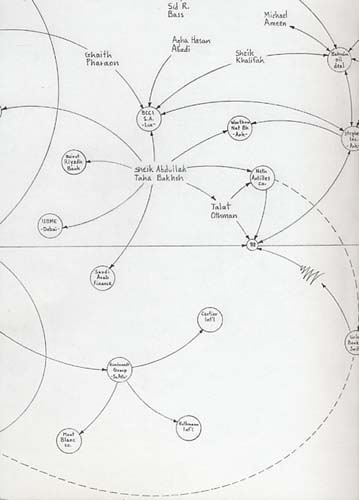
It is called George W. Bush, Harken Energy, and Jackson Stephens, ca. 1979-90 (5th version), 1999.
Lombardi has made a visual representation of the people, events, places, with lines that indicate the transference of money, litigation, sales of property, meetings, etc.
Here’s a statement of his (from this site)about how he creates these webs of information:
Working from syndicated news items and other published accounts, I begin each drawing by compiling large amounts of information about a specific bank, financial group or set of individuals. After a careful review of the literature I then condense the essential points into an assortment of notations and other brief statements of fact, out of which an image begins to emerge.
Like the little applet that transformed (what to me is) html gobbledygook into something I could grasp more readily, Lombardi has similarly reduced a huge amount of data into something much more instantly available. That, it seems, is precisely the point. Lombardi began arranging information into forms like these as a note-taking tool while researching topics for a book he was writing. As these arrangements became more complicated, his interest turned to them as an end in itself.
Vic Muniz is an artist that I hadn’t heard of until recently, but I am very glad I did hear of him. That’s why I’m passing on some information about him. His art is in the category that I’ll define as “really neat”. His work explores different mediums and plays on issues of positive and negative space. Here’s a great example.
 You are looking at an image of a youngster Muniz and his wife met on vacation in St. Kitts. He took pictures of the kids he met there, children whose parents worked on sugar plantations. This girls was among them. Back in New York, Muniz started thinking about the kids and the sugar plantation that was their most likely future. As a tribute to the kids, the back-breaking work their parents had to do to survive, and I suppose, as an acknowledgement of the future that these kids could expect, Muniz made portraits of them. It seems to me that any and each of these reasons are correct readings of these images.
To make the image Muniz put white sugar on black paper and pushed the grains around until the faces of the children he met on vacation emerged. I think the process is inventive. Displaying it was a problem though. Gravity and all that. So, he photographed his sugar-on-paper arrangements. I like that photography allowed him to make these fragile compositions permanent and presentable.


