08 January 2006
Ciao
Impart Art - Daily hasn't exactly been daily ever since the end of November. Sorry and all that, but since that isn't likely to change any time soon, and I have a thesis to complete before the first of April, and a host of other things, you'll have to make due with the archives for now.
Enjoy.

07 January 2006
Sugar Art
Vic Muniz is an artist that I hadn’t heard of until recently, but I am very glad I did hear of him. That’s why I’m passing on some information about him. His art is in the category that I’ll define as “really neat”. His work explores different mediums and plays on issues of positive and negative space. Here’s a great example.
 You are looking at an image of a youngster Muniz and his wife met on vacation in St. Kitts. He took pictures of the kids he met there, children whose parents worked on sugar plantations. This girls was among them. Back in New York, Muniz started thinking about the kids and the sugar plantation that was their most likely future. As a tribute to the kids, the back-breaking work their parents had to do to survive, and I suppose, as an acknowledgement of the future that these kids could expect, Muniz made portraits of them. It seems to me that any and each of these reasons are correct readings of these images.
To make the image Muniz put white sugar on black paper and pushed the grains around until the faces of the children he met on vacation emerged. I think the process is inventive. Displaying it was a problem though. Gravity and all that. So, he photographed his sugar-on-paper arrangements. I like that photography allowed him to make these fragile compositions permanent and presentable.
06 January 2006
Art in my Neighborhood
Knowing about art and not much else really makes the world look like a different place. Take this picture as an example. It's what I see outside my living room windows.

For those of you with nice views of greenery, seaside, forest, mountainous landscape, or other beauteous vistas, you'll probably think this is downright ugly, cityish, crowded, etc. Maybe some of you will think, "Wow. Satellite TV in Beirut". Others of you will wonder if I live in a dangerous part of town what with all the bars on the windows. Still others might be interested in the apparent bullet holes in the building on the left, or the general boringness of the very rectilinear architecture.
Want to know what I see when I look out the window?
I see modern sculpture.

Maybe if an architect or someone with greater understanding of construction technology looked at this they would know what it was for. I, without that specialization, look at it and am pretty sure it is 'useless'. Decorative. Embellishment. Art.
 It actually reminds me of this, a sculpture from the mid-1960s by Donald Judd. He did loads of these in lots of different sizes and colors. I like the repetition of them, the uniformity of the pieces. That a unified whole is made of very separable parts.
Much as I like Judd's sculptures, I find his art theory stifling and aggravating. He was one of those Modern purists, all about forms becoming increasingly streamlined as though that was the true, eternal, uncompromisable destiny of art.
So, although I disagree with why Judd made sculptures like this one, I never the less like the outcome. I like it the way I like certain clothes or junk TV. It looks nice. It looks right. I rather like seeing a "homage to Donald Judd" right outside my window. There are lots of other artists who made art to represent the way they thought art should be made, and sometimes I like their art too. But usually, I don't like their art theory.
05 January 2006
My take: Art and Celebrity
 This is the cover of John A. Walker’s Art and Celebrity, which I really expected to be a worthwhile book. Amazon’s description of the book includes the following:
The uneasy crossover between art and celebrity has been much discussed in recent years. Artists as celebrities is hardly a new phenomenon, but the growing cult of celebrity in contemporary culture is throwing up paradoxical ideas about the contradictions between "high" art and mass appeal and blurring the already unstable boundaries between art, commodity and popular culture.
This is a lively and accessible study of . . . the glitzy world where art and celebrity meet -- informed by a fundamentally serious look at what happens when the "serious" world of art collides with celebrity.
Even as I reread the description, I am struck with the desire to read what they have described, but Walker’s book isn’t that. Instead of a study of the phenomenon and its various incarnations and its problematic implications for artists, art, and the rest of us, Walker’s book is the precursor to such a study. The book contains an introduction, five chapters and a conclusion. Each chapter has a brief setting-of-the-stage and then artists, celebrities, and others are given their own little sub-heading followed by a description of what they did to merit inclusion in Walker’s book. In other words, the book is a series of loosely connected case studies. It lacks cohesive analysis and depth.
Anyway, my take on the book is that it is more fluff than substance, and definitely more celebrity than art.
02 January 2006
Seen in Beirut, finally
I’ve lived in Beirut for over a year, and this last week I went to two easily accessible places that I’d been meaning to get to ever since we arrived. If you’d like an alphabetized and annotated list of why I didn’t manage it I can provide it. I keep a diary. I know exactly what I was doing instead.
1. Goethe Institute. Yes, Beirut has one. No, it hasn’t been closed due to the situation. I spoke German with another German speaker for the first time in over 9 months. Makes a difference, folks. I can feel myself getting happier even though it made me a bit nervous. Because I learned German in school for so many years I still feel like I’m passing or failing with every incorrect article that escapes my lips. Anyway, they have a library, a kindergarten, a playground, and best of all, *real* Germans.
2. National Museum of Beirut. I’m not sure why a national museum is of a city. Shouldn’t it be the National Museum of Lebanon? Despite this conundrum, I had a wonderful time. Can you believe that an old art-fart lime me lived within an easy one mile walk of the place for over a year and didn’t bother to go? I really have nothing but praise for the museum. There were several helpful videos that reminded me of many a thing from my undergrad studies of ancient-through-roman art, and the layout of the exhibit successfully leads the visitor through the phases of Lebanon’s distant past. One of the most interesting things though, was that as you enter the exhibition space you see a photograph of this at the Louvre, an image of the transportation of Lebanon’s cedars. At first I though that the curator must have a chip on his/her shoulder over all the artifacts that Europeans excavated and hauled off. Then I kept reading. It originated in Iraq, not Lebanon, so surely the reproduction was not there as some sort of testimony against the plundering imperialists. Anyway, I don’t think I’ve ever seen a museum exhibit a reproduction of something some other museum has, but the more I thought about it, the more I really liked the idea. I'd love to see an exhibit completely empty except for photos of missing pieces and those little white cards telling where the real thing is. I’d love to see Egypt do an exhibition of all their now-scattered obelisks. It could be like that. Or Greece could do an exhibit of the full Acropolis statuary even though most of the good ones are tucked away in the museums of western Europe. Forget loaning out the originals and touring exhibitions. The exhibit would necessarily take on a different tone and purpose, but I like it.
01 January 2006
When was Art?
Becuase I am an idiot, I have been trying in vain to publish this post since the 29th.
Here’s a little exercise. Think for a short, short moment about your own idea of art; what it has to be/do/not be/not do. Keep it as short as you possibly can. Not a visual artist/art historian? No problem. Think instead about your idea of what freedom or justice means. Got an idea? It will probably do.
So, now think for a moment about art history (or if you had to revert to freedom, just think about history). How far back can you go before your idea of art no longer fits? For example, most people these days are happy to acknowledge photography as valid, canonized, high art. Not so 50 years ago. Another example? Greek vases. Is it only art if it was created to be art? I am sure that when the Greeks were decorating their vases they had no more artistic feeling than do these folks making these things. But don’t tell the Louvre, or the Italians.
Two important scholars form the backbone of what I have to say today. Hans Belting who wrote about image-creating before there was a thing called art, and Arthur Danto, who wrote about the end of art, which he argues took place back in the mid-1960s. It is a bit strange to think of art having started and stopped, but really, art was more like a craft or trade before the Renaissance. I don’t know if it is true that art has ended, but Danto sure makes sense when he argues for it.
Anyway, the purpose of the foregoing exercise is to emphasize that our current notion of many things (art and freedom are merely convenient examples) has very little in common with what our grandparents would say about those subjects. That in turn has little in common with what their own grandparents would say and so on throughout time. These ever evolving definitions are one reason that I have a series devoted to the problematic nature of art history. But it isn’t just an art history or a history problem. It is a problem for all of contemporary society and contemporary art. Art (freedom too) can't be everything to everyone becuase it never has been that.
28 December 2005
Art: Paying for it
Happy Birthday to my Dad.
Patrons are, if anything, essential and indispensable. No matter what the art; good, bad, or ugly, someone has to pay for it. Some people get really bent out of shape about art “selling out”, and I don’t blame them. It is annoying to think that something so crude as money is driving something so noble as art.
So I was paging through another great Christmas present that came my way this week--this book, which has the following advice in it:
. . . Oh ye artists who can spell, speak French, and read Homer, never show your patrons they speak bad French, or read Bad Greek, and spell carelessly, but listen to their French as if it was Racine’s, to their Greek as if old Homer himself were spouting, and read their epistles as if they had orthography, grammar, and common sense. Do this, and you will drink their claret, adorn their rooms, ride their horses, visit their chateaux, and eat their venison. But if, on the contrary, you answer the French not meant for you to understand, rectify their quotations which you are not supposed ever to have heard of, and discuss opinions only put forth for you to bow to, you will not eat their venison, you will not adorn their apartments, you will not ride their horses, you will not drink their claret, or visit their chateaux, at any rate more than once. And, so, artists, be humble and discreet.
So wrote Benjamin Robert Haydon, an “awkward man and an unsuccessful artist”, according to Grove (pg 427-8).
I’ve mentioned Sherrie Levine’s statement before, but today it is relevant for a part I didn’t talk about then. The statement ends with “The birth of the viewer must be at the cost of the painter.”
Is she right about that? I’m inclined to think that she is. The artist/patron relationship is, in every case I can think of, one in which one party bows to the other. Has it ever been otherwise?
27 December 2005
Scott Kim
This year, I got a really interesting book for Christmas that introduced me to the very fun art of Scott Kim. He's great at playing with the way we see and read--a topic I've written about before, and he comes up with the most amazing things as a result. Here's one of my favorites.

24 December 2005
Christmas Eve
December 24th – Christmas Eve. I used to think that Christmas Eve was a real throw away holiday. Then I lived in Germany where Christmas Eve is THE big deal of the season. The German name for Christmas ‘Weihnachten’ literally means Holy Night, which of course, is the night of the 24th.
Criticize it if you will, that’s your right. But I am really happy there is a Christmas to celebrate. I’m glad that one of the biggest days of the year centers on peace and good will. If it doesn’t for you, it ought to and you are missing out on the beauty of it all.
I view of that, I’ve trolled the web for some of the most peaceful art that I know of. The world seems like a better place when I think about it while looking at these, from Josef Albers.


23 December 2005
A recommended book
This little picture is from the book (or pamphlet, or reader, or booklet?) called Communications: The Transfer of Meaning. There are illustrations like the one here throughout the book. It was required reading when I was an undergraduate--part of my my failed attempt to become an artist. So I went out and got an overpriced copy. I'm still glad I did. It is a good little "thinker" book.

I somehow lost it. I don't even know when. Maybe when we moved to Germany? I can't imagine selling it or giving it away. It's only 48 pages. I definately could have moved it.
Anyway, a few months ago when I knew we were having company for the holidays I bought a copy to have brought here from the states. Now that I've got it, I'm super happy, and reliving my introduction to many of the ideas that are still swimming around in my brain. This book is very likely to be featured in future blog posts. Anyway, biographical though it may be, this book is responsible for my own interest in how we see, percieve, internalize etc. the world around us. Once we've done all that, the products we generate are equally worthy of consideration.
22 December 2005
A recommended site
There are, frankly, a lot of very good sites out there for your art fix. I've admitted before that I'm not much of an architecture expert. Actually, I'm not even really knowledgeable. Enter a weekly dose of architecture. Each week there's a new focal point.
I came across the site quite by accident, and I honestly can't remember the chain of art type sites that eventually lead me there. I discovered them last week, when lo forth and behold:

I saw something I recognized. Finally, a picture from the city I live in appears on my site. Beirut isn't the first city that comes to mind when you ask people to list architectural hotspots. Anyway, I have to admit that their analysis made me smile.
21 December 2005
Art History: Problematic situation #5
This is part of an ongoing series.
I’ve addressed some of the extensions of today’s problem in Art History before, but I thought it would be good to bring it back to its roots for a moment. This is a problem for art and anything else that has a history.
Speaking of women and their anonymity in history, Virginia Woolf wrote:
“Nothing remains of it all. All has vanished. No biography or history has a word to say about it.. . . I would as soon have her true history as the hundred and fiftieth life of Napoleon or the seventieth study of Keats and his use of Miltonic inversion . . . ”
That comes from pages 89-90 of her A Room of One’s Own, published in 1929. I’ve tried to find it and I can’t, but I’m sure she challenged her readers to write the history of women. To search out what their lives were like, and add that as a counterpoint to the history we already had.
I think the call has been answered, not thoroughly or perfectly, but at least acknowledged. I distinctly recall Women’s History Month and Black History Month in my elementary school in middle America. I remember that when we learned about the westward expansion of the United States, we learned about the Trail of Tears too. History, for at least two decades then, has ceased to be the domain of the victor telling the story from their point of view, or to reinforce their agenda.
What about art and its history, then? Do we allow art history to be the domain of the strong, famous, most successful, most shocking, most popular, most relevant to the Next-Big-Thing?
20 December 2005
Happy
My sister just arrived. I've got an undercurrent of happiness that is preventing most critical and analytical thought. So, here's a Calvin and Hobbes for you. It is from April 30, 1993. Enjoy.

19 December 2005
Art in the Movies
I’m thinking about art that shows up in Hollywood productions, not the relative merits of these sorts of movies-as-art. That would be an interesting post though.
A fantastic movie full of fantastic art is The Age of Innocence. Someday, I’ll make a list of every famous and not famous painting sitting there understatedly in the background of nearly every shot. It will be a big job, but I would actually enjoy doing it. Maybe it has been done. If so, I want the list so that next time I watch it the experience will even more fantastic than it already is.
There are other movies where the art factor is so blown out of proportion that it becomes irksome and frustrating. For me, What Dreams May Come is one such movie. At first, it was kind of neat that Robin Williams kept flitting from one painting-made-alive into another. It was a creative way to tie his story to his wife’s life. After several repetitions of this theme it began to look not so much like creativity but the lack of it. I found myself wondering which famous painting was going to be plagiarized next, and wishing the art director had paid a little less attention during their art history lectures.
Of course, we can’t forget movies-using-art scandals. James Cameron didn’t have permission to use all of the art that met its demise on the Titanic, and had to settle out of court to avoid being sued.
I’ve also been creating a list in my mind of all the movies I’ve ever seen that involve art-theft. It’s a pretty long list.
If you have a favorite art-filled movie, let me know.
18 December 2005
William Kentridge
I first came across William Kentridge when I was working for these folks as an intern. That, incidentally, was one of the best jobs I have ever had.
Anyway, I was researching the arts situation in South Africa in that capacity, and you don’t have to nose around in that region too long to find Kentridge. He’s a white South African who studied politics and shortly thereafter started doing art-type stuff. Obviously, I guess, much of his work centers on Apartheid and related issues.
I am really interested in his movies, which involve a production process that destroys the illusion regular movies present. They are animations. He draws each frame, and instead of creating a separate picture for the next frame he shoots it, and then erases and redraws on the same paper.
Anyone who has spent much time with an eraser knows how well that works. Little remnants of the previous image remain. It is a cool process that directly addresses impermanence, distortion, and the resurgence of the past. This is mixed with political messages and critiques, the implications of which challenge the assertion that contemporary art lacks relevance. I liked it back then so much that when I was accepted to grad school he was one of my proposed thesis subjects.
Now that I’m half way through a different topic I kind of wish I could go back to Kentridge.
17 December 2005
William Wegman
The Robert Klein Gallery in Boston has an impressive list of artists on their list. Clicking around there, I noticed quite a few big names in photography, as well as some that sort of surprised me.
The first: NASA. In addition to prints from photography's masters, The Robert Klein gallery can get you some pictures from the surface of Mars or shots of the moon that definitely weren't taken on earth.
The second: William Wegman. I don't know why I bother being surprised. He's included in the text book for the Contemporary Art class I took as an undergrad. He photographs dogs in as many ways, settings, costumes, environments that he can conceive. Go check it out. He's sort of the Anne Geddes of dogs.
So that got me thinking. If Wegman can be art, why do I cringe at Geddes? What's so wrong with being cute anyway? What's so wrong with being commercial? What is so wrong with babies? Does making room for ugly art mean there is no room left for charming, pudgy, human and dog babies?
16 December 2005
Viewing art: Originality
From Dictionary.com:
original
1. Preceding all others in time; first.
2. a. Not derived from something else; fresh and unusual: an original play, not an adaptation.
b. Showing a marked departure from previous practice; new: a truly original approach.
3. Productive of new things or new ideas; inventive: an original mind.
It is hard for me to think about contemporary art with out Sherrie Levine's Statement. The whole thing is short enough that I could reproduce it here without making my post longer than usual, but I want to focus on one idea from it. Here's some of the text:
"The world is filled to suffocating. Man has placed his token on every stone. Every word, every image, is leased and mortgaged. We know that a picture is but a space in which a variety of images, none of them original, blend and clash. A picture is a tissue of quotations drawn from the innumerable centers of culture."
I wrote recently about artistic independence, and this post is, I suppose, the other side of that coin. My main point there was that artists refer to, draw on, and borrow from each other and those actions can lead to false conclusions about what an artist (or a non-artist) was or was not doing.
Levine's Statement directs this issue away from artists/viewers and toward the image itself. Images simply are an agglomeration--as she calls it, a tissue of quotations. One thing of value that has come from postmodernism is this realization; that when we speak of originality, we generally are thinking of something much, much smaller than true originality would demand. A representation, any representation, is a re-presentation, a regurgitation of input. Originality of images must operate within this overarching reality, and that means it isn't actually originality.
15 December 2005
Art and Music
Ah music--to artists 150 years ago, music was synonymous with freedom. It was their ticket out of representationalism and into the hitherto unexplored realms of abstraction.
 This James Abbot McNeil Whistler's Symphony in White No. 1: The White Girl from 1861-62.
The title is taken from music, and so is the apparent lack of subject matter. Sure, there's a girl there, but she is white, white dress, white background and forgound, white, white, white. It isn't about her. It's about the color. Whistler would get far more abstract than this, but even his most daring Falling Rocket is only a partial abstraction.
So time goes by and things change. About fifty years after Whistler's image, Wassily Kandinsky took music as the ideal for the visual arts. He theorized and wrote about the confluence of music and color and painting, and started naming his paintings the way musicians name their compositions: improvisation, composition, contrasting sounds, etc. By the time we get to Kandinsky Modernism is in full swing. Cubism has already evolved through its first two phases, and the influence of academic "correct" painting had fallen considerably.
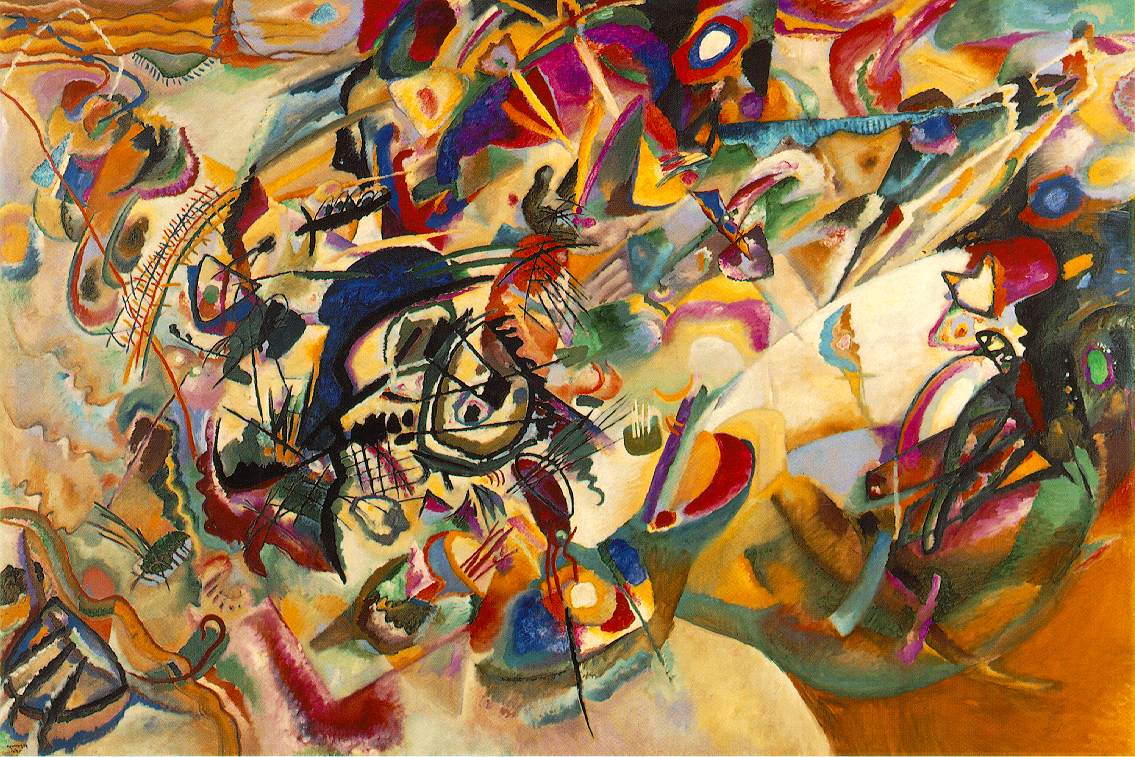 This is one of his 1913 compositions (number seven for those of you who care. And incidentally, the numbering thing also derives from music (think of all the numbered classical compositions out there). Kandinsky was able to take the influence of music further than Whistler ever had. Music is a far more overt inspiration and starting point for these later works.
Once again, time goes by and things change. Another fifty years pass. 100 years after Whistler's Symphony in White, Clement Greenberg wrote:
". . . the unique and proper area of competence of each art coincided with all that was unique to the nature of its medium. The task of self-criticism became to eliminate from the effects of each art any and every effect that might conceivably be borrowed from or by the medium of any other art. Thereby each art would be rendered 'pure' and in its 'purity' find the guarantee of its standards of quality as well as of its independence."
In other words, painting should not try to imitate music, and sculpture should not try to imitate literature, and music and literature should not try to imitate painting or sculpture. This was Greenberg's attempt to put some rules into an art world that, already in 1960, was all wrong.
14 December 2005
Conceptual Art
Conceptual Art really makes a lot of people mad. I think it makes them mad because it actually makes them feel stupid, and people don't like to feel stupid especially when it is an inanimate "dumb" object that makes them feel that way, so instead they get angry.
A bit of history seems called for. Conceptual Art is now a rather old thing as far as contemporary art goes. It has come and gone (I think). By the early 1970s, Conceptual art was already a well developed thing and one the wane.
In 1969, Sol LeWitt wrote 35 'Sentences on Conceptual Art'. Here are some of the highlights:
5. Irrational thoughts should be followed absolutely and logically.
10. Ideas alone can be works of art; they are in a chain of development that may eventually find some form. All ideas nee not be made physical.
13. A work of art may be understood as a conductor for the artist's mind to the viewer’s. But it may never reach the viewer, or it may never leave the artist's mind.
18. One usually understand the art of the past by applying the conventions of the present thus misunderstanding the art of the past.
24. Perception in subjective.
32. Banal ideas cannot be rescued by beautiful execution.
33. It is difficult to bungle a good idea.
35. These sentences comment on art, but are not art.
So conceptual artists did a lot of this kind of thing:

This is Joseph Kosuth's 1966 Titled (Art as Idea as Idea) [Water]. Conceptual Art on its own, isolated from the events that preceded and surrounded it, really does make you shake your head. But I think it makes sense and even seems pretty normal considering what was going on at the time. I think these artists and the industries that allowed them to function were sick of the avant-garde hero demi-god role that artists had been playing. There was a huge disillusionment in that cult and in the ideas of authenticity, originality, progress, and so on. Modernism was failing and with that failure looming, Conceptual Art seems to have been a coping mechanism.
People argue that stuff like this is more than an empty threat to the sanctity of art. They argue that it does actual harm to it. I can't say I agree with that. As I see it Conceptual Art elicits two reactions.
1. People see it, furrow their brow, scratch their head, move on.
2. People see it, hate it, revolt against it, dig their heels in opposite it.
In either case, the viewer walks away from Conceptual works with ideas about art. Either their idea has evolved or it hasn't. I doubt that matters. But whatever their thoughts about art may be, they've got 'em, and conceptual art got them thinking.
13 December 2005
. . . and Government Art
So yesterday I made a case for art and not art rather than good and bad art. I need one more disclaimer on it. There are all these areas where art is used as a descriptor on a specific category of creation: media arts, arts and crafts, folk art, decorative art, etc. My previous post wasn’t intended to castigate or condone any of these art derivations/deviations/divisions. They exist in their own right apart and outside of the art I wrote about yesterday.
And that brings me to Government Art, which is one of those categories outside the scope of art as described yesterday. I’ll just come right out and say that most of what governments make to present themselves to the world stinks. It isn’t art. Government Art is only called that because that’s what they claim it is. Most of the art in this category is an oxymoron like “honest politician”, but there are a few notable exceptions.
We aren’t talking about the exceptions today though. We are talking about the rule.
The first example is from the US Capitol building, which, thank goodness, wasn’t even mentioned in any of the art classes I have ever taken. Nothing from the US Capitol is in any of my art books either. If you click here you’ll find an image of the statuary on the pediment of the Senate entrance. All classically rendered, proportional etc., I can’t really object to the looks of it except to say that it is fairly blah. But look at what is depicted. The following is a statement from the US government’s site about this statuary:
The sculptural pediment over the Senate entrance on the U.S. Capitol's east front is called Progress of Civilization. The center figure is America, who stands with an eagle at her side and the sun at her back. On the right, a woodsman, hunter, Indian chief, Indian mother and child, and Indian grave represent the early days of America. On the left the diversity of human endeavor is suggested by the soldier, the merchant, the two youths, the schoolmaster and child, and the mechanic. Completing this side of the tympanum are sheaves of wheat, symbolic of fertility, and an anchor, symbolic of hope; these elements are in contrast with the grave at the opposite end of the tympanum.
What a load of propaganda. But that’s what Government Art generally is, and luckily, most of it is so devoid of educational value that nobody is taught about it. At least, art students aren’t. I frankly think that the sculpture should be taken down.
On a different, but equally bad note, Bosnia has recently added this to their collection of state art. Government Art (with only a few exceptions) is a travesty.
Subscribe to:
Posts (Atom)


