28 April 2006
Confronting the Lebanese Gaze
Background
A little while ago, I started running. Shortly thereafter I determined that I needed a better way to handle unwanted attention (in the form of comments from passers-by and rather obnoxious staring). My plan was to take some advice from Art History, and confront the gaze.
Implementation
Well, its been almost a week, and I've faithfully been out running and putting the lessons of history into practice. Along the way I have observed who is looking and how they react when they see I am looking.
Lessons Learned
1. Adolescent and young adult males are the ones cat calling. Although Men over 23(? I can never guess ages) sometimes look, they are not the ones who comment.
2. Young men seem to feel most comfortable commenting when they are in the presence of at least one friend. Moral support perhaps?
3. The Lebanese (like most everyone else I've ever met) don't like to be caught staring. In roughly 60% of cases, they look away when they see I'm looking back.
4. The other 40% percent were looking at my face anyway. They tend to maintain eye contact when I look. No doubt they recognize me. I've been there every morning for two weeks now. (Yippee for me! I haven't given up yet!)
Case Studies
1. One morning I ran past two young men who were walking the opposite direction. One called out to me "Good morning Sweetheart! Welcome to Lebanon!". I looked right at him the whole time, expressionless except for an increasingly arched eyebrow. On my return leg I passed these two again. They neither looked nor spoke to me.
2. On another occasion I ran past two young men who were standing around doing nothing (who hangs out at 6 am??). One of them called out in Arabic with that look on his face. I did not overt my gaze, which I could tell by his expression was quite unexpected. I ran on, and noticed a few hundred yards later that the two were following me on a scooter. The same youth called out something else in Arabic before making a U-turn and vanishing.
Results and Evaluation
Yesterday and today, I have not been welcomed to Lebanon. No one has stared in an untoward fashion. I consider my implementation a success, and by extension, have proven the significance of what Manet did over a century ago.

25 April 2006
There are no good writers . . .
. . . only good rewriters. Yeah, yeah.
I'm in the middle of rewriting chapter 1, per my advisor's very apt criticisms. Maybe for the time being, I should quit Imparting Art, and start giving all my devoted readers (both of you) a blow-by-blow account of how amazingly much my thesis makes me wish I could cease existing.
I'll write about Confronting the Lebanese Gaze soon. It sure has been fun.
24 April 2006
A Challenge to Time's March
A few days ago I wrote about the time-as-narrative phenomenon that characterized modernism, and indicated that some artists have taken stabs at throwing off time’s tyranny. Sally Mann’s most recent series, What Remains, provides a good example of this. The series focuses on the aftermath of death, on the connection between the earth and the dead she subsumes.
Death presents an assault on time without any assistance from art. It is among a very few universal human experiences, and as such it connects peoples, times, and cultures that otherwise are irreconcilable. Mann's series includes pictures of bones, decaying bodies, the earth. Although these images are recent (the earliest from sometime during 1999), there is nothing inherently recent-seeming about them. The images are not dated, but if you sift through a good half-dozen of Mann’s interviews, you can figure out roughly when each section of What Remains was created. But why bother? It adds nothing. Finally, Mann made all the images of the series (except for one) with a camera and a process that are over a century old, a revival of technologies that died out a long time ago.
Death itself, Mann’s portrayal of it, and her method for doing so are irritants if you wish to place these images in time. And although the earth’s process for reclaiming the dead is at the heart of this series, not even that process is presented in a meaningful chronology. Her dog’s bones appear first. The dog’s remains are in a far more advanced state of decay than are the human corpses that follow them. These corpses range from initial to late stages of decomposition and after these images the narrative of decay jumps backward again to the moment of death rather than its aftermath. This portion is followed by landscapes taken at a Civil War battlefield, several generations after death and decay touched the soil. The final segment returns us to the present, with contemporary close-up portraits of her (still living) children.
Time’s power is challenged by the anti-chronology of this series, which is also a hindrance to the narrative of decay. There is no progression from early to late stages, future to past, start to stop. As such, a force that would otherwise be a powerful source of insight is abstracted into irrelevance.
22 April 2006
The Lebanese Gaze
For about a week now, I’ve been out running on the Corniche (Beirut’s big boardwalk by the sea) every morning at six. I love it, but I don’t love being gawked at. Every day, I get at least one shouted “Welcome to Lebanon!”, with a few other random, often lame comments, and I turn quite a few male heads. Such behavior irritates me, but my response to it has always been to act as though I am both deaf and blind, under the proverb that “If you don’t play, they all go away.”
This approach bothers me for a few reasons. First, it doesn’t do nearly enough to condemn their behavior. Second, I’m neither deaf nor blind. I can see them staring even if I act like I can’t. As always, art has been through the same thing, and I think it might provide a solution.
Gawking is the real-life expression of the gaze, which is a major issue in art history. At its most basic level, the gaze is the point of view behind any given work of art. Who is looking, and why? That is the gaze. With some subject matters, like 19th century landscapes, the gaze might not be such a big deal. Most of us have at one point or another been awed by, or felt the serene gentleness of nature, and that’s not at all unlike the way these painters gazed at nature.
Depictions of people are another matter, and depictions of naked people go a step further. The issue of who is looking, and why matters quite a lot in these cases, probably because men and women, children and adults look at each other differently. What a man sees in an image of a woman is not necessarily what a woman or a child sees.
Now when you consider that men were the primary producers of art for almost all of its precious history, we have to conceded that it is predominantly the male gaze that we are talking about here. So, when Eduard Manet painted this image, he was addressing a long, long line of gazing men.
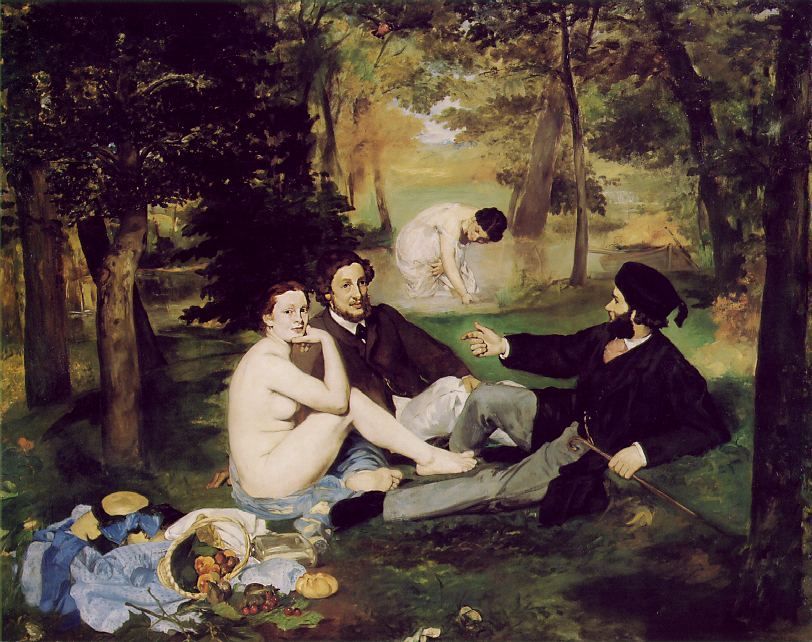
The fact that the nude woman looks back at us and back at Manet puts her in a class of her own. She looks at you as you look at her, and that challenges your ability to simply enjoy looking at her. I think it is high time I started staring back when I run, and I'll do it with about as much unimpressed boredom on my face as is on hers.
21 April 2006
Beirut's Ceramic Lounge
Yesterday, I visited Lebanon’s only Contemporary Ceramics Studio, the appropriately named Ceramic Lounge. It is in the squeaky-clean area of Beirut that promotes itself as an “art village”. Here’s the concept at the lounge. You go, choose a white ceramic thing (they have all kinds of table/kitchen wares, plus boxes, banks, ornaments, coasters, decorative figurines, etc.), choose some colors and start painting. For those who doubt their own creative genius, they have tons of ideas, patterns, things to trace and things to out-right copy. While you work, you can eat. They offer drinks and light snacks. When you finish your meisterwerk, they glaze and fire it for you, ensuring the colors last.

There are a lot of things to praise about the Ceramic Lounge. The staff were helpful both in person and on the telephone (oddly rare in Lebanon, or maybe its just the language barrier striking once again). The atmosphere there is accordingly relaxed, open, and fun. The quality of the finished product is beyond dispute (microwave, dishwasher, everything-safe). Not least of the lounge’s merits is the food. I can, with confidence in my objectivity, state that their cheesecake is THE best I have had in Lebanon. That alone might justify a visit.
Lest you think that I’m just advertising for them (NO web presence?—a cause in itself for demerit) my experience there was not all roses, sunshine, and happiness. The cost of everything in the lounge is unnecessarily high, and prices are poorly explained. One tiny item, a desert and a drink cost over $20, which admittedly precipitated a slight decline in my avid interest in making their art a part of my life.
20 April 2006
Where in Time?
While researching for my thesis, I came across the work of Dirk Reinartz, a German photojournalist who incidentally died in 2004. I had no idea that his work was not that of a young man when I read about him. About a decade ago, Reinartz released a book of landscapes that I think presents some challenges for those who appreciate photography. He took his camera to some of the sites where, during World War II, the Nazis had done their worst. Instead of going to the well worn, oft visited, museum-like locations (think Auschwitz), Reinartz went to unmarked sites. Frankly, I did not know that there are places in Germany, unmarked, where such tragic events took place. But the scale of Hitler’s genocide was such that not every prison camp could be made into a memorial, monument, or museum. German is a small country. Europe is crowded. Some of that land has had to be reclaimed.
Reinartz images of the sites where countless prisoners died bear no mark of the suffering that played out there. There are no pools of blood, no bones or bodies, no fences, no buildings. The complete nothingness within the image poses some real problems when one stops to ask two questions. First, what was Reinartz doing? Was he trying to lay Germany’s past to rest? Was he trying to deemphasize what had happened in those locations by showing the absence of any obvious effects? Or, did he hope to re-introduce these locations into the consciousness of contemporary Germany? Like the rest of the world, Germany is on the brink of losing the final survivors, perpetrators, remembers of those events, and Reinartz may have wanted to attempt to preserve some piece of this legacy, even if that piece shows how much the potency of the events had already been diluted by time. Second, what is the truth about these locations? A forest landscape doesn’t tell the truth about those who were murdered here. Does it further injure the dead to depict the site of their death like this?
Regardless of what Reinartz was up to, his work meddles with time. His photographs of these sites require viewers to relate the present appearance with the reality of what the landscape witnessed in the past. Whether the past is whitewashed by the present, or the present is darkened by its past, Reinartz photographs collapse nearly half a century as past and present collide.
19 April 2006
Narrative and Time
The peak of modernism (1950s) was characterized by abstraction and a general rejection of representation. Artist began naming their work accordingly, with titles that were equally representative of nothing. “Untitled” or “No. 34, 1942” are good examples. You have no idea what an Untitled might look like, and a numbered work isn’t giving away very much either. That, it seems was precisely the point. Lee Krasner described it this way, “Numbers are neutral. They make people look at a picture for what it is—pure painting.”
Krasner was speaking specifically about her husband, Jackson Pollock’s number/year approach to titles. Painting were numbered x from year z, rather than “Pretty Horses Along the Coast of Spain”, or whatever title he might have dreamed up instead. So that’s actually really interesting. Imagine how different our experience of a Pollock might be if he attached words in the form of a title to his images. Wouldn’t you be more likely to look for representations of those words in his web of interlaced drips?
The absence of a title gave Pollock and others in what we might call the “Untitled Crowd” a measure of freedom. If you call a painting even something so esoteric as “Contemplation of Consciousness” any viewer can decide if your image matches the images they might associate with those words.
So, artists had a good reason to chuck wordy titles out with the representational bathwater. It prevented the title from supplying a false or destructive narrative that would invariably dominate or influence the way the picture was viewed. “Untitled” ensured that this kind of narrative stayed out of the picture’s way, but slyly brought in another narrative in its place.
Numbers aren’t nearly as neutral as Krasner and Pollock though. Their paintings aren’t randomly numbered. They adhere to a universal, maybe even oppressive chronology, anchored in time and sequence. Why does this matter? Maybe it didn’t to Pollock. Time and its modifiers; first, last, new, old, before, after, etc. govern these images more than they possibly could have if the absence of a title had not necessarily left us only with time to place them. Time becomes narrative.
Not surprisingly, postmodernism is marked by a rejection of absolutes, time not excluded. I think the ways artists have challenged time’s dominance are fascinating, and each is worthy of its own post.
18 April 2006
Eggs
Since leaving the US for the first time in 1997, I have come to classify events in my life as US-same and US-different. This works for big and little things alike. Bad traffic? US-same. A game of chicken at every intersection both major and minor? US-different. It is simple enough.
Like traffic, eggs are both same and different.
US-same: you can get brown or white, they come in what the US calls medium, large or x-large, you pay money for them, and unlike other things the price is roughly the same.
US-different: eggs come in flats of 30, you can buy as many or as few off the flat as you want, medium, large and x-large eggs are not separated, and there is no cost increase for the larger ones.
I bet it is among the things that make the US a burning hell for off-the-boat Lebanese. Just like everything else in America, eggs are sorted, numbered, standardized, etc. etc. The pervasive order of eggs and everything else must be maddening.
In my refrigerator, a haphazard array of large and small eggs clusters happily in the little tray at the top of the door. Not unlike nearly everything else in my life, the egg situation here makes me think of art.

This is a 1968 sculpture by Louise Bourgeois. Little egg-like forms seem to unveil themselves as we watch. There isn’t much order, regularity, or consistency within this piece. Whatever it is, this sculpture isn’t a minimalist work. It isn’t about repeatability, clean lines, or uniformity. In would never be mistaken for a Donald Judd, Carl Andre, Robert Morris, Sol LeWitt, Tony Smith, or the work of any minimalist sculptor who was active during the same period. You can find something similar in the work of Brancusi or Jean Arp. They were both pretty big fans of egg shapes, but they also were both dead when Bourgeois made her sculpture.
Eggs are a loaded symbol culturally and artistically. At present, I am positioned between the two Easters Lebanon acknowledges, and that combined with the general springiness of the season means that there are eggs everywhere. They symbolize life, rebirth, the future, a new beginning and it isn’t lost on artists.
17 April 2006
Mostly Welcome
Since this blog began in mid-October, 2005, I have spent more time not-blogging than actually blogging. Back when I was diligently, daily, imparting something about art, I really loved it. I had a great time with it. I learned. I had fun. Loved, loved, loved the comments.
In the three months that have passed since I bid blogging farewell, I have grown deeply ambivalent, and the rich, velvety dust on Impart Art Daily has ceased to bother me. At first, I collected little reminders of things I should definitely write about after returning to my blogging fun. Slowly, that impulse faded into the nothingness this post seems to be getting at.
My reason for not-blogging was very good. I had a thesis to complete in a very short time. And I did it too. 79 pages of text that, with images and every thing else that goes into a thesis, will eventually top out at over a hundred pages. It will probably be printed and bound and on my bookshelf before Christmas. My blog even came in handy while I was writing. A tiny little post from December really fit into my work and saved me a ton of “go research it and check out the data” time.
Although my reason for not-blogging has long since come to a rather tidy conclusion, my interest in blogging has yet to recover. And in my absence I found that I’ve forgotten a lot of what I’ve already written. Part of me is terrified of rewriting something you’ve read here before. . . .
Another reason for not-blogging has to do with how I have spent the last several months. Put simply (but hopefully not offensively) Impart Art has always been targeted to those who probably don’t know that much about art. Since that includes just about everyone, I was filling a need, and the rudimentary level of it kept the content (I flatter myself) interesting and accessible. For several months, my energy has been devoted to tasks that are neither rudimentary nor broadly applicable. The degree of specificity of thought and writing required by my thesis made my brain ache in ways that Impart Art never had or could. In short, it has been hard to switch gears, and actually, I haven’t yet succeeded.
So, anyway, that’s all just a really big disclaimer. I welcome myself back to blogging, but in the charming Lebanese way that always makes me laugh. So like me, you too are mostly welcome to Impart Art Daily (usually).
01 April 2006
Update
Hello April!
The thesis, yes. It is still dominating every moment of my life (and my husband's life, and robbing my children of time with their mother). It is still costing me my sanity, my other interests, my ability to socialize or even have fun.
But WAIT!
It is slowly, methodically, achingly getting written.
Looking into the future to the best of my ability, I predict that it will done by the end of the coming week. Then give me another week to pick up the pieces of my life and do some of the things I've not done in ages, and then, maybe, I'll start posting again.
08 January 2006
Ciao
Impart Art - Daily hasn't exactly been daily ever since the end of November. Sorry and all that, but since that isn't likely to change any time soon, and I have a thesis to complete before the first of April, and a host of other things, you'll have to make due with the archives for now.
Enjoy.
07 January 2006
Sugar Art
Vic Muniz is an artist that I hadn’t heard of until recently, but I am very glad I did hear of him. That’s why I’m passing on some information about him. His art is in the category that I’ll define as “really neat”. His work explores different mediums and plays on issues of positive and negative space. Here’s a great example.
 You are looking at an image of a youngster Muniz and his wife met on vacation in St. Kitts. He took pictures of the kids he met there, children whose parents worked on sugar plantations. This girls was among them. Back in New York, Muniz started thinking about the kids and the sugar plantation that was their most likely future. As a tribute to the kids, the back-breaking work their parents had to do to survive, and I suppose, as an acknowledgement of the future that these kids could expect, Muniz made portraits of them. It seems to me that any and each of these reasons are correct readings of these images.
To make the image Muniz put white sugar on black paper and pushed the grains around until the faces of the children he met on vacation emerged. I think the process is inventive. Displaying it was a problem though. Gravity and all that. So, he photographed his sugar-on-paper arrangements. I like that photography allowed him to make these fragile compositions permanent and presentable.
06 January 2006
Art in my Neighborhood
Knowing about art and not much else really makes the world look like a different place. Take this picture as an example. It's what I see outside my living room windows.

For those of you with nice views of greenery, seaside, forest, mountainous landscape, or other beauteous vistas, you'll probably think this is downright ugly, cityish, crowded, etc. Maybe some of you will think, "Wow. Satellite TV in Beirut". Others of you will wonder if I live in a dangerous part of town what with all the bars on the windows. Still others might be interested in the apparent bullet holes in the building on the left, or the general boringness of the very rectilinear architecture.
Want to know what I see when I look out the window?
I see modern sculpture.

Maybe if an architect or someone with greater understanding of construction technology looked at this they would know what it was for. I, without that specialization, look at it and am pretty sure it is 'useless'. Decorative. Embellishment. Art.
 It actually reminds me of this, a sculpture from the mid-1960s by Donald Judd. He did loads of these in lots of different sizes and colors. I like the repetition of them, the uniformity of the pieces. That a unified whole is made of very separable parts.
Much as I like Judd's sculptures, I find his art theory stifling and aggravating. He was one of those Modern purists, all about forms becoming increasingly streamlined as though that was the true, eternal, uncompromisable destiny of art.
So, although I disagree with why Judd made sculptures like this one, I never the less like the outcome. I like it the way I like certain clothes or junk TV. It looks nice. It looks right. I rather like seeing a "homage to Donald Judd" right outside my window. There are lots of other artists who made art to represent the way they thought art should be made, and sometimes I like their art too. But usually, I don't like their art theory.
05 January 2006
My take: Art and Celebrity
 This is the cover of John A. Walker’s Art and Celebrity, which I really expected to be a worthwhile book. Amazon’s description of the book includes the following:
The uneasy crossover between art and celebrity has been much discussed in recent years. Artists as celebrities is hardly a new phenomenon, but the growing cult of celebrity in contemporary culture is throwing up paradoxical ideas about the contradictions between "high" art and mass appeal and blurring the already unstable boundaries between art, commodity and popular culture.
This is a lively and accessible study of . . . the glitzy world where art and celebrity meet -- informed by a fundamentally serious look at what happens when the "serious" world of art collides with celebrity.
Even as I reread the description, I am struck with the desire to read what they have described, but Walker’s book isn’t that. Instead of a study of the phenomenon and its various incarnations and its problematic implications for artists, art, and the rest of us, Walker’s book is the precursor to such a study. The book contains an introduction, five chapters and a conclusion. Each chapter has a brief setting-of-the-stage and then artists, celebrities, and others are given their own little sub-heading followed by a description of what they did to merit inclusion in Walker’s book. In other words, the book is a series of loosely connected case studies. It lacks cohesive analysis and depth.
Anyway, my take on the book is that it is more fluff than substance, and definitely more celebrity than art.
02 January 2006
Seen in Beirut, finally
I’ve lived in Beirut for over a year, and this last week I went to two easily accessible places that I’d been meaning to get to ever since we arrived. If you’d like an alphabetized and annotated list of why I didn’t manage it I can provide it. I keep a diary. I know exactly what I was doing instead.
1. Goethe Institute. Yes, Beirut has one. No, it hasn’t been closed due to the situation. I spoke German with another German speaker for the first time in over 9 months. Makes a difference, folks. I can feel myself getting happier even though it made me a bit nervous. Because I learned German in school for so many years I still feel like I’m passing or failing with every incorrect article that escapes my lips. Anyway, they have a library, a kindergarten, a playground, and best of all, *real* Germans.
2. National Museum of Beirut. I’m not sure why a national museum is of a city. Shouldn’t it be the National Museum of Lebanon? Despite this conundrum, I had a wonderful time. Can you believe that an old art-fart lime me lived within an easy one mile walk of the place for over a year and didn’t bother to go? I really have nothing but praise for the museum. There were several helpful videos that reminded me of many a thing from my undergrad studies of ancient-through-roman art, and the layout of the exhibit successfully leads the visitor through the phases of Lebanon’s distant past. One of the most interesting things though, was that as you enter the exhibition space you see a photograph of this at the Louvre, an image of the transportation of Lebanon’s cedars. At first I though that the curator must have a chip on his/her shoulder over all the artifacts that Europeans excavated and hauled off. Then I kept reading. It originated in Iraq, not Lebanon, so surely the reproduction was not there as some sort of testimony against the plundering imperialists. Anyway, I don’t think I’ve ever seen a museum exhibit a reproduction of something some other museum has, but the more I thought about it, the more I really liked the idea. I'd love to see an exhibit completely empty except for photos of missing pieces and those little white cards telling where the real thing is. I’d love to see Egypt do an exhibition of all their now-scattered obelisks. It could be like that. Or Greece could do an exhibit of the full Acropolis statuary even though most of the good ones are tucked away in the museums of western Europe. Forget loaning out the originals and touring exhibitions. The exhibit would necessarily take on a different tone and purpose, but I like it.
01 January 2006
When was Art?
Becuase I am an idiot, I have been trying in vain to publish this post since the 29th.
Here’s a little exercise. Think for a short, short moment about your own idea of art; what it has to be/do/not be/not do. Keep it as short as you possibly can. Not a visual artist/art historian? No problem. Think instead about your idea of what freedom or justice means. Got an idea? It will probably do.
So, now think for a moment about art history (or if you had to revert to freedom, just think about history). How far back can you go before your idea of art no longer fits? For example, most people these days are happy to acknowledge photography as valid, canonized, high art. Not so 50 years ago. Another example? Greek vases. Is it only art if it was created to be art? I am sure that when the Greeks were decorating their vases they had no more artistic feeling than do these folks making these things. But don’t tell the Louvre, or the Italians.
Two important scholars form the backbone of what I have to say today. Hans Belting who wrote about image-creating before there was a thing called art, and Arthur Danto, who wrote about the end of art, which he argues took place back in the mid-1960s. It is a bit strange to think of art having started and stopped, but really, art was more like a craft or trade before the Renaissance. I don’t know if it is true that art has ended, but Danto sure makes sense when he argues for it.
Anyway, the purpose of the foregoing exercise is to emphasize that our current notion of many things (art and freedom are merely convenient examples) has very little in common with what our grandparents would say about those subjects. That in turn has little in common with what their own grandparents would say and so on throughout time. These ever evolving definitions are one reason that I have a series devoted to the problematic nature of art history. But it isn’t just an art history or a history problem. It is a problem for all of contemporary society and contemporary art. Art (freedom too) can't be everything to everyone becuase it never has been that.
28 December 2005
Art: Paying for it
Happy Birthday to my Dad.
Patrons are, if anything, essential and indispensable. No matter what the art; good, bad, or ugly, someone has to pay for it. Some people get really bent out of shape about art “selling out”, and I don’t blame them. It is annoying to think that something so crude as money is driving something so noble as art.
So I was paging through another great Christmas present that came my way this week--this book, which has the following advice in it:
. . . Oh ye artists who can spell, speak French, and read Homer, never show your patrons they speak bad French, or read Bad Greek, and spell carelessly, but listen to their French as if it was Racine’s, to their Greek as if old Homer himself were spouting, and read their epistles as if they had orthography, grammar, and common sense. Do this, and you will drink their claret, adorn their rooms, ride their horses, visit their chateaux, and eat their venison. But if, on the contrary, you answer the French not meant for you to understand, rectify their quotations which you are not supposed ever to have heard of, and discuss opinions only put forth for you to bow to, you will not eat their venison, you will not adorn their apartments, you will not ride their horses, you will not drink their claret, or visit their chateaux, at any rate more than once. And, so, artists, be humble and discreet.
So wrote Benjamin Robert Haydon, an “awkward man and an unsuccessful artist”, according to Grove (pg 427-8).
I’ve mentioned Sherrie Levine’s statement before, but today it is relevant for a part I didn’t talk about then. The statement ends with “The birth of the viewer must be at the cost of the painter.”
Is she right about that? I’m inclined to think that she is. The artist/patron relationship is, in every case I can think of, one in which one party bows to the other. Has it ever been otherwise?
27 December 2005
Scott Kim
This year, I got a really interesting book for Christmas that introduced me to the very fun art of Scott Kim. He's great at playing with the way we see and read--a topic I've written about before, and he comes up with the most amazing things as a result. Here's one of my favorites.

24 December 2005
Christmas Eve
December 24th – Christmas Eve. I used to think that Christmas Eve was a real throw away holiday. Then I lived in Germany where Christmas Eve is THE big deal of the season. The German name for Christmas ‘Weihnachten’ literally means Holy Night, which of course, is the night of the 24th.
Criticize it if you will, that’s your right. But I am really happy there is a Christmas to celebrate. I’m glad that one of the biggest days of the year centers on peace and good will. If it doesn’t for you, it ought to and you are missing out on the beauty of it all.
I view of that, I’ve trolled the web for some of the most peaceful art that I know of. The world seems like a better place when I think about it while looking at these, from Josef Albers.


23 December 2005
A recommended book
This little picture is from the book (or pamphlet, or reader, or booklet?) called Communications: The Transfer of Meaning. There are illustrations like the one here throughout the book. It was required reading when I was an undergraduate--part of my my failed attempt to become an artist. So I went out and got an overpriced copy. I'm still glad I did. It is a good little "thinker" book.

I somehow lost it. I don't even know when. Maybe when we moved to Germany? I can't imagine selling it or giving it away. It's only 48 pages. I definately could have moved it.
Anyway, a few months ago when I knew we were having company for the holidays I bought a copy to have brought here from the states. Now that I've got it, I'm super happy, and reliving my introduction to many of the ideas that are still swimming around in my brain. This book is very likely to be featured in future blog posts. Anyway, biographical though it may be, this book is responsible for my own interest in how we see, percieve, internalize etc. the world around us. Once we've done all that, the products we generate are equally worthy of consideration.
Subscribe to:
Posts (Atom)
