skip to main |
skip to sidebar
UPDATE: 15/03/07--the image is here!
Just a reminder, in case you missed the post heralding my current project, March is Women's History Month. I'll be posting about women artists all month long. After my post about Louise Nevelson, who is quite famous, I decided to focus on women who aren't so well-known (or at least those who were hitherto totally unknown to me).

So far, there has been a definite focus on France, and I don't know about you but I'm getting wanderlusty. Not that France isn't all that. It really, really is, but there's a world full of women out there and the month is already nearly half over. Today, we're leaving the continent all together and moving far, far east.
Art was every bit as much a man's pursuit in Japan as it was in Europe during the 1600s, the century in which Kiyohara Yukinobu lived. Painting was one among the "Four Accomplishments" that upper-class men cultivated (the other three were music, calligraphy, and the chess-like game go). But Yukinobu's father was a master Kano-school painter, and so she had access to a world that normally would have excluded her.
I've tried off and on for the better part of an hour to upload a good example of her paining, but alas, blogger will not comply. You can find one at the Kyoto National Museum. The link will take you to their search page. Enter Yukinobu's name, and you'll find it. I recommend that you use their picture viewer to magnify the image as much as you can. Her brushwork is amazing.
I have not been able to find much else about her life or work. I can see a trip to the library in my future. Just as soon as good reserach libraries re-enter my world of possibilities.
In rhapsodies of praise for its “inner living quality”, George Rowley wrote of Mu Ch‘i and his Six Persimmons (ink on silk, 13th c.), in his book Principles of Chinese Painting. Here's a scan of the rather poor image in the book:

“Mu Ch‘i can paint six persimmons upon a square foot of silk so that the tensions between them seem to be inexhaustible. Not only is each circle of fruit perfectly adjusted to all the others by the equilibrium of the intervals, but the measure of those intervals is accentuated by the ideographic stems in black ink and strong brush which unmistakably mark the distances and the rising and falling movement within the group. Rightness of interval, furthermore, is bound up with the shapes of the motifs. What nuances arise from the full round curve of one persimmon and the flattened contour of another in relationship to the distance between them!” (pgs. 6 & 59)
Hmm. I actually would like to know what nuances arise, because I’ve missed it.
Rowley’s book was published in 1947, with a second edition in 1959. That goes a long way toward explaining why he used words like “perfect” and “rightness” to describe the composition and placement of the fruit. These words have long since fallen out of favor, at least in the context of formal analysis. Also, note that Rowley failed to describe why these particular persimmons are such a famous example of Chinese painting. Instead of proving the matter, he no more than declares it to be so. We know that he sees inexhaustible nuance in the relational-placement of the fruit and that’s about all.
One of the biggest reasons to be upset by Rowley’s failure to explain the underlying principles of Chinese composition is that most viewers will need to be shown how to recognize ‘perfection’. I doubt many of us intuitively see it or comprehend it. I know I don’t. In my very first art history class I was shown these two quatrefoils, by Ghiberti and Brunelleschi. The high-relief sculptures were these artists’ entry in a competition for the honor of designing the east doors of the baptistery of Florence (around 1400):

Our lecturer asked us to guess which quatrefoil won, and went on to explain that composition had a lot to do with who won and who lost. Can you pick the composition with greatest ‘rightness’? That day in class I chose the wrong one, and honestly this is an exercise that I still have trouble with. Although I have long since learned to recognize western art’s conventional appearances, I still vividly recall when I couldn’t see it at all.
I took a class about the arts associated with Zen and Tao shortly before we moved to Beirut. I was fascinated by the subject matter, delighted by the application of these philosophies/religions to the arts, culture, and even aspects of daily living. The harmony among these seemingly divided pursuits appealed to my sense of universalism. That art, belief, and life are all part of the same big picture is something that I have always felt anyway.
Among the arts that Zen influences is the tea ceremony. There are whole books, some of them ancient, about how to properly prepare, present, and drink tea. They describe in detail the correct proportion and appointment of the room, the manner of the guests, their optimal mode of dress, arrival, and conversation.
Tea continues to be an art in Japan, and a ritual in Britain. It was neither in my childhood home. My mother drank tea only when she was ill, and encouraged all of us to do the same. She drank an infusion called ‘rose-hip’ which still makes me think of head colds and flu bugs. I have no memory of ever taking her up on her offer, but she still swears by it.
Later, when I was an adult and went a-traveling, I discovered that with enough sugar anything tastes great, and a hot cup of anything takes the edge off a cold day. I began experimenting with my favorite drinks and found that flat soda is down right divine hot. Root Beer becomes sassafras tea. Sprite becomes a delicate lemony delight.
I don’t care for sugar as much as I used to, which I guess means I’m getting old. It actually makes my mouth ache. Plus, I never have flat soda around like I did when I was single. The stuff gets consumed before it has a chance to fizzle out. When I went to London last month I had the best cup of peppermint tea that I have ever had. I had it without sugar because there was no sugar on my table. And I admit, I’m hooked. Every morning since I got back to Beirut I’ve had a cup of peppermint tea. A box of individually wrapped bags had been lurking in our cabinet since the beginning of 2005.
Some of you know that I was learning French this summer, and lets just say I’m still an absolute beginner. I can’t even say “I’m learning French” in French. Today that came back to bite me when, at the grocery store I bought green tea with peppermint instead of peppermint all by itself because I didn’t bother to realize that vert means green.
It smells fantastic.
I can not find even one authoritative source that indicates its status within the LDS church’s dietary guidelines. I’ve done all the research I can, and I have come to what I think is a very safe conclusion about it. Does anyone out there have access to anything authoritative about this?
One year ago today, Matthew and I arrived in Beirut. We are older and wiser than we were then, but we still have lessons to learn. One of them reminded me of an art history lecture from my undergrad days. We were talking about composition, and the way the western artist’s sense of it changed when they saw the Japanese way of representing space. Van Gogh’s 1888 Night Cafe is a good example of some of the changes.
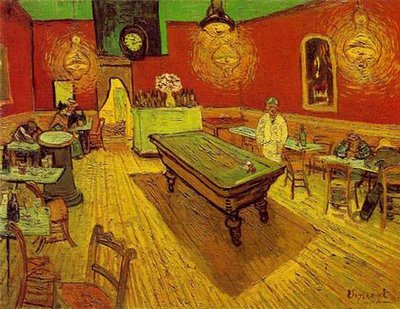
See how the floorboards are raked upward as they recede? That kind of angle was a very new thing in a Europe that still couldn’t quite let go of Renaissance perspective. But perspective wasn’t the only element of composition that changed. Even though the Night Cafe might seem pretty simple, it is actually a very complicated. Lets see if I can show you what I mean. Focus your attention on the bottom right hand corner of the image. Nothing there. Now look at the bottom left corner, which is rather cluttered with chairs and tables going every which way. These chairs are closest to the viewer. The pool table in the center is about as far back as the people sitting on the extreme right. So, how is it that the big empty foreground on the right and the crowded, complicated foreground on the left don’t look lopsided? Shouldn’t it? Shouldn’t it seem awfully unstable? Maybe it should, but for me it doesn’t. Somehow it works. That somehow is at the heart of today’s post.
My guess is that there are definitely people out there who would look at Night Cafe and feel like the picture was totally off kilter. I would further guess that if your most comfortable written language is read from right-to-left, you would have more trouble with this image that I do, being a native left- to-right reader. Here’s a simple overview of how looking goes: I see the cluster of chairs on the left first, and keep “reading” to the right, where there is nothing, and my eye comes to a rest in the middle on the pool table. But what about someone who approaches their visual world from the right, moving to the left? I imagine that they start with the big empty space on the right, and move right over to the left and get stuck in the gaggle of chairs.
To give you left-to-right readers an idea of what I think Night Cafe is like for right-to-left readers, here’s a mirror image of Night Cafe.
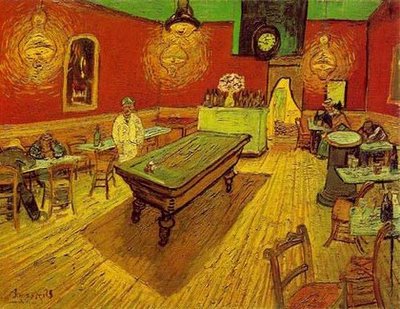
You are now up against the difficulties a right-to-left brain would have. I don’t know about you, but I feel like the reverse image is terribly off balance. Maybe a primarily Arabic, Chinese, or Japanese reader out there can tell me which Night Cafe they prefer.
Happy Halloween, everyone. This really is a great holiday, and the only one that I have really mourned over the last several years. Outside the US, one can scrape together a pretty decent celebration of practically anything else, but abroad, there is no door to door trick-or-treating, not jack-o-lanterns on front porches, nothing. My children have no clue that they ought to be very envious of what awaits every child in America tonight.
When I think of Halloween, the last thing that comes to my mind is Ancient China. But, China has been on my mind anyway, and with today being Halloween, I put the two together. All month the Kennedy Center has sponsored a Festival of China, so I recently dug up my old text books from a class on the arts inspired by Zen and Taoist teachings. In one of them, I found what I think is a perfect poem:
Withered vines, aged trees, twilight crows.
Beneath the little bridge by the cottage the river flows.
On the ancient road and lean horse the west wind blows.
The evening sun westward goes,
As a broken-hearted man stands at heaven’s close.
This is an example Chinese Dramatic verse, a poem by Ma Chih-yuan (1270-1330) created upon the tune of T’ien Ching Sha. The poem has been expertly translated to preserve the rhyme concluding each of the five lines. Lyric poems such as this one are known by the name of the tune they are set to, and are not considered untitled even though they are not given a name beyond that of the tune.
It is noteworthy that the tonal patterns in this poem would have provided much interest in the original language. In line one the tones are exact opposites of what they are in line three, and the second and fifth line are tonally identical. The symmetry and repetition of this pattern, although difficult to convey in English, would never the less have reinforced and given further unity to the message of the poem.*
What is that unified message? Well, the scene is of fall, of sun-set, of old trees and an ancient road. The horse is lean and the man is beaten down. They are in no condition to withstand the wind, and even the crows might be a threat to them. The poem overflows with signs of decay and death. There is something inevitable about the scene. I don't imagine anyone would read it and think, "Oh cheer up broken-hearted man! Tomorrow is another day." The finality of the scene is reinforced by the river continuing its course as well as the unrelenting wind and the progress of the setting sun. The fact that he is broken-hearted seems natural considering the landscape in which he is placed, and his presence gives as much information about the setting as the landscape does about him. Although all that is said of him is that he is broken-hearted, we sense that the surrounding environment tells us much more than this.
And that brings me back to Halloween. The culture I grew up in doesn't typically look death in the face. It prefers obtuse euphemisms to blunt statements of reality. I frankly think we as a culture are terrified of anything we can not control or change, hence the distance we craft between ourselves and that universal human reality. Halloween stands as a potential exception to this--a chance for a little make-believe.
*I owe all the background information about the poem and the translation to James J. Y. Liu's The Art of Chinese Poetry.