05 December 2006

I Miss Bill Watterson


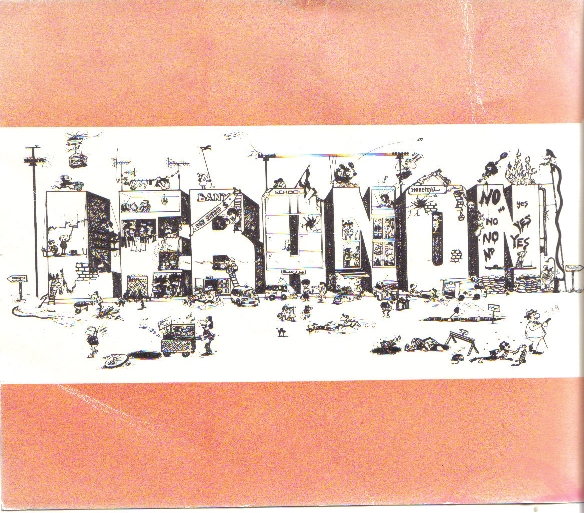
Go ahead, click it, make it big enough to read.
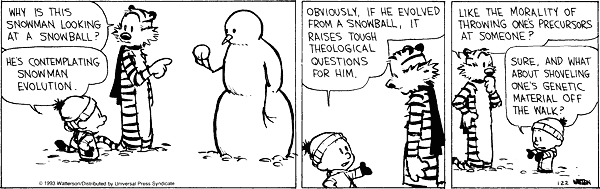

And, because I'm aching to get in trouble for something, here's a speech Watterson gave that I most definately don't have permission to republish. I nevertheless believe that it is among the most worthwhile reading a person could do. I dare you to read it all, and if you can manage it, leave me a comment with your favorite line in it, or if you are a compelte weirdo, your least favorite line.

****

Speech by Bill Watterson
Kenyon College, Gambier Ohio, to the 1990 graduating class.
SOME THOUGHTS ON THE REAL WORLD BY ONE WHO GLIMPSED IT AND FLED
Bill Watterson
Kenyon College Commencement
May 20, 1990

I have a recurring dream about Kenyon. In it, I'm walking to the post office on the way to my first class at the start of the school year. Suddenly it occurs to me that I don't have my schedule memorized, and I'm not sure which classes I'm taking, or where exactly I'm supposed to be going.

As I walk up the steps to the postoffice, I realize I don't have my box key, and in fact, I can't remember what my box number is. I'm certain that everyone I know has written me a letter, but I can't get them. I get more flustered and annoyed by the minute. I head back to Middle Path, racking my brains and asking myself, "How many more years until I graduate? ...Wait, didn't I graduate already?? How old AM I?" Then I wake up.

Experience is food for the brain. And four years at Kenyon is a rich meal. I suppose it should be no surprise that your brains will probably burp up Kenyon for a long time. And I think the reason I keep having the dream is because its central image is a metaphor for a good part of life: that is, not knowing where you're going or what you're doing.

I graduated exactly ten years ago. That doesn't give me a great deal of experience to speak from, but I'm emboldened by the fact that I can't remember a bit of MY commencement, and I trust that in half an hour, you won't remember of yours either.

In the middle of my sophomore year at Kenyon, I decided to paint a copy of Michelangelo's "Creation of Adam" from the Sistine Chapel on the ceiling of my dorm room. By standing on a chair, I could reach the ceiling, and I taped off a section, made a grid, and started to copy the picture from my art history book.

Working with your arm over your head is hard work, so a few of my more ingenious friends rigged up a scaffold for me by stacking two chairs on my bed, and laying the table from the hall lounge across the chairs and over to the top of my closet. By climbing up onto my bed and up the chairs, I could hoist myself onto the table, and lie in relative comfort two feet under my painting. My roommate would then hand up my paints, and I could work for several hours at a stretch.

The picture took me months to do, and in fact, I didn't finish the work until very near the end of the school year. I wasn't much of a painter then, but what the work lacked in color sense and technical flourish, it gained in the incongruity of having a High Renaissance masterpiece in a college dorm that had the unmistakable odor of old beer cans and older laundry.

The painting lent an air of cosmic grandeur to my room, and it seemed to put life into a larger perspective. Those boring, flowery English poets didn't seem quite so important, when right above my head God was transmitting the spark of life to man.

My friends and I liked the finished painting so much in fact, that we decided I should ask permission to do it. As you might expect, the housing director was curious to know why I wanted to paint this elaborate picture on my ceiling a few weeks before school let out. Well, you don't get to be a sophomore at Kenyon without learning how to fabricate ideas you never had, but I guess it was obvious that my idea was being proposed retroactively. It ended up that I was allowed to paint the picture, so long as I painted over it and returned the ceiling to normal at the end of the year. And that's what I did.

Despite the futility of the whole episode, my fondest memories of college are times like these, where things were done out of some inexplicable inner imperative, rather than because the work was demanded. Clearly, I never spent as much time or work on any authorized art project, or any poli sci paper, as I spent on this one act of vandalism.

It's surprising how hard we'll work when the work is done just for ourselves. And with all due respect to John Stuart Mill, maybe utilitarianism is overrated. If I've learned one thing from being a cartoonist, it's how important playing is to creativity and happiness. My job is essentially to come up with 365 ideas a year.

If you ever want to find out just how uninteresting you really are, get a job where the quality and frequency of your thoughts determine your livelihood. I've found that the only way I can keep writing every day, year after year, is to let my mind wander into new territories. To do that, I've had to cultivate a kind of mental playfulness.

We're not really taught how to recreate constructively. We need to do more than find diversions; we need to restore and expand ourselves. Our idea of relaxing is all too often to plop down in front of the television set and let its pandering idiocy liquefy our brains. Shutting off the thought process is not rejuvenating; the mind is like a car battery-it recharges by running.

You may be surprised to find how quickly daily routine and the demands of "just getting by: absorb your waking hours. You may be surprised to find how quickly you start to see your politics and religion become matters of habit rather than thought and inquiry. You may be surprised to find how quickly you start to see your life in terms of other people's expectations rather than issues. You may be surprised to find out how quickly reading a good book sounds like a luxury.

At school, new ideas are thrust at you every day. Out in the world, you'll have to find the inner motivation to search for new ideas on your own. With any luck at all, you'll never need to take an idea and squeeze a punchline out of it, but as bright, creative people, you'll be called upon to generate ideas and solutions all your lives. Letting your mind play is the best way to solve problems.

For me, it's been liberating to put myself in the mind of a fictitious six year-old each day, and rediscover my own curiosity. I've been amazed at how one ideas leads to others if I allow my mind to play and wander. I know a lot about dinosaurs now, and the information has helped me out of quite a few deadlines.

A playful mind is inquisitive, and learning is fun. If you indulge your natural curiosity and retain a sense of fun in new experience, I think you'll find it functions as a sort of shock absorber for the bumpy road ahead.

So, what's it like in the real world? Well, the food is better, but beyond that, I don't recommend it.

I don't look back on my first few years out of school with much affection, and if I could have talked to you six months ago, I'd have encouraged you all to flunk some classes and postpone this moment as long as possible. But now it's too late.

Unfortunately, that was all the advice I really had. When I was sitting where you are, I was one of the lucky few who had a cushy job waiting for me. I'd drawn political cartoons for the Collegian for four years, and the Cincinnati Post had hired me as an editorial cartoonist. All my friends were either dreading the infamous first year of law school, or despondent about their chances of convincing anyone that a history degree had any real application outside of academia.

Boy, was I smug.

As it turned out, my editor instantly regretted his decision to hire me. By the end of the summer, I'd been given notice; by the beginning of winter, I was in an unemployment line; and by the end of my first year away from Kenyon, I was broke and living with my parents again.

You can imagine how upset my dad was when he learned that Kenyon doesn't give refunds.

Watching my career explode on the lauchpad caused some soul searching. I eventually admitted that I didn't have what it takes to be a good political cartoonist, that is, an interest in politics, and I returned to my firs love, comic strips.

For years I got nothing but rejection letters, and I was forced to accept a real job.

A REAL job is a job you hate. I designed car ads and grocery ads in the windowless basement of a convenience store, and I hated every single minute of the 4-1/2 million minutes I worked there. My fellow prisoners at work were basically concerned about how to punch the time clock at the perfect second where they would earn another 20 cents without doing any work for it.

It was incredible: after every break, the entire staff would stand around in the garage where the time clock was, and wait for that last click. And after my used car needed the head gasket replaced twice, I waited in the garage too.

It's funny how at Kenyon, you take for granted that the people around you think about more than the last episode of Dynasty. I guess that's what it means to be in an ivory tower.

Anyway, after a few months at this job, I was starved for some life of the mind that, during my lunch break, I used to read those poli sci books that I'd somehow never quite finished when I was here. Some of those books were actually kind of interesting. It was a rude shock to see just how empty and robotic life can be when you don't care about what you're doing, and the only reason you're there is to pay the bills.
Thoreau said,

"the mass of men lead lives of quiet desperation."

That's one of those dumb cocktail quotations that will strike fear in your heart as you get older. Actually, I was leading a life of loud desperation.

When it seemed I would be writing about "Midnite Madness Sale-abrations" for the rest of my life, a friend used to console me that cream always rises to the top. I used to think, so do people who throw themselves into the sea.

I tell you all this because it's worth recognizing that there is no such thing as an overnight success. You will do well to cultivate the resources in yourself that bring you happiness outside of success or failure. The truth is, most of us discover where we are headed when we arrive. At that time, we turn around and say, yes, this is obviously where I was going all along. It's a good idea to try to enjoy the scenery on the detours, because you'll probably take a few.

I still haven't drawn the strip as long as it took me to get the job. To endure five years of rejection to get a job requires either a faith in oneself that borders on delusion, or a love of the work. I loved the work.

Drawing comic strips for five years without pay drove home the point that the fun of cartooning wasn't in the money; it was in the work. This turned out to be an important realization when my break finally came.

Like many people, I found that what I was chasing wasn't what I caught. I've wanted to be a cartoonist since I was old enough to read cartoons, and I never really thought about cartoons as being a business. It never occurred to me that a comic strip I created would be at the mercy of a bloodsucking corporate parasite called a syndicate, and that I'd be faced with countless ethical decisions masquerading as simple business decisions.

To make a business decision, you don't need much philosophy; all you need is greed, and maybe a little knowledge of how the game works.

As my comic strip became popular, the pressure to capitalize on that popularity increased to the point where I was spending almost as much time screaming at executives as drawing. Cartoon merchandising is a $12 billion dollar a year industry and the syndicate understandably wanted a piece of that pie. But the more I though about what they wanted to do with my creation, the more inconsistent it seemed with the reasons I draw cartoons.

Selling out is usually more a matter of buying in. Sell out, and you're really buying into someone else's system of values, rules and rewards.

The so-called "opportunity" I faced would have meant giving up my individual voice for that of a money-grubbing corporation. It would have meant my purpose in writing was to sell things, not say things. My pride in craft would be sacrificed to the efficiency of mass production and the work of assistants. Authorship would become committee decision. Creativity would become work for pay. Art would turn into commerce. In short, money was supposed to supply all the meaning I'd need.

What the syndicate wanted to do, in other words, was turn my comic strip into everything calculated, empty and robotic that I hated about my old job. They would turn my characters into television hucksters and T-shirt sloganeers and deprive me of characters that actually expressed my own thoughts.

On those terms, I found the offer easy to refuse. Unfortunately, the syndicate also found my refusal easy to refuse, and we've been fighting for over three years now. Such is American business, I guess, where the desire for obscene profit mutes any discussion of conscience.

You will find your own ethical dilemmas in all parts of your lives, both personal and professional. We all have different desires and needs, but if we don't discover what we want from ourselves and what we stand for, we will live passively and unfulfilled. Sooner or later, we are all asked to compromise ourselves and the things we care about. We define ourselves by our actions. With each decision, we tell ourselves and the world who we are. Think about what you want out of this life, and recognize that there are many kinds of success.

Many of you will be going on to law school, business school, medical school, or other graduate work, and you can expect the kind of starting salary that, with luck, will allow you to pay off your own tuition debts within your own lifetime.

But having an enviable career is one thing, and being a happy person is another.

Creating a life that reflects your values and satisfies your soul is a rare achievement. In a culture that relentlessly promotes avarice and excess as the good life, a person happy doing his own work is usually considered an eccentric, if not a subversive. Ambition is only understood if it's to rise to the top of some imaginary ladder of success. Someone who takes an undemanding job because it affords him the time to pursue other interests and activities is considered a flake. A person who abandons a career in order to stay home and raise children is considered not to be living up to his potential-as if a job title and salary are the sole measure of human worth.
You'll be told in a hundred ways, some subtle and some not, to keep climbing, and never be satisfied with where you are, who you are, and what you're doing. There are a million ways to sell yourself out, and I guarantee you'll hear about them.

To invent your own life's meaning is not easy, but it's still allowed, and I think you'll be happier for the trouble.

Reading those turgid philosophers here in these remote stone buildings may not get you a job, but if those books have forced you to ask yourself questions about what makes life truthful, purposeful, meaningful, and redeeming, you have the Swiss Army Knife of mental tools, and it's going to come in handy all the time.

I think you'll find that Kenyon touched a deep part of you. These have been formative years. Chances are, at least one of your roommates has taught you everything ugly about human nature you ever wanted to know.

With luck, you've also had a class that transmitted a spark of insight or interest you'd never had before. Cultivate that interest, and you may find a deeper meaning in your life that feeds your soul and spirit. Your preparation for the real world is not in the answers you've learned, but in the questions you've learned how to ask yourself.

Graduating from Kenyon, I suspect you'll find yourselves quite well prepared indeed.

I wish you all fulfillment and happiness. Congratulations on your achievement.

Bill Watterson

04 December 2006

A Nation Divided Against Itself


In two months and 10 days, Lebanon will certainly commemorate the death of Rafik Hariri, whose assassination marked the beginning of the turmoil that has gripped Lebanon for the past two years. From the beginning, it was assumed that Syria was to blame for Hariri’s death. One month after the assassination, hundreds of thousands of Lebanese descended on Beirut’s central district to express their anger at the Syrian-backed leadership of their country. They called for the immediate withdraw of Syria from Lebanon. With the help of the international community acting through the United Nations, Syrian troops were removed from the country, but their influence lingered. If the UN investigative body is to be believed, Syria’s influence in the country has been evidenced by a steady trail of assassinations spread over the past two years.

Why then, is the current political climate pro-Syrian? Why are there hundreds of thousands of Lebanese demonstrating in favor of the very leadership that was blamed for Hariri’s death? Well, lets not forget the summer’s war. Although the United States was quick to express concern for Lebanon when Syria was seen as the culprit, they turned a blind eye when Israel came knocking. The UN peacekeepers at the boarder did not prevent or intervene in the hostilities. There they were, doing nothing.

So Hezbollah was the closest thing to a defender that the south had. There was every appearance at the beginning that Israel was going to do to Lebanon what it had been doing to Gaza for weeks—strangle, starve, and suffocate. And it didn’t happen. Israel essentially gave up the fight. No wonder Hezbollah has claimed a divine victory. No wonder so many Lebanese see it that way.

But there are many others who don’t. Every day, I see people in number heading downtown to continue the ongoing protests intended to bring down the western-leaning government. And every day, as I walk or drive through the city, I see Lebanese flags hanging from balconies—the sign of those who despite the war are still against Syrian interference.

Recently, the New York Times reviewed an art exhibit here in Lebanon, aimed at identifying what it is to be Lebanese and what their country ought to become. The author observed, “all of the main . . . confessional communities (Christian, Sunni, Shiite, Druse), want a Lebanon united by their definition of what Lebanon should be.” Each sect believes they are the real Lebanon.

The article made some valuable observations on contemporary divisions within the country, and for that it was worth a read. But I’m not sure the art at the center of it would be worth looking at. There were only a few, bad photos of the show and the descriptions given by the author were lifeless.

03 December 2006

Media and the Real


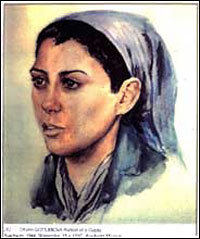
I’ve just listened to an interesting NPR story about a prisoner at Auschwitz who was assigned to paint watercolor portraits of her fellow prisoners because (according to the Nazi commander there) photographs simply weren’t satisfactorily capturing the degenerate qualities of the gypsies.

Here is one such image. It was painted by Dina Gottliebova Babbitt, who is now 83 years old and wants ownership of her work. The Auschwitz museum claims ownership of anything that serves as evidence of the place's history.

NPR’s story wasn’t about the merits of photos vs. paintings, but I can't help thinking about that. I’ve been wondering if artists choose to do what they do. My guess is that it is rarely a case where a person weighed the options and chose one medium over the other. More often than not, people go with the medium they happened to learn before they really thought about being an “artist”, be it drawing, photography, or even the new technology-media. There's usually a predisposition. But here, it was a clear choice, and a completely backward seeming one.

Nobody today, except in closed court rooms, would turn to a painting for evidence. Photographs, which make the most credible appeal to reality of any of art’s expressive forms, were thought “not real enough” in this case. It seems like proof enough to me that what the Nazi’s saw in these lesser races was a projection of their inner horrors. Why else would a subjective art, like painting, be seen as more accurate than a documentary photography?

02 December 2006

Tea Time


I took a class about the arts associated with Zen and Tao shortly before we moved to Beirut. I was fascinated by the subject matter, delighted by the application of these philosophies/religions to the arts, culture, and even aspects of daily living. The harmony among these seemingly divided pursuits appealed to my sense of universalism. That art, belief, and life are all part of the same big picture is something that I have always felt anyway.

Among the arts that Zen influences is the tea ceremony. There are whole books, some of them ancient, about how to properly prepare, present, and drink tea. They describe in detail the correct proportion and appointment of the room, the manner of the guests, their optimal mode of dress, arrival, and conversation.

Tea continues to be an art in Japan, and a ritual in Britain. It was neither in my childhood home. My mother drank tea only when she was ill, and encouraged all of us to do the same. She drank an infusion called ‘rose-hip’ which still makes me think of head colds and flu bugs. I have no memory of ever taking her up on her offer, but she still swears by it.

Later, when I was an adult and went a-traveling, I discovered that with enough sugar anything tastes great, and a hot cup of anything takes the edge off a cold day. I began experimenting with my favorite drinks and found that flat soda is down right divine hot. Root Beer becomes sassafras tea. Sprite becomes a delicate lemony delight.

I don’t care for sugar as much as I used to, which I guess means I’m getting old. It actually makes my mouth ache. Plus, I never have flat soda around like I did when I was single. The stuff gets consumed before it has a chance to fizzle out. When I went to London last month I had the best cup of peppermint tea that I have ever had. I had it without sugar because there was no sugar on my table. And I admit, I’m hooked. Every morning since I got back to Beirut I’ve had a cup of peppermint tea. A box of individually wrapped bags had been lurking in our cabinet since the beginning of 2005.

Some of you know that I was learning French this summer, and lets just say I’m still an absolute beginner. I can’t even say “I’m learning French” in French. Today that came back to bite me when, at the grocery store I bought green tea with peppermint instead of peppermint all by itself because I didn’t bother to realize that vert means green.

It smells fantastic.

I can not find even one authoritative source that indicates its status within the LDS church’s dietary guidelines. I’ve done all the research I can, and I have come to what I think is a very safe conclusion about it. Does anyone out there have access to anything authoritative about this?

01 December 2006

That's pretty good for a . . .


Consider this:

When asked to provide details about his life to a curator, the painter Balthus sent the following telegram in reply: "No biographical details. Begin: Balthus is a painter of whom nothing is known. Now let us look at the pictures. Regards. B." Balthus was rebelling against the modern fondness for viewing an artist's output through the prism of his public image. He worried that once an artist's personal life was known, his work would be seen only as a means of diagnosing the artist's psychological shortcomings and not as an end in itself. (found here)

So, do Vincent's letters to Theo make Starry Night a better picture? Did Warhol's attention-craving-madness make his silkscreenes art? Would it have mattered if Jackson Pollock had instead been Jackie? What if Picasso hadn't been a womanizer?

Pictures rarely, if ever, stand alone. There is always a context, a background, an origin. All too often, a person's lifestyle choices are seen as an integral part of the images they make. But what if everything we (think we) know is wrong? Do we read art one way for a suicide, and another way for death by natural causes? Do we read the art by men one way and women another? What exactly are our foregon conclusions about a life that are transposed onto the image we see?

29 November 2006

24 November 2006

Star & Dandelion


As you all ought to know, I have two charming kids, and to protect the innocent, we'll call the oldest child star and the youngest dandelion. On frequent occasion, my interest in art gets taken out on them. It happened again not long ago. Matthew showed me a link to a neat little webpage where you can make a simulated Pollock "drip painting" just by waving the mouse over the formerly blank canvas--err, screen. Of course, I immediately set the Jr.s down to try it. Neither one is a very good fake Pollock, but both are pretty good additions to Star and Dandelion's art escapades. Can you guess who did which painting?
(readers of character will resist the urge to cheat)

22 November 2006

What I did last night.


It started with these doors that I found at the Metropolitan Museum's website. I repeated the image a few times, and then I started to map some of the geometry. Fun, fun, fun. Really.


I hope you’ve clicked the link to see the original. It is small, and although the design wouldn’t need to infinitely repeat to fill such a small place, it can and as my image shows, it can very well.

I’ve always enjoyed geometry. That was the only class I took in high school where the subject matter (rather than a charismatic teacher) was remotely interesting.

Whoever created this specific pattern did a few things that show a remarkable amount of artistry, or bending of geometry’s rules. The resolution of a square into a circle, of a triangle into a hexagon, the kind of stair-step alignment of the stars, etc. These are not perfect shapes, but shapes that have been slightly pushed and pulled to make the overall pattern work. I am baffled by this kind of art (craft?) because although I can find fun patterns in it, I doubt I could design this or something like it, and there are many variations on this kind of pattern that look quite a bit like this one but are different enough to have required a bit of genius.

21 November 2006

We are Safe


But here's why that's news today.

Here's your art idea for the day:

“a picture of a dead dog shows a dead dog. It only becomes difficult when you want to communicate something beyond that, when the content is too complicated to be depicted with a simple portrayal”
Gerhardt Richter (Harrison and Woods 1037)

20 November 2006

Age-value and Art


Back in early October, I went to an antique dealer in town who I knew sold old pointed-arch window frames. The man selling them wanted $150 for the ones about a meter high, $200 for the larger ones. As is. And they were a mess. They had obviously been left out in the rain, there were chunks missing, no or broken glass, peeling paint, etc. I pointed all that out to the man and offered him $20.

Looking back on it, I think he was probably offended that I, a foreigner, would dare to think that one of the region’s treasures could be worth so little. After all, these are not really being made anymore, apparently came from palaces and their origins, age, and relative rarity adds value. But I disagree. The window frames were in terrible shape. They might as well be garbage or firewood and nobody pays even so much as $20 for a few scraps of wet wood. I still can’t believe that he thought $150 was a possible price. He offered to lower it to $130, but that was his final offer. So I, very satisfied with NOT buying one, went home.

Anyway, I’ve been thinking about age-value and art and wondering what it all means. The assertion that age=art comes down to everything eventually becoming art if you just wait long enough.

In some cases, age does add value. Like Greek vases, hand made lace, etc. Especially when a craft is lost it has a much higher chance of becoming an art. But alas, the carpentry of making a pointed arch is not lost at all, and arguing that an old, decaying window frame is somehow worth more because it is too broken to possibly serve its purpose is crazy.

17 November 2006

A little Agitprop


I found this today and thought of Terra.

16 November 2006

Blog Indeed


So Katie left a comment on my blog that basically said, “you suck at blogging”, which is true. The fact that I haven’t made a post in more than a few months is proof enough of that.

Do you want an art idea anyway? That’s why you’re reading this isn’t it?

“The horror is this . . . to speak of the “nothing to say”. Roland Barthe’s Camera Lucida 92-93.

But for the sake of posting something more, we’ll indulge in a little apologetics—not that it matters or that it has anything to do with art:
1. I’m busy
2. I have to write all the time and I get tired of it.
3. Blame Lebanon
4. I am knee-deep in plans for Christmas because I am an incurable Christmas-freakazoid.
5. My children are more important
6. My thesis is more important.
7. I have to think about art all the time and I get tired of it.
8. Gearing up for the 10k
9. My kids. If everyone had this much huggable cuteness around then no one would blog.

21 July 2006

The First World


For most of my life I have admired the beauty that is there to be found in dirt, in ugliness, in the mundane. I've had a lot of opportunity to appreciate that kind of aesthetic in Beirut, I've seen it in my books about Damascus, and driving from the Jordanian border to Amman led me to believe that Jordan's also got something of a shabby-chic aesthetic. This kind of beaty within the ashes is at times overwhelming, and I find it much more moving than the beauty of cleanness.

I have often wondered why this would be, why I would be so moved by the discovery of visual perfection in the worn out, broken, dirty, grimy patches of life. And now I think I have the answer. Growing up in the US there was a lot of clean. Germany is even worse (better?). When you see something truly falling apart at the seams it is the exception, not the rule. I think my eye was drawn to these hideous exceptions because of their rarity. Beauty of this kind was completely organic, spontaneous, an accident. Clean is never an accident.

As we move west, I'm noticing a lot of clean. Huge, expansive, seemingly unending stretches of super-clean, super-new, super-nice public space. Looking around the Tel Aviv airport I almost feel like I'm watching a movie or having a dream. No garbage. No broken floor tiles. No dirt. Anywhere. Welcome to the First World.

Clean like this, is indeed overwhelming, and to my used-to-the-grime eyes, and even beautiful.

20 July 2006

Tel Aviv

We have tickets for tomorrow evening. Amman to Tel Aviv, Tel Aviv to Atlanta, to Charlotte. All you Ws who can't wait to see us: we will give the girls a chance to settle in a bit and then we will see about a visit to the St. Louis homestead. I'd like to coordinate that with Kathleen's delivery--let me know if you'd rather not have us around until after you return from VA.

Stella and Danielle news: both girls LOVE going under the water in the swimming pool. At first we thought Danielle was being extra careless and falling down too much, and then we noticed that when her head went under the water she got this HUGE grin on her face. So we started letting her go under as much as she wanted (mom/dad assisted dunking). Makes her completely happy. Once Stella saw that, she could not be out done by the baby and decided it was her new favorite game too. She had been very resistant up until that point.

The girls are up, and that means we are off to the pool again.

19 July 2006

Joe


Happy Birthday to my brother! I miss you and I hope to see you soon.

We arrived in Amman very early yesterday, and so we have now had two days here. We are slowly figuring out how to keep the girls well-fed on room service. We have learned that Danielle likes applesauce. So far, they are having a very happy vacation, and have no idea that anything else is going on. Stella even sort of liked the bus ride. We were lucky to be sitting next to a family with children exactly the age of ours, and Stella spent almost the whole drive playing with an Austrian/Albanian boy named Bruno. Like her former play-buddy Zayd, Bruno was a very even-tempered child and that's good because Stella is easily put off by pushy, aggressive kids. We've had a fun time with Bruno and his family ever since, meeting up at the pool etc., but his family is off to Vienna in the morning.

We have obtained permission to travel to Tel Aviv where flights are not so booked as they are here. I'm actually looking forward to that. I can add Israel to a growing list of countries I've traveled through, but never seen.

Thanks to all of you who have commented and mailed me and who are otherwise thinking about us and keeping your fingers crossed. I hope you are all sleeping at least as well as we are these days.

18 July 2006

Flight into the Wilderness


We are in Amman Jordan, in a very lovely hotel. If there ever was a time to stop worrying about our safety, it is now. We will be fine, and very likely, soon in North Carolina.

Our hotel is located at the edge of the Dead Sea. It is about as super luxurious as the one we left.

The drive here was completely awful. We were not informed of our departure plans until 4:15 on Monday morning, at which point we were told to be packed and ready to board busses at 7:30. We were not told our destination or any other details. Travel was safe, but it took us several hours at the boarders (Lebanon/Syria and Syria/Jordan) for every part of the process to leave/arrive.

I now have a lot of new and really great stamps in my passport, but we paid dearly for them. Being stuck in a bus for 24 hours was part of that payment, but the toll all this has taken on the girls is also significant. And about the girls; we were expecting to handle our girls together and we were expecting the journey to take about half that long , but that task fell almost entirely to me. Matthew was asked to manage our entire Bus. He was almost constantly busy (coordinating with security control, communicating with the other busses, gathering and transmitting information about the passengers, desperately trying to get the people to fill out their transit paperwork properly, etc. etc.). He did a great job. And frankly, so did I.

So we got here shortly after seven, I think, and we have a nice room that is sadly without any accomodation for babies or children. We have no idea if we will even stay the night here. When I bought the internet card that is making this post possible, I heard the UN Security people request use of a conference room in our Hotel for today at 4. Maybe there will be news of the next step. But for all we know, they are interested in getting the Staff out of here to their end destinations as soon as possible. It is my understanding that as soon as a flight to the US is available, they will put us on it--whether or not we have gotten any sleep.

I am having a hard time reconciling the very five-star expereince I have had during this blocade/war/evacuation with all the stories I've heard about how these things have played out in the past. I've been inconvenienced and quite a lot, but nothing more extreme. I find myself very worried about our things, books, art, dishes. I wonder if I will ever see my own bed again. Will our things be there when we get back? Will we be robbed again? What if they take my wedding china? Does it even matter? I hate that the thought of losing these things bothers me so much, but it really does.

13 July 2006

Not at all about Art


Its been about 6 hours since the airport was bombed--all three runways are out of service. Part of me is laughing at all the rich Lebanese with foreign passports who always talk about how lucky they are. If anything happens, they say, at least we can get out of here. Not now! Of course, I’m in the same boat they are but I still think its funny (schadenfreude, moi?) to know that we are all underdogs now.

Anyway, someone asked me in early 2003 if I really thought that Iraq posed a threat to the US. Well, back then the whole “Oops, gee, looks like there aren’t any WMDs” had not come out. Not knowing better, I thought maybe Iraq did pose a threat. That doesn’t add up to a pre-emptive war, but I thought there was a trouble brewing that turned out to be a carefully crafted illusion.

Now some words about Israel and the current skirmish they are having with Hezbollah/Lebanon. Lebanon is weak and poor, and Hezbollah exists because Lebanon’s government is too weak and poor to do anything about their existence. Israel has therefore decided not to differentiate between the impotent government that can not control Hezbollah and Hezbollah itself. Hezbollah probably does pose a threat to Lebanon’s government, but the more pressing question is: does Hezbollah pose a credible threat to Israel? Frankly, Israel is not a nice neighbor and their actions really strike me as arrogant, heavy-handed, and unjust. Israel is a rich, powerful, aggressive nation. Hezbollah isn't a nation at all, and barely has the capacity to launch puny little attacks over the southern boarder. They like to show that they can manage that. But that really is where it ends. They can’t take out Israel’s airports. They can’t do anything even remotely on that scale. Not in a million years.

Israel has decided that their best tactic is to come down on Lebanon like a ton of lead. I have to say that bombing the airport was an effective strategy on their part to shut down the Lebanese capital and government, but that in NO way does anything to Hezbollah. Israel’s actions, if anything have weakened the capacity of Lebanon to deal with Hezbollah. By damaging the airport, the infrastructure that supports Arab tourism in and around Beirut, they are damaging the only people who really have a mandate to rein Hezbollah in. Which then begs the question of why Israel is doing what it is doing.

The politics of a rich, powerful nation bullying a weak, poor nation are really on my mind. Should the scale of power, money, strength, etc. matter? Israel is doing this not because it is right, but because they can. Lebanon is a sitting duck, a fantastic whipping boy. Israel likes to spin this as a hard-line approach to terrorism, a zero tolerance policy. But I fail to see how damaging the government and infrastructure of Lebanon makes Israel safer from Hezbollah. Why not restrict the conflict to the forces in the south that started this?

Back to the US, I really wish we (all of us) would stop defending the mess we have gotten ourselves into in Iraq and admit that we would have been much better off securing our ports and boarders. I wish there could be a collective acknowledgement that Iraq has been a profound waste of time, money and lives. I wish that we would accept and agree that the war was ill-conceived. And most of all, I wish that we would have the decency and character to commit never again to engage in a war simply because we are big enough and strong enough to do it.

05 July 2006

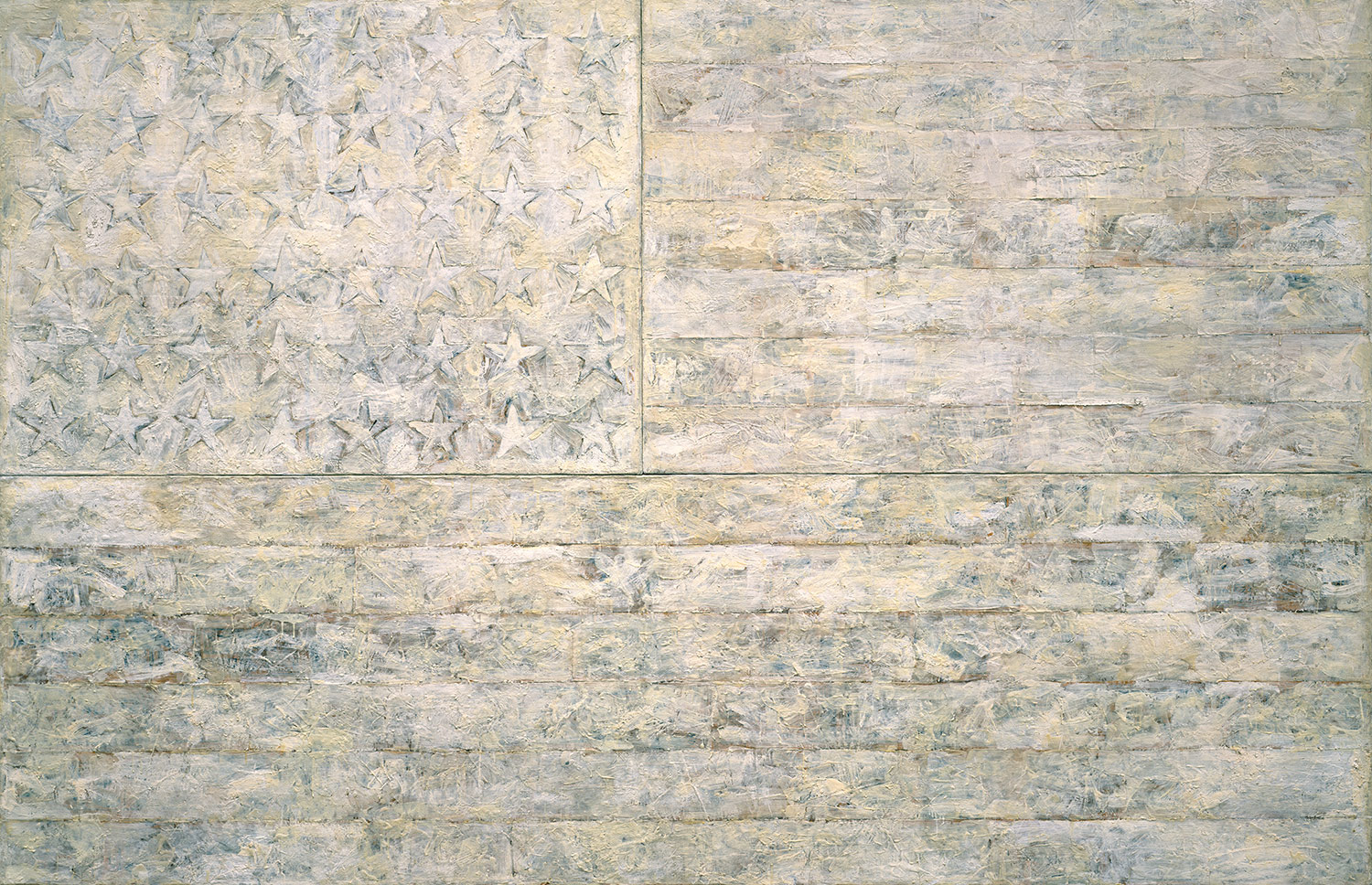
Happy fourth--a day late.


Jasper Johns, White Flag, 1955.

04 July 2006

Progress and Decline


I want to talk about progress and decline as totalizing discourses: as meta-arguments that shape what we see and how we see it.

Progress and decline are among the most seductive totalizing discourses of our era (the ones that have survived despite postmodernism’s critique of such discourses). It is very, very tempting to look at charts, numbers, data-mined this-and-that and come up with a clear chain of events that shows either the waxing or waning of an individual’s health, an economy, a president’s popularity. These days, nearly anything can be represented in numbers, and numbers are the epitome of empirical fact.

Progress and decline might seem just to be patterns that emerge from data. It might seem that they just sort of innocently wave at you, calling out, “Hi! Looks like your company is dying!” And I guess maybe, for some kinds of data gathering, that might be all it is. But we tend to draw conclusions from progress and decline, and we tend to forecast the continuation of these. I remember back when I was a kid and the student demonstrations at Tiananmen Square took place and the Berlin Wall was torn down, everyone said “Communism will soon die out”. Every time the leadership in China shifts and they get a new Chairman there is rampant speculation about the decline of communism in the immediate future. In the west, we believe so strongly in the inevitable decline of communism and our own democratic superiority that we see it happening even where it clearly has not been.

That is the danger of a totalizing discourse. It colors our perception of the present and the future, and it causes us to even recast the past so that what happened lines up with how we anticipate the future will be.

Progress and decline are difficult narratives to thwart, particularly in art. We like to think of art and artists as progressing through phases that are easily categorized and labeled. We like logical transitions, logical building-upons, logical progress. And at the right time, when we are sick of Mannerism, or Baroque, or Rococo, or Neoclassicism, or Academic Painting, or Realism, of Romanticism, or any other style that has given way to another style, we will carefully chart its decline in the face of some other progress.

What I’ve been wondering about lately though is this: Not every culture has such a well developed sense of waxing/waning in art. Chinese painting, for example, emphasized and extolled the same visual qualities (in essence the same style) for centuries. There was no narrative of progress. It was, if a narrative at all, one of continuity. So, does postmodernism mean anything at all to contemporary Chinese artists?

03 July 2006

The Wisdom of Roland Barthes


One day, quite some time ago, I happened on a photograph of Napoleon’s youngest brother, Jerome, taken in 1852. And I realized then, with amazement I have not been able to lessen since: “I am looking at eyes that looked at the Emperor.”
Camera Lucida, 3.

Photography is cool. It always has been. At about this time, 1o years ago, I decided it was time to quit wasting semesters, so I signed up for the classes that would have led me to a degree in photography. It wasn't meant to be, but I still think that art and anything remotely connected to it is more interesting than anything else. Though I'm definitely in the life-long-commitment-to-art camp now, I marvel at how I got here. The experiences I had in those classes nearly a decade ago were so formative that they are still fresh in my mind, and I hope they always will be.

. . . the realists do not take the photograph for a "copy" of reality, but for an emanation of past reality: a magic, not an art.
Camera Lucida, 88.

I think my love of photography comes from being in love with seeing. If I had to choose a sense (only one) to keep, it would be my sight. It has always been that way, even before I signed my life away to the visual arts. Maybe that's why I was never much more than a mediocre musician, and remain to this day insensitive to culinary fineries. Unlike my sisters and mother-in-law, I care more for color/pattern than texture when I buy clothes. Looking simply is a joy, and one that I perhaps too much privilege.

01 July 2006

A picture to share


Lots of very random thoughts, none of which have to do with my thesis or with art or with why I have not been blogging lately. Pooh, pooh.

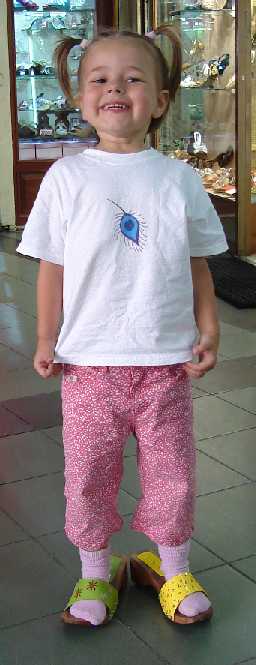
This is my daughter. Isn't she a sweetie? This picture was taken on one of the rare days when she has allowed me to put her hair in pigtails.

Her shirt was made buy Aunt Kat, who is a super-neat Aunt to have. That, on her shirt is a peacock feather. You can read all about how cool it is here on her Aunt's blog.

Also, the other day, there was a discussion on Aunt K8's blog about sock fashions. Compare Star's "up" style with her cousin's.

And I love that the shoes in the picture don't fit, and don't match. We were out shopping and she was trying on display shoes--a favorite passtime.

14 June 2006

What I think of X Playpen


X is a really powerful symbol. To explore some of what an X can do, you can try this exercise: draw a stick man, and instead of using dots for eyes on a stick man, you can give him Xs. And presto! Weather the little stick man is dead, drunk, or beaten unconscious, those Xs means trouble.

Simply put, X is a negation, and this associated meaning is so strong that an artist has to be careful how it is used. Imagine if Gober applied the X to the playpen in a different way:


This use isn’t clever at all, provokes no thought, and communicates something else entirely. To X out a picture of a playpen is very different than to make the pen itself impossible, or inhospitable. What kid would want to be put in Gober’s pen? What kind of adult would think it was a good idea anyway? More than anything else, his playpen seems to be saying “Kids not welcome”. And I think it is great that Gober used the tools of a child’s existence to communicate that message. I like this contrast, because it shows the power of even banal, over-used symbols.

So, does Gober hate kids? I doubt it. To me, Gober’s playpen indicates an environment in which kids ought to have a place, but where they really don’t belong. I think it is a criticism of the politics and society in which many kids find them selves. The world is what we’ve made it, and we’ve made it a place that is generally not suited to children or their needs.

10 June 2006

One to Think About


Robert Gober's X Playpen, 1987.

09 June 2006

Permission


Sally Mann has given me permission to use her images for my thesis. I've requested seven of them, spanning about 15 years. I might end up asking other artists for one or two more (to contrast Mann's corpses with other artists' representations).

My first e-mail from Sally Mann was back in April. I think that was the first time I have ever been truly star-struck. It made me feel the way I image normal 12 year olds felt at New Kids On The Block concerts. I never was a normal 12 year old.

01 June 2006

Thesis Update, Again.


Grrrrrrrr.

I'm editing again.

Maybe I should rename this blog "watch this moron get a M.A.", and I'd be the moron.

That might work.

I now have feedback on the first three chapters (three more to get feedback on), and it was good, fine, ok feedback. I'm taking it.

And I don't have permission yet to use the pictures I want to, and all I can do now is wait.

I feel like my whole cognitive being has been put through a food processor. Or a paper shredder. Or a meat grinder.

31 May 2006

Out of Beirut


Today I read about an exhibition going on in Oxford England. It is called Out of Beirut, and features a number of contemporary Lebanese artists, who all seem to be more or less responding to Lebanon’s civil war. The civil war was a relatively recent event, so recent in fact that it resides squarely in the active memories of everyone except the very young. That reality—-that it is an event too recent to have receded into history—-places it into the domain of memory, the very topic I have been burying myself in for months.

I admit, in a moment of weakness, I thought to myself, “Hey, I’m in Beirut, I’m here in the middle of it. I could become the world’s only expert on Lebanese memory and add that dialogue to those discussing Jewish memory, American memory, German memory etc. etc. And the pain, the suffering, the working-through of it all is so present here, and I’ve got a corner on it.”

Reason set in quickly. First, I don’t speak Lebanese Arabic or any Arabic for that matter. More importantly I don’t want to, and I don’t think I would be able to really investigate Lebanon’s memory without that. But even if I did want to, and could, and would, I still think I wouldn’t.

It reminded me of something I though back when I was an undergraduate in a seminar given by a candidate for a faculty position in the Art History department. She presented an overview of her doctoral dissertation, which was up for several nation-wide awards. Her subject: sculptural depictions of women’s headdresses in ancient Palmyra, Syria. I went to the seminar because it was about modes of dress, the history of which I find completely fascinating. But as I was sitting there listening, all I could think was, “I never want to know so much about so little.”

I am not saying Lebanon’s experience of war, pain, suffering, crimes, atrocities, violence, etc. is in some way inferior, smaller than (even if it was), or less significant that those of cultures that memory scholarship currently focuses on. I have no desire to invalidate the very valid experiences or their memory. That isn’t the issue. The issue is that, in Beirut, it is easy to forget that hardly anyone outside knows or cares.

30 May 2006

Mark Lombardi


I haven’t been able to stop thinking about images that represent information, as described yesterday. First it was the images of html code, and then it was the discussion around it that jogged my memory of Mark Lombardi, who is probably best described as an independent scholar/artist who committed suicide a few years ago. Anyway, his art is more clearly connected with the present discussion than any other artist I know of.

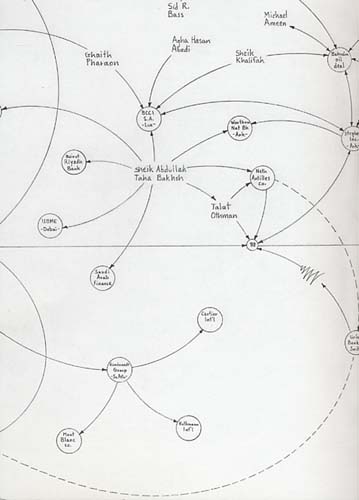
Here’s a detail from one of his images:


It is called George W. Bush, Harken Energy, and Jackson Stephens, ca. 1979-90 (5th version), 1999.

Lombardi has made a visual representation of the people, events, places, with lines that indicate the transference of money, litigation, sales of property, meetings, etc.

Here’s a statement of his (from this site)about how he creates these webs of information:
Working from syndicated news items and other published accounts, I begin each drawing by compiling large amounts of information about a specific bank, financial group or set of individuals. After a careful review of the literature I then condense the essential points into an assortment of notations and other brief statements of fact, out of which an image begins to emerge.

Like the little applet that transformed (what to me is) html gobbledygook into something I could grasp more readily, Lombardi has similarly reduced a huge amount of data into something much more instantly available. That, it seems, is precisely the point. Lombardi began arranging information into forms like these as a note-taking tool while researching topics for a book he was writing. As these arrangements became more complicated, his interest turned to them as an end in itself.

29 May 2006

The art of Impart Art


This is what happens when art historians and computer scientists share a computer.

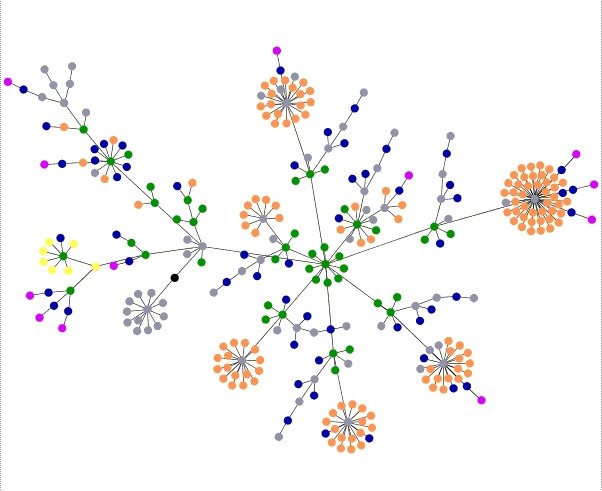
The image I posted yesterday is a graphic representation of the html code that runs the main page of my blog. My husband read about it on one of his techie-news sources, and the page was up on the browser when I got to the computer yesterday. The site linked to a page that contained similar representations of other sites, and a legend so that you know what the colors mean. It also included a link to a java applet that I ran to create the image of my site, and it can make one of your favorite page too. Here’s a link to try it out, and I recommend that you do. It is oddly beautiful to watch.

There are some web pages out there that generate orderly, systematic constellations, and the beauty of these impressed me in two ways. First, I know nothing about programming, but my husband has often complained about “messy” code; which is to say superfluous, inefficient, improper code that waddles toward its destination. This graphic exposes the structure of a site, and by displaying it in this way, even I can tell (roughly) how a site is doing what it is doing. And I like the symbolic representation—colors for kinds of data. It has translated html, which I simply don’t get, into something I do get—the image. Of all the other things art ought to do, this is among them. Taking something otherwise incomprehensible and bringing it within reach of a viewer or an audience is one of art’s least dispensable qualities.

25 May 2006

Art History: Problematic situation #6


This is part of an ongoing series discussing Art History's issues.

It has been ages since I wrote about Art history's problems. Some of my posts have been relevant, but its time to really speak to the point.

Art is (and as far as I can tell) and has always been self-referential. Among other things, art quotes art. When I wrote about identity, I commented on the long tradition in art of eye-candy-cuties. The Bouguereau I used as an example echoes so many others like it--maybe it even references predecessors. I don't actually know.

But I do know that artists continue to rummage through the past for ideas, and sometimes they even simulate the past. The thing is, though, that the past was the present at one time. The ruins of ancient civilizations weren't ruins when they were new. Sure, that's obvious. But often, what artists pick up is not the original "new" look of the art of the past. Rather, they copy the aged appearance that the thing has in the present.

This is Auguste Rodin's 1900 sculpture called Walking Man. Put simply, it is without arms and head because lots of sculptural antiquities are missing a limb here or there. Not that they were originally made without arms, heads, or both feet. They were. But the way we see them today, more often than not, something is missing.

Rodin's work was a century ago, but there is still at least some hearkening to the look of age, even in a new work of art. I think Sally Mann's antique camera and process fall into this category. Some of her more recent images from Deep South and What Remains look like they have barely survived from a much earlier period. In this case, new looks really old, referencing things that look old only because they are old.


24 May 2006

Idyllic Domesticity


that above is
Jeff Wall’s 1978 Destroyed Room.

If you look closely at the image (it’s small, I know.) you’ll see high heels, ladies under-things, etc. This is the destroyed room of a woman. Does that matter? For a lot of reasons, I’ve been thinking about femininity and its unrelenting equatedness with domesticity, as though cleanliness is a prerequisite to true womanhood. Maybe that’s why when I see the Destroyed Room my knee-jerk reaction is imagine the room’s owner has a boyfriend, and to blame said boyfriend for the havoc doubtless generated by some kind of jealous rage. The heels indicate the woman, and the destruction indicates the man.

How sexist. Especially in view of what was happening in the 1970s and what life is actually like now, I’m really shocked by my own gender bias that this reveals.

23 May 2006

Guerrilla Girls


I wrote a little while ago about feminism and art, and sort of wondered what the whole thing was for.

And although I would like to believe that gender discrimination plays virtually no role in contemporary (western) society, I’d be fooling myself to do so. I’ve been good at fooling myself over the years. What can I say? I’m gullible. The faith-in-humanity side of me has a huge tendency toward denial, particularly the denial of any real injustice, unkindness, inhumanity. I have, for as long as I can remember, been good at finding other explanations that have allowed the general goodness of mankind to remain intact.

I don’t buy it anymore. In saying that the current status of men and women is not just, two questions immediately surface.
1. Whose fault is it?
2. If this isn’t just, what would be?

Both are tough questions. The first is an important one, because whenever someone says “Feminism”, somewhere a man gets defensive. But more importantly, there are women who are doing feminism no favor through their actions. Women are part of the problem, either by contributing extremist viewpoints that fuel contention or for defending the status quo on some kind of moral ground. For the most part in contemporary (western) society, women are limited by their own view of themselves more than by an outside, repressive authority. We waste time and money on things we believe we want or even need to be “feminine” without questioning that standard or the reason we seek to fulfill it.

The second question is more elusive, and I have no idea how to articulate an answer for it.

These questions also relate directly to art and industry that surrounds it. Why is art still dominated by white men? If white men aren’t actually superior artists (and come on folks), what is wrong with the system? Why are they still the profound majority?

Guerrilla Girls is the art world’s very own feminist activist group. They grapple with these and many other issues all the time. I’m not sure I’m with them because their tone is more aggressive than I deal well with. But there’s an interesting interview on their site anyway, focusing on who they are and why they do what they do.

22 May 2006

Four kinds of Memory/Art


For those of you who would like some clarification on my last post, I’ve made an attempt here to discuss ways that memory and art overlap. The reason this is significant, is that our evolving notion of history influences our notion of art and art history. As memory gains significance in the formations of history, it will, I think, carry over into art, and contribute to our ideas about images and image making.

Memory in Art 1.
Images from memory
Drawing something from memory is a lot different than having it in your studio, or on your table, pinned to your bulletin board, or in your backyard. Memory isn’t really the best tool for recording the details of a thing, a vista, or an event, but all the same, there are a lot of realistic-looking, though probably imperfect images out there that were painted from memory.

Memory in Art 2.
Images of memory
Here’s where it gets a bit strange. Before I wrote that memory is its own medium quite apart from any other medium (language, art, etc.). Memory can include smells, sensations, moods, and each of these can be hard to put into a hunk of marble or communicate through oils on canvas. Dali’s Persistence of Memory is a great example, and so is I see again in Memory my Dear Udnie by Francis Picabia, 1913 (pictured at left). Dali and Picabia’s abstracted, fanciful images assert the very great difference between how it feels to experience memory and how it feels to look at images. I imagine that Picabia was trying to express what his memory of Dear Udnie felt like. I think he hoped that his composition would communicate that better than something more literal. Images of memory tend to embrace abstractions, ambiguities, and expressiveness that other forms of modernism rejected as simply too personal, too self-ingratiating, too much like subject matter.

Memory in Art 3.
Image as memory—memorial
Religion and Government have given the world a lot of memorial images. Think of the huge epic paintings of the French Revolution, copious images of Chairman Mao, the gigantic Lincoln memorial, all the Buddhas I’ve ever seen, and the scores of European museums filled with innumerable Christian images. These straddle the categories of art and memorial, made to do both. Of course, some images are made as one and do the other too.

Memory in Art 4.
Image as material memory, remnant of the past.
We use art like this all the time, as a window into bygone centuries or decades. We look for clues as to what people thought, what was taboo, what was shocking, what was desirable. Art preserves and conceals these things all at once, and the task of sorting out what the artist meant and what we only think s/he meant will likely continue to keep art historians busy for years to come.

19 May 2006

Memory Art


One of the central ideas in my thesis is that memory influences art in unique ways. As a concept, memory seems simple enough but it is actually complicated and problematic in unexpected ways.

Think of an intense memory from your childhood, or some other distant period. What is that memory made of? A smell? A feeling? A mood? A chain of actions or a single scene? Is the significance of the memory bound up in these things or in something else? Can you differentiate between the way you felt at the time, and the way you feel now as you remember it? If you were to share that memory, how would you ensure it was accurately transmitted?

First, memory is its own medium, like music, language, or vision. When you try to translate that medium into something else (like paint, photography, etc.) content and meaning are lost or modified, as they would be in any translation. Memories can never be totally shared.

Unless they are collective memories, which are tied to groups with similar ideas about a thing or event that resides in the past. Within Judeo-Christian theology, there are many references to doing things in memory of God, which points to the very big difference between your memory of something and a thing you do in memory of that thing. There is a kind of collective memory that is indicated by, communicated through, and perpetuated in monuments, memorials, and memorial acts.

And then there’s another kind of memory. The memory of your dead grandmother, for example is something independent of what you remember about her. It is more like her legacy. Our individual memories take us back in time, or do we draw the past into the future by remembering? Where dead loved ones are concerned, as we hold them in memory they are propelled into the present.

A final form of memory is pretty close to the monuments and memorials mentioned above. Physical things can be described as memory—like a souvenir not of a vacation, but of the past. Unlike the ‘official’ aspect that monuments frequently have, materials are incidental, chance, less contrived and as such, may be a more accurate window into the past.

What, if anything does this have to do with art? Well, memory has become a significant force in the social sciences, history, and literature as a remedy, cure-all, or counterbalance to oppressive, totalizing, and limiting historic discourses. Art has long been influenced by these ideas that surround history, and with memory’s blossoming there, it won’t be long until art is singing memory’s song.

I don’t mean for that to sound as condescending as I think it does. Memory is a beautiful, mystical, unfathomable thing. I welcome it into art’s expansive domain.

18 May 2006

Thesis Update


Last week I submitted my second 'official' thesis draft to my advisor. She is fairly confident that it will be ready for the other readers in July and ready for the Graduate office's editing check shortly thereafter, and ready for the university library to bind in good time (September?) meaning that I will likely qualify for graduation in December.

I still haven't decided who I should thank and who I should not, but the dedication page was decided even before my topic was. And I don't know if I should bother with a preface.

If any of you want a copy, you can have it for $20. Just let me know, and I'll have an extra one bound for you. This is a one-time publication, so it’s now or never. And by now, I mean any time before the library gets it which will maybe be in September, so you can take your time making this decision. I know it’s a tough one.

My thesis will likely be titled "Death, Memory, and the Photography of Sally Mann", and will include 7 images, if Ms. Mann approves my use of them.

16 May 2006

Chocolate Art


No, we aren’t really talking about cuisine or fine dining or any of the culinary arts.

But I will pass along a recipe that I include among those arts and it’s yummy and it’s relevant to my art idea today. It’s at the end of the post.

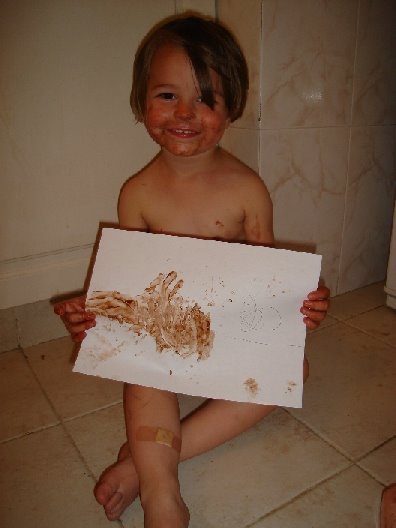
So one afternoon, I made a chocolate desert and let my daughter have one of the mixing bowls. This is one of those childhood indulgences that I thought she ought to have access to, but she soon found a different use for the chocolate.


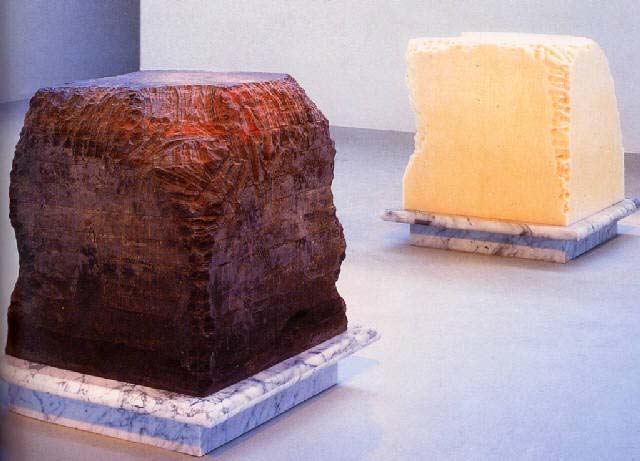
And she isn’t alone. Lots of artists have worked with chocolate, which is a phenomenon I can’t fully explain. Among them are Janine Antoni who made this piece called Chocolate Gnaw in 1992


and Vic Muniz who I wrote about back in January for his sugar art. He’s also done marvelous things with chocolate syrup. Here’s an example from 1999


Antoni’s huge hunk of gnawed-away chocolate deserves more attention than this, and I guess Muniz’s work could also use some more explication. But I'd rather have some chocolate. If you'd like to join me, here’s the recipe that became the medium of my daughter’s creativity.

Inspirational Chocolate Dessert *
4oz. semisweet chocolate
½ cup heavy cream
3 egg yolks
5 egg whites
3 tbsp granulated sugar

Line a jelly roll pan with foil, butter it, and turn the oven on to 425 F.

Roughly chop the chocolate and melt it together with the cream in a small-ish sauce pan, stirring constantly.
Remove from heat and add the egg yolks one at a time, combining thoroughly after each one.
Return the pan to low heat for a few minutes, stirring all the while to cook the yolks.

Beat the whites with a handheld mixer for a few minutes until they are fluffy but not firm. Add the sugar, and continue beating until stiff peaks form.

Fold the chocolate and beaten egg whites together.
Spread evenly in the jelly roll pan, and bake for about 20 minutes.

Remove from oven. Cover with a tea towel, and invert on a table or countertop. Place the pan to the side, and gently loosen the foil from the cake.

Allow to cool completely.
Cut away any crust that may have formed a the edges of the cake.
Spread with something ridiculously tasty, like peanut butter cream frosting (equal volumes peanut butter and real whipped cream, blended with enough confectioners’ sugar to give it the consistency and taste of frosting).
Roll it up and serve.

*yes, I named it all by my onesie.

15 May 2006

Wooloo's Asylum NYC


It has taken a while, but the web (which I have been sifting through regularly in search of the information you'll read here) has finally caught up.

A few weeks ago, I relayed some information about an exhibit called Asylum NYC. Remember? 10 artists locked in a gallery with access to nothing but pens and paper? My sister wanted to know who won and what they did to win. Thanks to an Artnet review, I can tell you. The review's main point was that, as far as politics and activism go, this project was a big disappointment. I however, think that politics and activism are not the best perspective to take on this exhibit. It addresses the significance of NY, the difficulty foreigners face to work there, and the power the system has to allow or deny them that chance.

Anyway, a woman from Serbia and Montenegro named Dusanka Komnenic won for doing this:


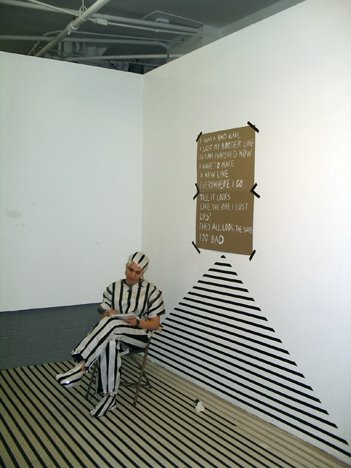
So, obviously, she has adopted the appearance of a prisoner. She made that little costume out of tape, which I think is quite creative, and I'm pretty sure that the markings on the wall are tape too. Like the exhibit itself, which examines the system under which foreign artists must operate to survive in NY, this artist's installation/performance addressed the rules the artists in this exhibit had to follow.

But wait, there wasn't just one winner. The other winning artist managed to win without doing anything. He wasn't even there. He was denied entry to the US even though he had been invited to participate in the exhibit. When it was clear he would not be able to participate, he sent all the letters and other documents that he had submitted to the government in his place. I bet the artists who actually did participate and didn't win have already burnt him in effigy.

14 May 2006

Identify Yourself


Believe it or not, the current concept of identity is a kind of new thing. Yeah, weird. I would have thought that identity was a sort of universal in time and space. Nope. Of the changes to constructs of identity in the past century, I am fairly certain that photography has had a major impact.

Today, your identity is practically synonymous with your photographic likeness. Passports (US) driver’s licenses, other official documents and identification forms include a picture of the identified person’s face. As simple as this is, there is a substantial weight of cultural prejudice against it. “Don’t judge a book by its cover”, “More than skin deep”, etc. are among the sayings that contradict the association between appearances and realities. But your likeness is your appearance, and your identity is reality. In practice, we simply DO associate a person’s face with their soul. Their appearance IS who they are, or at least an emphatic part of it.

That’s probably why the though of being possessed is so freaky, why movies where people switch bodies with someone else just keep on coming, and it is so entertaining to see people do things that are completely inconsistent with their appearance (like a dainty Charlie’s Angel knock 15 thugs flat in under 30 seconds).

Within art, there are a lot of problems associated with the deep, inseparable connection that most of us draw between bodies and identities. I think that these fall into a few general categories.

1. Bodies with no specific identity usually allude to a general, identifiable group. Bouguereau’s nymphs as shown here are simply lovely eye candy; part of a long, long tradition of lovely eye candy cuties. These girls aren’t individuals and have no soul, but the eye candy tradition stands in for identity and makes their lovely presence in the painting make sense.


2. Bodies with a known identity call up that person. Portraiture usually is about the sitter. Sometimes it says a bit too much, and it often says too little, but the aim is to marry identity and image. That’s what any successful portraiture does, anyway.

3. There are times when a body is shown and there is no identity, and no substitute identity. The body is just a body and there is no identity, no context. Doubtless, like the thought of being possessed, people tend to find these works of art troubling.


This is a Philip Pearlstein that I think fits this description. There is nothing to tell you who this body might belong to, and it isn’t being presented for consumption the way Bouguereau presented his.

Frankly, I’d like to see a bit more separation between my appearance and myself. I've thought about making myself a t-shirt that reads “I am NOT my appearance”, but that would be marshalling my appearance to the definition of my identity, and I’m not quite that stupid.

06 May 2006

Homosexuality and Art


I recently read Tyler Green’s comments about Catherine Opie, who is one of contemporary art’s foremost photographers. She’s a lesbian, and has spent over a decade (among other things) documenting “the California gay leather scenes and the lesbian communities that she is a part of.”

That quote comes from Connie Samaras’ 1993 defense of Opie’s work, and the work of other photographers whose work presented “non-normative sexual behavior”. The art world, she claimed had too-long overlooked everything except white, male, heterosexual sexual content. Samaras’ description continues:

“Four photographs are from a series of tight head shots against yellow backgrounds of lesbians wearing moustaches. The images are not about the trompe l'oeil illusion; rather, they playfully destabilize gender boundaries, allowing for the kind of fluidity at work in lesbian gender sex play.”

You can see an example of this, an Opie self-portrait over at Mr. Green’s site. Like Samaras, Green defends Opie’s work, the risk of presenting every conservative’s worst fears about homosexuality. He claims that the homosexual community has tried too hard to conform to mainstream heterosexual norms. “One reason [Opie] takes photographs of her friends in the leather and other alt-sex communities is because she wants to remind people that not all gay people want what HRC wants, not all gay people are as assimilationist as HRC would like, and that there is a multiplicity of gay life in America.

Wow. I don’t even know if he is correct about that. I live in Lebanon. Need I say more? I have no idea if the “real” gay community in the US is more like Samaras and Green and Opie describe it, or more like Andy describes it.

02 May 2006

Keeping it simple


An arts group called wooloo is currently sponsoring a fun little project going on this week in New York City. 10 non-American artists are competing for a visa. The rules? They have to live in a gallery for a week, during which they are not allowed to leave. In the gallery they have access to nothing other than paper and pens (and they get a place to sleep and three meals a day). During the week they are expected to make art, and at the end of the week a couple of wooloo-ers will judge what they've done. The lucky winner will receive a three-year artist visa to stay in the US.

I love it, and I'll try to explain why. First, I love simple art. Sure, Damien Hirst's pickled sharks are cool in ways that ought to make anyone wish they too could get millions for pickling sharks. And I can't get enough of artists who find new mediums of expression. But there is something refreshing about a bunch of artists who (for whatever reason) are going back to something very basic (pen and paper!). Especially in contemporary art, which is overrun with people trying to stand out and be different, the simplicity of this project is a bit startling. I wonder how many of them will actually draw. I wonder how many will beg the gallery's visitors to bring them other things (which is allowed and even encouraged).

Second,
getting a visa to stay is a very relevant reward for a foreigner and an artist. I like that this project acknowledges how much these artists depend on the art establishment. Their lives (for a week at least) are both literally and figuratively right there in the gallery. It emphasizes how much power the art establishment has over everything else these artists might do. In this case, their connection with the exhibition will determine a significant part of their future. By extension, it acknowledges that success in art is nothing more than succeeding with a few well-placed people.

I can't wait to find out who wins.

28 April 2006

Confronting the Lebanese Gaze


Background
A little while ago, I started running. Shortly thereafter I determined that I needed a better way to handle unwanted attention (in the form of comments from passers-by and rather obnoxious staring). My plan was to take some advice from Art History, and confront the gaze.

Implementation
Well, its been almost a week, and I've faithfully been out running and putting the lessons of history into practice. Along the way I have observed who is looking and how they react when they see I am looking.

Lessons Learned
1. Adolescent and young adult males are the ones cat calling. Although Men over 23(? I can never guess ages) sometimes look, they are not the ones who comment.
2. Young men seem to feel most comfortable commenting when they are in the presence of at least one friend. Moral support perhaps?
3. The Lebanese (like most everyone else I've ever met) don't like to be caught staring. In roughly 60% of cases, they look away when they see I'm looking back.
4. The other 40% percent were looking at my face anyway. They tend to maintain eye contact when I look. No doubt they recognize me. I've been there every morning for two weeks now. (Yippee for me! I haven't given up yet!)

Case Studies
1. One morning I ran past two young men who were walking the opposite direction. One called out to me "Good morning Sweetheart! Welcome to Lebanon!". I looked right at him the whole time, expressionless except for an increasingly arched eyebrow. On my return leg I passed these two again. They neither looked nor spoke to me.
2. On another occasion I ran past two young men who were standing around doing nothing (who hangs out at 6 am??). One of them called out in Arabic with that look on his face. I did not overt my gaze, which I could tell by his expression was quite unexpected. I ran on, and noticed a few hundred yards later that the two were following me on a scooter. The same youth called out something else in Arabic before making a U-turn and vanishing.

Results and Evaluation
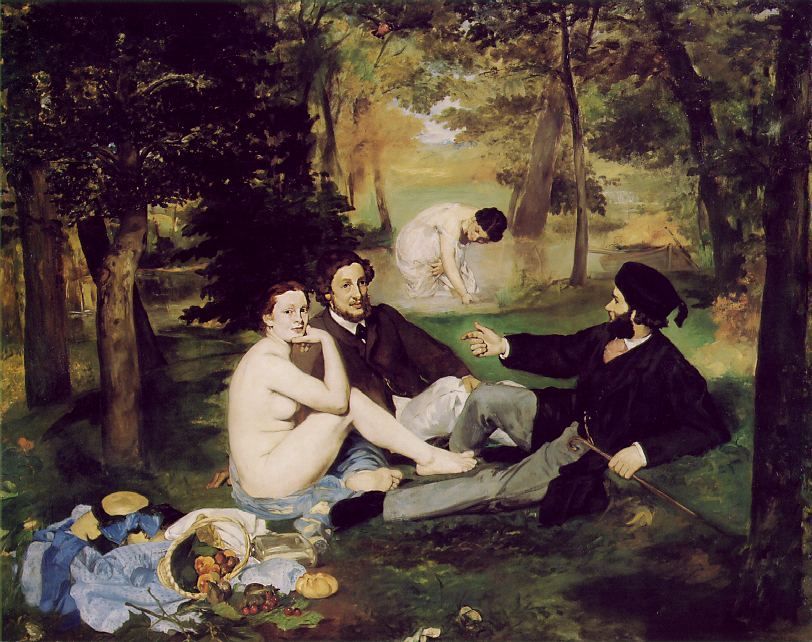
Yesterday and today, I have not been welcomed to Lebanon. No one has stared in an untoward fashion. I consider my implementation a success, and by extension, have proven the significance of what Manet did over a century ago.

25 April 2006

There are no good writers . . .


. . . only good rewriters. Yeah, yeah.

I'm in the middle of rewriting chapter 1, per my advisor's very apt criticisms. Maybe for the time being, I should quit Imparting Art, and start giving all my devoted readers (both of you) a blow-by-blow account of how amazingly much my thesis makes me wish I could cease existing.

I'll write about Confronting the Lebanese Gaze soon. It sure has been fun.

24 April 2006

A Challenge to Time's March


A few days ago I wrote about the time-as-narrative phenomenon that characterized modernism, and indicated that some artists have taken stabs at throwing off time’s tyranny. Sally Mann’s most recent series, What Remains, provides a good example of this. The series focuses on the aftermath of death, on the connection between the earth and the dead she subsumes.

Death presents an assault on time without any assistance from art. It is among a very few universal human experiences, and as such it connects peoples, times, and cultures that otherwise are irreconcilable. Mann's series includes pictures of bones, decaying bodies, the earth. Although these images are recent (the earliest from sometime during 1999), there is nothing inherently recent-seeming about them. The images are not dated, but if you sift through a good half-dozen of Mann’s interviews, you can figure out roughly when each section of What Remains was created. But why bother? It adds nothing. Finally, Mann made all the images of the series (except for one) with a camera and a process that are over a century old, a revival of technologies that died out a long time ago.

Death itself, Mann’s portrayal of it, and her method for doing so are irritants if you wish to place these images in time. And although the earth’s process for reclaiming the dead is at the heart of this series, not even that process is presented in a meaningful chronology. Her dog’s bones appear first. The dog’s remains are in a far more advanced state of decay than are the human corpses that follow them. These corpses range from initial to late stages of decomposition and after these images the narrative of decay jumps backward again to the moment of death rather than its aftermath. This portion is followed by landscapes taken at a Civil War battlefield, several generations after death and decay touched the soil. The final segment returns us to the present, with contemporary close-up portraits of her (still living) children.

Time’s power is challenged by the anti-chronology of this series, which is also a hindrance to the narrative of decay. There is no progression from early to late stages, future to past, start to stop. As such, a force that would otherwise be a powerful source of insight is abstracted into irrelevance.

22 April 2006

The Lebanese Gaze


For about a week now, I’ve been out running on the Corniche (Beirut’s big boardwalk by the sea) every morning at six. I love it, but I don’t love being gawked at. Every day, I get at least one shouted “Welcome to Lebanon!”, with a few other random, often lame comments, and I turn quite a few male heads. Such behavior irritates me, but my response to it has always been to act as though I am both deaf and blind, under the proverb that “If you don’t play, they all go away.”

This approach bothers me for a few reasons. First, it doesn’t do nearly enough to condemn their behavior. Second, I’m neither deaf nor blind. I can see them staring even if I act like I can’t. As always, art has been through the same thing, and I think it might provide a solution.

Gawking is the real-life expression of the gaze, which is a major issue in art history. At its most basic level, the gaze is the point of view behind any given work of art. Who is looking, and why? That is the gaze. With some subject matters, like 19th century landscapes, the gaze might not be such a big deal. Most of us have at one point or another been awed by, or felt the serene gentleness of nature, and that’s not at all unlike the way these painters gazed at nature.

Depictions of people are another matter, and depictions of naked people go a step further. The issue of who is looking, and why matters quite a lot in these cases, probably because men and women, children and adults look at each other differently. What a man sees in an image of a woman is not necessarily what a woman or a child sees.

Now when you consider that men were the primary producers of art for almost all of its precious history, we have to conceded that it is predominantly the male gaze that we are talking about here. So, when Eduard Manet painted this image, he was addressing a long, long line of gazing men.


The fact that the nude woman looks back at us and back at Manet puts her in a class of her own. She looks at you as you look at her, and that challenges your ability to simply enjoy looking at her. I think it is high time I started staring back when I run, and I'll do it with about as much unimpressed boredom on my face as is on hers.

21 April 2006

Beirut's Ceramic Lounge


Yesterday, I visited Lebanon’s only Contemporary Ceramics Studio, the appropriately named Ceramic Lounge. It is in the squeaky-clean area of Beirut that promotes itself as an “art village”. Here’s the concept at the lounge. You go, choose a white ceramic thing (they have all kinds of table/kitchen wares, plus boxes, banks, ornaments, coasters, decorative figurines, etc.), choose some colors and start painting. For those who doubt their own creative genius, they have tons of ideas, patterns, things to trace and things to out-right copy. While you work, you can eat. They offer drinks and light snacks. When you finish your meisterwerk, they glaze and fire it for you, ensuring the colors last.


There are a lot of things to praise about the Ceramic Lounge. The staff were helpful both in person and on the telephone (oddly rare in Lebanon, or maybe its just the language barrier striking once again). The atmosphere there is accordingly relaxed, open, and fun. The quality of the finished product is beyond dispute (microwave, dishwasher, everything-safe). Not least of the lounge’s merits is the food. I can, with confidence in my objectivity, state that their cheesecake is THE best I have had in Lebanon. That alone might justify a visit.

Lest you think that I’m just advertising for them (NO web presence?—a cause in itself for demerit) my experience there was not all roses, sunshine, and happiness. The cost of everything in the lounge is unnecessarily high, and prices are poorly explained. One tiny item, a desert and a drink cost over $20, which admittedly precipitated a slight decline in my avid interest in making their art a part of my life.

20 April 2006

Where in Time?


While researching for my thesis, I came across the work of Dirk Reinartz, a German photojournalist who incidentally died in 2004. I had no idea that his work was not that of a young man when I read about him. About a decade ago, Reinartz released a book of landscapes that I think presents some challenges for those who appreciate photography. He took his camera to some of the sites where, during World War II, the Nazis had done their worst. Instead of going to the well worn, oft visited, museum-like locations (think Auschwitz), Reinartz went to unmarked sites. Frankly, I did not know that there are places in Germany, unmarked, where such tragic events took place. But the scale of Hitler’s genocide was such that not every prison camp could be made into a memorial, monument, or museum. German is a small country. Europe is crowded. Some of that land has had to be reclaimed.

Reinartz images of the sites where countless prisoners died bear no mark of the suffering that played out there. There are no pools of blood, no bones or bodies, no fences, no buildings. The complete nothingness within the image poses some real problems when one stops to ask two questions. First, what was Reinartz doing? Was he trying to lay Germany’s past to rest? Was he trying to deemphasize what had happened in those locations by showing the absence of any obvious effects? Or, did he hope to re-introduce these locations into the consciousness of contemporary Germany? Like the rest of the world, Germany is on the brink of losing the final survivors, perpetrators, remembers of those events, and Reinartz may have wanted to attempt to preserve some piece of this legacy, even if that piece shows how much the potency of the events had already been diluted by time. Second, what is the truth about these locations? A forest landscape doesn’t tell the truth about those who were murdered here. Does it further injure the dead to depict the site of their death like this?

Regardless of what Reinartz was up to, his work meddles with time. His photographs of these sites require viewers to relate the present appearance with the reality of what the landscape witnessed in the past. Whether the past is whitewashed by the present, or the present is darkened by its past, Reinartz photographs collapse nearly half a century as past and present collide.

19 April 2006

Narrative and Time


The peak of modernism (1950s) was characterized by abstraction and a general rejection of representation. Artist began naming their work accordingly, with titles that were equally representative of nothing. “Untitled” or “No. 34, 1942” are good examples. You have no idea what an Untitled might look like, and a numbered work isn’t giving away very much either. That, it seems was precisely the point. Lee Krasner described it this way, “Numbers are neutral. They make people look at a picture for what it is—pure painting.”

Krasner was speaking specifically about her husband, Jackson Pollock’s number/year approach to titles. Painting were numbered x from year z, rather than “Pretty Horses Along the Coast of Spain”, or whatever title he might have dreamed up instead. So that’s actually really interesting. Imagine how different our experience of a Pollock might be if he attached words in the form of a title to his images. Wouldn’t you be more likely to look for representations of those words in his web of interlaced drips?

The absence of a title gave Pollock and others in what we might call the “Untitled Crowd” a measure of freedom. If you call a painting even something so esoteric as “Contemplation of Consciousness” any viewer can decide if your image matches the images they might associate with those words.

So, artists had a good reason to chuck wordy titles out with the representational bathwater. It prevented the title from supplying a false or destructive narrative that would invariably dominate or influence the way the picture was viewed. “Untitled” ensured that this kind of narrative stayed out of the picture’s way, but slyly brought in another narrative in its place.

Numbers aren’t nearly as neutral as Krasner and Pollock though. Their paintings aren’t randomly numbered. They adhere to a universal, maybe even oppressive chronology, anchored in time and sequence. Why does this matter? Maybe it didn’t to Pollock. Time and its modifiers; first, last, new, old, before, after, etc. govern these images more than they possibly could have if the absence of a title had not necessarily left us only with time to place them. Time becomes narrative.

Not surprisingly, postmodernism is marked by a rejection of absolutes, time not excluded. I think the ways artists have challenged time’s dominance are fascinating, and each is worthy of its own post.

18 April 2006

Eggs


Since leaving the US for the first time in 1997, I have come to classify events in my life as US-same and US-different. This works for big and little things alike. Bad traffic? US-same. A game of chicken at every intersection both major and minor? US-different. It is simple enough.

Like traffic, eggs are both same and different.
US-same: you can get brown or white, they come in what the US calls medium, large or x-large, you pay money for them, and unlike other things the price is roughly the same.
US-different: eggs come in flats of 30, you can buy as many or as few off the flat as you want, medium, large and x-large eggs are not separated, and there is no cost increase for the larger ones.

I bet it is among the things that make the US a burning hell for off-the-boat Lebanese. Just like everything else in America, eggs are sorted, numbered, standardized, etc. etc. The pervasive order of eggs and everything else must be maddening.

In my refrigerator, a haphazard array of large and small eggs clusters happily in the little tray at the top of the door. Not unlike nearly everything else in my life, the egg situation here makes me think of art.


This is a 1968 sculpture by Louise Bourgeois. Little egg-like forms seem to unveil themselves as we watch. There isn’t much order, regularity, or consistency within this piece. Whatever it is, this sculpture isn’t a minimalist work. It isn’t about repeatability, clean lines, or uniformity. In would never be mistaken for a Donald Judd, Carl Andre, Robert Morris, Sol LeWitt, Tony Smith, or the work of any minimalist sculptor who was active during the same period. You can find something similar in the work of Brancusi or Jean Arp. They were both pretty big fans of egg shapes, but they also were both dead when Bourgeois made her sculpture.

Eggs are a loaded symbol culturally and artistically. At present, I am positioned between the two Easters Lebanon acknowledges, and that combined with the general springiness of the season means that there are eggs everywhere. They symbolize life, rebirth, the future, a new beginning and it isn’t lost on artists.

17 April 2006

Mostly Welcome


Since this blog began in mid-October, 2005, I have spent more time not-blogging than actually blogging. Back when I was diligently, daily, imparting something about art, I really loved it. I had a great time with it. I learned. I had fun. Loved, loved, loved the comments.

In the three months that have passed since I bid blogging farewell, I have grown deeply ambivalent, and the rich, velvety dust on Impart Art Daily has ceased to bother me. At first, I collected little reminders of things I should definitely write about after returning to my blogging fun. Slowly, that impulse faded into the nothingness this post seems to be getting at.

My reason for not-blogging was very good. I had a thesis to complete in a very short time. And I did it too. 79 pages of text that, with images and every thing else that goes into a thesis, will eventually top out at over a hundred pages. It will probably be printed and bound and on my bookshelf before Christmas. My blog even came in handy while I was writing. A tiny little post from December really fit into my work and saved me a ton of “go research it and check out the data” time.

Although my reason for not-blogging has long since come to a rather tidy conclusion, my interest in blogging has yet to recover. And in my absence I found that I’ve forgotten a lot of what I’ve already written. Part of me is terrified of rewriting something you’ve read here before. . . .

Another reason for not-blogging has to do with how I have spent the last several months. Put simply (but hopefully not offensively) Impart Art has always been targeted to those who probably don’t know that much about art. Since that includes just about everyone, I was filling a need, and the rudimentary level of it kept the content (I flatter myself) interesting and accessible. For several months, my energy has been devoted to tasks that are neither rudimentary nor broadly applicable. The degree of specificity of thought and writing required by my thesis made my brain ache in ways that Impart Art never had or could. In short, it has been hard to switch gears, and actually, I haven’t yet succeeded.

So, anyway, that’s all just a really big disclaimer. I welcome myself back to blogging, but in the charming Lebanese way that always makes me laugh. So like me, you too are mostly welcome to Impart Art Daily (usually).

01 April 2006

Update


Hello April!

The thesis, yes. It is still dominating every moment of my life (and my husband's life, and robbing my children of time with their mother). It is still costing me my sanity, my other interests, my ability to socialize or even have fun.

But WAIT!

It is slowly, methodically, achingly getting written.

Looking into the future to the best of my ability, I predict that it will done by the end of the coming week. Then give me another week to pick up the pieces of my life and do some of the things I've not done in ages, and then, maybe, I'll start posting again.